The incident
An extremely windy night back in December 2020 had some unexpected consequences for my house. That night, the wind was so strong that it shook the venetian blind outside my house, detaching some of the slats at the bottom and, as a result, the hooks that joined the slats were exposed. The wind kept shaking the blind, so the hooks scratched my car, which was parked right in front of the blind. There were scratches everywhere! Scratches on the bodywork and even on the windscreen.
I took pictures (Figure 1) of everything and I called our home insurance company. A technical expert assessed the damage by videocall (due to the Covid-19 pandemic). After a few days, the insurance company responded:
The damage is not covered because the measured wind speed was below the threshold of
km/h.
In fact, over the phone, I was given a figure; according to them, the wind that night reached  km/h. Giving me a narrow difference between the threshold and the measured value, with no margin of error whatsoever, made me so angry that I was determined not to let it be. My scientific side started to awaken.

I searched for the official figure measured by the Agencia Estatal de Meteorología (the state meteorological agency in Spain) in my village that day. The maximum wind gust speed for that night was  m/s
m/s  km/h. The margin of error still bothered me, but I had no way of finding the type of anemometer1 used to obtain that information.
After talking to a meteorologist friend, I found a report issued in 2020 by the World Meteorological Organisation [1, p. 206] stating that for margins of error in wind measurements:
A required measurement uncertainty for horizontal speed of
m/s below
m/s and better than
above
Therefore, taking that maximum value of the uncertainty, i.e.  the wind measured at the measurement station that night was
  km/h. That means that the wind could have reached around
  km/h at the measurement station. Again, I was still not prepared to let it go. The reason is that the wind speed can change so drastically within a few metres, especially when there are buildings in the area.2
Wait a minute! The perpetrator, i.e. the wind, had left visible traces (the scratches on my car) at the crime scene. I could use basic maths and physics to try to estimate the wind speed at my house that night. The scientist in me was fully awake.
Estimating the wind speed
The first quantity needed is the force exerted by the wind  at the bottom of the blind when the blind produced the farthest scratch on the windscreen. After knowing
  the wind force can be translated into wind speed
  A reference book on the dynamics of objects is [2], while [3] provides the basics of fluid mechanics.
The object that experienced the wind force is the blind, with mass  kg and length
  cm. Figure 1 is a photograph of the aftermath a few hours later and Figure 2 shows a simplified model with all the forces, vectors, distances and angles needed.

The important physical quantity in this case is the torque  produced by a force (also known as moment of force). The torque characterises the capacity of a force to produce a rotation around a given axis. It is computed as:
  where
where  is the vector force and
  is the vector from a chosen origin to the point where the force is acting. For static objects, the sum of all the torques produced by the forces must vanish:
![\[ \sum\limits_{i}\boldsymbol{\tau}_{i} = \boldsymbol{0}. \]](https://ima.org.uk/wp/wp-content/ql-cache/quicklatex.com-d5712bad4be72bb87e8f3079b1e3ca40_l3.svg "Rendered by QuickLaTeX.com")
In this case, the wind force lifted the blind, which is a rotation of the blind with respect to the upper hanging point. At the precise moment when the blind reached the maximum height, the blind is static, which translates into the following equation for the torques produced by the wind force and the weight  with respect to the origin
  (Figure 2):
(1) 
where all the quantities are the magnitudes of their respective vectors (i.e. they are scalars). For simplicity, the blind is considered to be a plank with the centre of mass at half its length  and the wind force acts at the bottom of the blind, i.e.
  The angle
  can be estimated using basic trigonometry (see again Figure 2):
![\[ \alpha = \arctan\left(\frac{180 \text{cm}}{(260-114) \text{cm}}\right) = 0.89 \text{rad} \approx 51^\circ. \]](https://ima.org.uk/wp/wp-content/ql-cache/quicklatex.com-11f965e42b9c7e6cd1b824979a369d05_l3.svg "Rendered by QuickLaTeX.com")
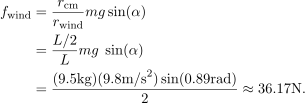
From equation (1), the magnitude of the wind force at the bottom of the blind is
(2) 
The next step is translating the wind force3  into wind speed This is done using basic fluid dynamics. First, we have the relation between force
  and pressure
  :
:  where
where  is the area on which the force acts. The pressure of a fluid is related to its speed
  via Bernoulli’s principle:
  where
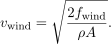
where  is the density of the fluid.4 In the present case, the fluid density is that of the air. Combining these two equations gives the relation between wind force and wind speed:
(3) 
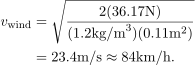
The air density at sea level5 is  kg/m³. The area of action of the wind force can be estimated to be around
  cm at the bottom of the blind times its width
  m:
m:  m². Having all these quantities allows us to compute the wind speed:
(4) 
In addition, the associated error of the wind speed  can also be estimated using error propagation of all the previous estimated and measured quantities. The full computation of is not shown here; only the final result is provided:
  km/h. The quantities considered to contribute more to the error are the error of the area
  m
m and the error of the wind force
  In turn,
  depends on the error of the angle6
  which depends on the errors in measuring the distances, estimated to be
  cm.
cm.
At last, the estimated wind speed at the bottom of the blind when the farthest scratch was made is
(5) 
This value is reasonable and agrees with the actual measured wind speed in the surroundings ( km/h at the measuring station in my village) by less than twice the error bound, but, in this case, this estimated value is at the house and not somewhere else.
End of the story
After having done all my research, I sent the complete version of the report shown here with all the pictures and maths calculations to our home insurance company to claim for the damage to the car and to the blind itself. A few months later, a lawyer representing the insurance company called to say that I was not a qualified expert, so my report could not be fully considered and that if the damaged car were not mine, maybe it could have been covered by third-party liability. The system wore me down, so I decided to finally let it go.
I must confess, though, as is usual in life, I enjoyed the (research) journey even though the result was a bit disappointing.
Victoria Sánchez Muñoz
University of Galway
Notes
- A device used to measure wind speed.
- Anemometers are usually placed in large areas with no buildings nearby to avoid such disturbances.
- The assumption of
 is generous, since the base of the blind typically has a higher mass than the slats, thus
  which would translate into a higher value of than the estimate here. In turn, the wind speed would be higher. Therefore, the value in (2) can be considered a lower bound.
 - In Bernoulli’s equation, there is also a gravitational term, which has been ignored here because the contribution is negligible.
- The altitude of my village is about
 m, which in atmospheric terms is practically sea level, so the value at sea level approximates well to the real value at that altitude. Nonetheless, using the relative humidity, temperature, dew temperature and average pressure measured for those hours on that day, the air density was
  kg/m³. The difference with the assumed value at sea level
  kg/m
kg/m is negligible.
 - It also depends on the error of the mass of the blind
 and of the approximation of
  However, these errors contribute less to the total error.
Graham Hoare Prize 2022 winning article.
References
- World Meteorological Organization (2020) Measurement of meteorological variables of WMO, No. 8, in Guide to Instruments and Methods of Observation, vol. I, World Meteorological Organization Geneva, Switzerland.
- Tipler, P.A. and Mosca, G. (2003) Physics for Scientists and Engineers, vol. 1, W.H. Freeman, New York.
- White, F.M. (2011) Fluid Mechanics, McGraw Hill, New York.
Reproduced from Mathematics Today, December 2022
Download the article, The Estimation of Wind Speed: Challenging the Insurance Company’s Decision (pdf)