This event has now passed, however Anya’s talk is now available on the IMA YouTube Channel.
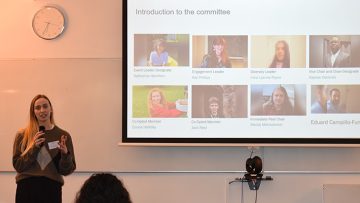
In the latest run of the Early Career Mathematicians Seminar Series, we will be joined by the winners of the Best Presentation prize at the Tomorrow’s Mathematician Today 2025 conference organised by the University of Greenwich and the IMA. Anya Khurana (Cambridge) and Thomas Shaw (Durham) both won the GCHQ Prize for the best presentation, as voted by the panel of judges.
Anya and Thomas will be speaking for 30 minutes each, see below for their abstracts.
Anya’s Talk: Lattices and Sums of Squares
Lattices are a rich area of maths, and not only are they related to geometry, they can also be used to study questions in number theory! The aim of this talk is to use lattices to prove Fermat’s sum of two squares theorem, a theorem about whether prime numbers can be written as sums of two square numbers. We will start by investigating whether regions in two dimensions contain lattice points and look at how Minkowski’s theorem helps to answer this question. We will then use Minkowski’s theorem, with a result from number theory, to prove Fermat’s sum of two squares theorem.
Thomas’ Talk: Microbial Coexistence with Resource Toxicity
For many livings things, some substances help them to grow, and some substances cause them to decay. Sometimes it is the case that a resource eventually becomes harmful to a living thing. One example of this is bacteria with metals: once the bacteria has consumed too much of the substance, it becomes toxic. Can different species of bacteria all coexist when their common resource of a metal eventually becomes toxic?
In this talk, we discuss a mathematical model to describe this phenomenon, and the conditions in which the model predicts that the bacteria are able to survive. This talk will be ideal for those interested in dynamical systems, mathematical biology or the wider field of applied mathematics!
Bios:
Anya Khurana, University of Cambridge
Anya is a first-year mathematics student at Cambridge University. Her favourite courses so far have been Groups and Dynamics & Relativity, the most applied and the most pure courses! In her free time, Anya enjoys playing Dobble, bulls and cows (a game like wordle but with numbers) and exploring the area surrounding Cambridge by running. Anya is originally from Singapore, and has been fascinated by the changing seasons since coming to the UK.
Thomas Shaw, University of Durham
Thomas is a 4th year Mathematics student at Durham University. His research interests are in the field of Mathematical Biology, and he will be continuing his study of the field with a PhD in September. In his free time, he likes watching films and cooking.
To book
If you would like to attend this online event, please book your place via myIMA.
If you are an IMA Member or you have previously registered for an IMA conference, then you are already on our database. Please “request a new password” using the email address previously used, to log in.
You will receive your Zoom link for the event 1 day prior.