About three years ago two wind turbines were erected not far from where I live. For two years they did not operate, apart from an occasional test, as the rotations of their blades interfered with the air traffic control radar of a nearby airport! Eventually air traffic control managed to modify their radar detection software to eliminate interference from the moving blades, and the turbines can now be seen moving more often (when there is enough wind!).
The turbine owners claim that each turbine can generate enough power to support around  households, which made me think about how we might go about calculating the power generated by a wind turbine and determining how good they are at extracting energy from the wind.
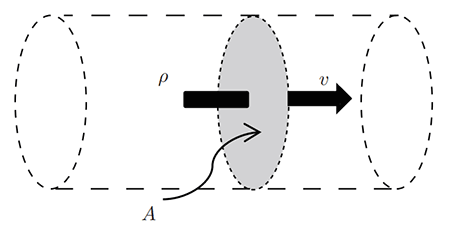
We start by thinking of a mass of air of density,  , moving at a speed,
  , through a cylinder of cross-sectional area,
  (Figure 1).
The mass flow rate,  , through the cylinder is
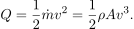
  , so, noting that power is the rate of transfer of kinetic energy, the available power,
  , of the wind crossing area, , is
(1) 
Power increases as the cube of the wind speed, so doubling the wind speed gives an eightfold increase in available power. A large collecting area, , is also important, which is why most wind farm turbines have blade radii of over  m.
m.
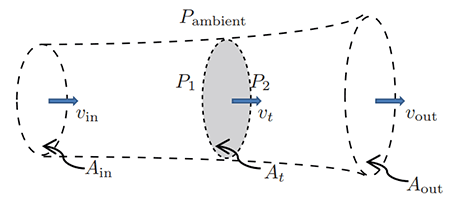
Now imagine this cylinder of air passing through the area swept out by the turbine blades (Figure 2). Conservation of mass gives us:
(2) 
assuming the air density remains unchanged.
The force transferred to the turbine is equal to the rate of change of momentum of the air passing through the area swept out by the blades (we will assume this is a complete circular disc, unimpeded by the turbine hub). The force,  , is given by
  . This is equal to the pressure difference,
  , across the turbine, multiplied by the area,
  . Hence, making use of equation (2), we have:

(3) 
We will use the Bernoulli principle (i.e. conservation of energy) to determine another expression for the pressure difference. Energy is not conserved across the turbine, but we can consider the upstream and downstream flows of air separately as follows:

Subtracting the downstream equation from the upstream one we obtain:
(4) 
Now we combine equations (3) and (4) to get:
(5) 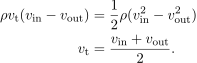
We see that the speed of the air flowing through the turbine is the average of the upstream and downstream air speeds.
The power,  , extracted by the turbine, is the difference between the available power in the upstream wind and that in the downstream wind, so, making use of equations (2) and (5) we have:
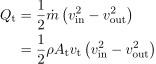
(6) 
The power that would be generated if wind with the upstream speed,  , were to pass through the turbine area, , is given by
  . The ratio of the extracted power, , to this, impossible to achieve, power,
  , can be written as:
(7) 
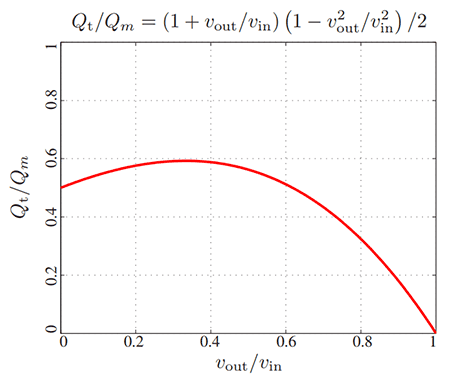
This ratio is shown as a function of  in Figure 3. It clearly has a maximum, which we can obtain by differentiating equation (7) with respect to and setting the result to zero. Doing this we find that the maximum occurs when
  , that is when
  . Using this in equation (7) we have a maximum power ratio of:
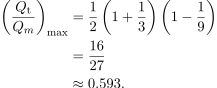
This is a coefficient of performance and says that one cannot extract more than 59.3% of the kinetic energy of the wind (in practice, of course, not even this amount can be achieved, because of other losses in the turbine mechanisms for example). It was described by Albert Betz [1] in a book in 1919 [2] and is known as Betz’s law, or the Betz limit.
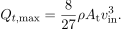
Putting into equation (6) we have the maximum power as:
(8) 
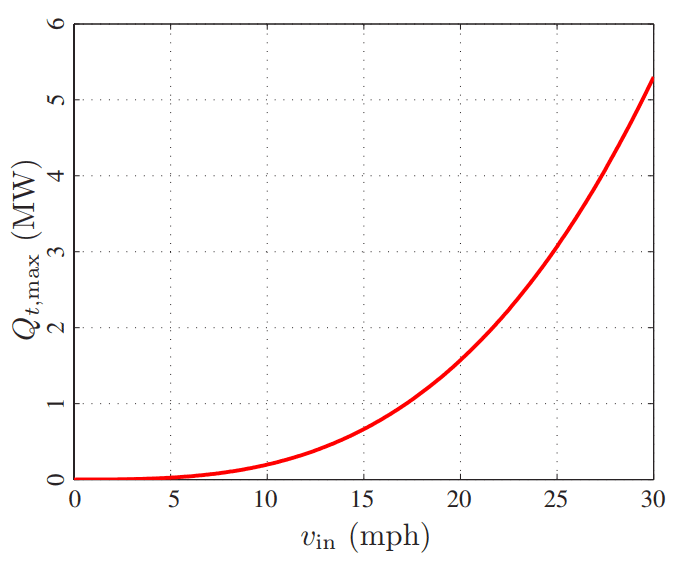
What sort of powers does this mean? My local wind turbines have blade radii of about  m. With an air density of around
  kg/m
kg/m , turbine power as a function of wind speed is illustrated in Figure 4. According to records kept for the local airport, typical wind speeds over the last year are around
  mph (
mph ( m/s), with gusts up to
  mph.
mph.
At mph, Figure 4 shows that the maximum extracted power is about  kW. (The actual extracted power will be less than this, of course, as equation (8) ignores losses in the mechanism.) Taken over a year this provides about
  MWh. Shared among households this provides about
  kWh per household. According to [3], the average annual electrical energy use per household in the UK is between
  kWh and
  kWh. This requires wind speeds of around
  mph to
  mph. I guess we should hope for gusty conditions more often!
Alan Stevens CMath FIMA
Acknowledgement
‘Urban Maths’ cartoonist: Adrian Metcalfe –
www.thisisfruittree.com
References
- Wikipedia (2017) Albert Betz, http://tinyurl.com/Wiki-Betz (accessed 2 October 2017).
- Betz, A. (1994) Wind Energie und ihre Ausnutzung durch Windmüllen (Wind energy and its use by windmills), Taschenbuch.
- OVO Energy How much electricity does a home use?, http://tinyurl.com/OVO-use (accessed 2 October 2017).
Note
A letter from Isla Finney provides an improved estimate for the wind speeds at the turbine site and height of around 15–16 mph. This wind speed would give a maximum extracted power which would more than cover 1500 average households, though the question of losses in the mechanism remains. For further details see the April 2018 issue of Mathematics Today.