Alfred S. Posamentier and Robert Geretschlager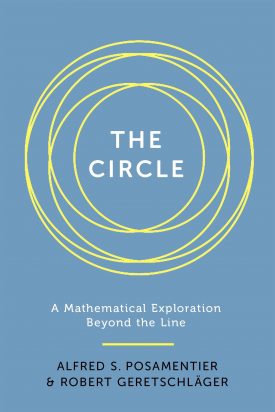
PROMETHEUS BOOKS 2016, 300 pages
PRICE (HARDBACK) £24.00 ISBN 978-1-63388-167-9
Rarely is a book so fully dedicated to just one subject, and in particular, to such detail. The book delivers what it says. It covers the properties of circles and quickly delves into deep levels of geometrical properties of these objects. Spanning eleven chapters, with extended proofs in the appendix as well – for those interested in circle geometry, this is a go-to reference resource.
From the outset, it is clear that Posamentier and Geretschläger intend a fully mathematical, and to be precise, geometrical treatment of the properties of circles. This is done by extension of ideas in plane geometry transposed to the circular form. Geometrical proofs based on chords, lines and tangents are laid out step-by-step in considerable completeness.
Unfortunately, from Chapter 2 onwards the level of detail is overwhelming and even writing as a physicist, not unfamiliar with extended proofs, this book was personally not to my own liking. I can see the value for those with a geometrical fascination and an eye for the beauty of carefully layered geometric explanation. This is echoed on the back cover reviews offered by very senior and knowledgeable mathematicians. For me, the workings of the diagrammatic explanations became difficult to follow. While all steps are laid out in a logical manner, the nature of the subject means that the material can be dry in places with many, many steps. Maybe the attention span of this particular reader is not suited to this flavour of the subject area.
While clearly not the reviewer’s own brand of tea, the book was certainly wide as well as deep. It covered very interesting areas such as packing problems, cycloids and a whole host of circular constructions. Dotted throughout the texts were nuggets of very interesting explanations of geometric properties found in circles such as the arbelos and a nice section on shapes with circle-like properties – Reuleaux triangles – which are not actually circles.
The chapters on circles in art and literature, as well as hypocycloids and the afterword dealing with cultural aspects of circles were very interesting. Perhaps the book could have benefitted from these basic concepts being introduced at the beginning of the work as a starter to warm up the mental muscles of the reader.
Missing from the book was mention of π to any reasonable extent. There are whole books dedicated to this subject alone – and while clearly this was a geometric treaty – at least one chapter could have been offered showing derivations of π. For example, how π could be found using packing methods or derivation based on geometric approximations. For many, mention of circles leads to this mysterious transcendental creature. More on this would have been nice to have.
Backing up the text is a powerful twenty-five page appendix section that gives some further proofs beyond the thorough ones already found in the text. There is also a comprehensive chapter notes (further reading) section and full index.
As discussed in this review, not quite as expected, though for the right audience this book offers very detailed information. Where followed in minute accuracy, very thorough proofs of circular properties are presented and available to the interested reader.
Kenny Green AMIMA
Book review first published in Mathematics Today February 2018