In his latest piece from the West Country, Alan Champneys recounts a personal journey that led him to publish, earlier this year, a collaborative paper on mathematics and poetry. This particular form of poetry is called a sestina, which is a poem of 39 lines comprising six verses of six lines each, and a three-line final verse or ‘envoi’. Rather than employing rhyme, in the sestina, each verse uses the same line-ending words, but in a permuted order. The form of the permutation is prescribed. The story starts with a brave attempt by an apprentice poet to construct a sestina, not with 6 verses, but 78 with 78 lines in each. The question arises for which  will the prescribed permutation lead to a poem of verses where no two stanzas have the line ending words in the same order. In answering the question, we find curious links between permutation groups, chaotic dynamics, number theory and the nature of friendship and collaboration.
Permutation poetry and chaotic collaboration
Bath Spa University is renowned for its creative writing course. Some years ago I met a recent graduate from the programme, an aspiring poet, who began taking the same regular bus commute as me. Harry Man, for that is his name, had secured a post-degree internship with a Bristol publishing house. Not that I knew this. Harry’s was just one of those nameless faces I recognised day after day. Interaction was limited to a brief smile and nod, without ever engaging in conversation; except, of course, about weather – but that does not count. Until one day, sat on the bus seat behind Harry, I noticed him reading a book that appeared to contain mathematical symbols.
Harry was studying the sestina, a complex and ancient poetic form designed around a particular pattern. Each verse of a sestina has six lines and there are six verses in total. In addition there is a coda, called an envoi that contains just three lines. For the main poem, the final word of each line is crucial. The collection of six such end words is invariant from verse to verse, yet the order is permuted.
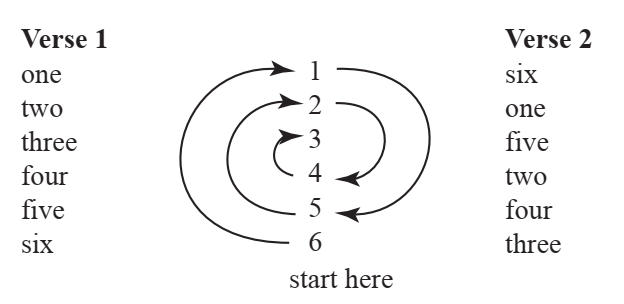
The sestina word-order permutation was illustrated in Harry’s book (see for example Stephen Fry’s introduction to poetry [2]), in the form of a spiral as depicted in Figure 1. Here ‘six’ represents the end words used in the first verse, and the numbers 1 to 6 represent the position within a verse. The arrangement of the second verse is found by following the curly path represented by the spiral. That is, the first line ends with the word that was the position 6 ‘end word’ in the first verse, the next line ends with the word that was in position 1, then 5, 2, 4 and finally 3. After writing a second verse, we follow the same process to get the end word order of the third verse; that is, the final word of the second verse is the first end word of the third verse etc.). Following this procedure five times, we arrive at all six verses of the poem.
I plucked up immense courage and leaned forward. ‘Do you mind me asking  ?’ And so began my own journey into the mathematics of poetry.
After several bus journeys, Harry had explained his rather ambitious goal. He had written the first two stanzas of a sestina, or more accurately an -tina, with  . With the exuberance of youth, he hit upon 78 as an appropriate number of verses, because it is twice the total number of lines in the usual 6-verse sestina. But he had a struck a difficulty. Aside from the complexity of writing an artistically interesting 6123-line poem; there was a more fundamental problem, a mathematical impasse. For , the permutation does not work. Let me explain.
As a mathematician, I find the spiral illustration confusing. It would be more natural to represent the transformation from verse to verse as a mapping. Let be the number of -line verses and let  represent the word that is at the end of the th line of verse
  . Then the position in verse
  is given by
(1) ![\begin{equation*} n \mapsto \begin{cases} 2n, & \mbox{ if } n \leq \left [ \dfrac{m}{2} \right ], \\ 2m+1 - 2n, & \mbox{ if } \left [ \dfrac{m}{2} \right ] < n \leq m, \end{cases} \end{equation*}](https://ima.org.uk/wp/wp-content/ql-cache/quicklatex.com-9167d9e812261912c214d623c86e069c_l3.svg "Rendered by QuickLaTeX.com")
where is the number of lines in a verse and ![[ \cdot ]](https://ima.org.uk/wp/wp-content/ql-cache/quicklatex.com-35c87bb13fd00c9c68073711c2f173aa_l3.svg "Rendered by QuickLaTeX.com") represents
represents
the integer part of an expression. Thus, for  we have
(2) 
or simply the 6-cycle  , as constructed in Figure 1.
For an -verse sestina to work properly, each of the end words, should take a turn at the end of the th line of a verse, for each  . That is, the permutation (1) should lead to an -cycle. We shall call a sestina number if the permutation represented by (1) on the set of integers has minimal period .
This indeed occurs if . But it does not work for  or
or  , the respective permutation dynamics of which are
![\[m = 7\text{: } (1,2,4,7)(3,6)(5), \quad m = 8\text{: } (1,2,4,8)(3,6,5,7).\]](https://ima.org.uk/wp/wp-content/ql-cache/quicklatex.com-cd579dd48cbac450d46138a3a18bf825_l3.svg "Rendered by QuickLaTeX.com")
Moreover, Harry’s choice of fails because the orbit of
the permutation splits into three 26 cycles (try it!). Nevertheless, there are numbers other than  for which the the permutation does indeed lead to an -cycle (again, you may care to check):
1, 2, 3, 5, 6, 9, 11, 14, 18, 23, 26, 29, 30, 33,
35, 39, 41, 50, 51, 53, 65, 69, 74, 81,
83, 86, 89, 90, 95, 98, 99, 105, 113,
119, 131, 134, 135, 146, 155, 158, 173,
174, 179, 183, 186, 189, 191, 194,
which, I believe, is a complete list for  .
.
So we have a nice mathematical puzzle. If I were to give you the above set of numbers, could you tell me the next number in the sequence? What is the rule that generates them? Are there even infinitely many, or does the sequence terminate somewhere?
Equation (1) can be represented as a discrete-time dynamical system acting on the first integers. A simple rescaling, letting  , shows that repeated iteration of (1) is equivalent to the dynamics of the tent map for
 ![y \in [0,1]](https://ima.org.uk/wp/wp-content/ql-cache/quicklatex.com-540077747c00eec8f370a36e2e73f537_l3.svg "Rendered by QuickLaTeX.com") :
:
(3) 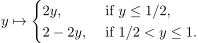
Instead of the integers from 1 to we now have the points  distributed between 0 and 1. For any value of we will call these points sestina points.
The dynamics of the map is represented graphically in Figure 2 via the so-called cobwebbing process. Here  is replaced at the next unit of time by its value given by the formula (3). This value is then fed back as the next value of into the same formula, and so on. This feedback process is represented as the reflection of the value of the image of a given -value in the 45
 line.
line.
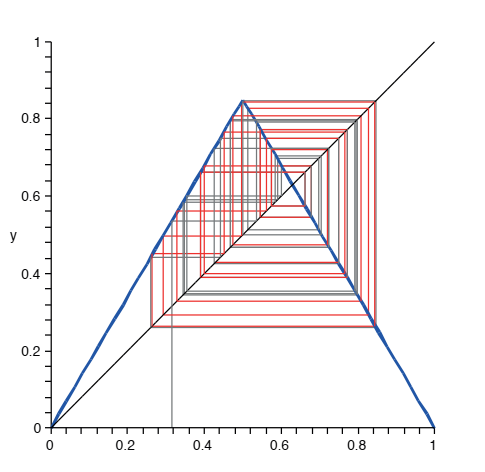
 , which is part of the general family of tent maps:
(4) 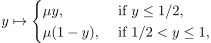
with slope  (see e.g. [3]). Straightforward analysis shows that if
  , then the fixed point
  is the unique attractor of the system. That is, all initial conditions will eventually converge towards under repeated iteration of (4). If
  , then all points with
  are fixed points of this dynamical system.
It is when  that things get interesting. In fact, among chaotic maps, the tent map is rather special because of the sharp point at
  . So as
  increases through 1, rather than a Feigenbaum period-doubling cascade that is familiar to all who have studied smooth chaotic dynamical systems (see e.g. [3]) the dynamics immediately becomes chaotic as passes through 1.
For  the map is fully chaotic. That is, almost all initial conditions are part of the chaotic set and each region of the chaotic set is visited with equal probability. Embedded within the chaos are a (countable) infinity of unstable periodic orbits with all possible periods. In particular, all rational initial conditions of (3) lie on periodic orbits. To see this, note that if an initial condition
  for integers and
  then all forward images of this point must be expressible as a fraction
  for some integer
  . Moreover, the map takes the unit interval to itself, hence
  . Since there are only
  such fractions, this must be a periodic orbit of period at most . In particular we are interested in the case that
  for odd
  and
and  for some
  .
.
The question we seek to address can thus be rephrased as: what is the image under repeated iteration of (3) of the specific initial condition  , for each odd integer
  ? If this orbit has minimum period then we say that is a sestina number. The only other possibility is that this initial condition lies on a periodic orbit with a lower period . So, it seems we must look at conditions for the existence of periodic orbits of (3) (and hence of (1)) of arbitrary period
  .
.
The examples above show that fails to be a sestina number because there exists a fixed point (a 1-cycle) and a 2-cycle; and fails because the permutation is decomposed into two disjoint 4-cycles. So in order to characterise which numbers are not sestina numbers, we need to consider conditions for a position  (
( ) to be part of a period- cycle for
  .
.
Considerations of this type lead to the following elementary result, the proof of which can be found in our paper [1].
Theorem 1. A number is a sestina number if and only if  and
and  for any which is a factor of .
Unfortunately the result is not constructive, because in order to check whether an arbitrary is a sestina number, we have to factorise several potentially very large numbers. In particular, it is not clear from the theorem how many sestina numbers there are, or even if there are infinitely many or not. The following corollaries establish some more information.
Corollaries
- For to be a sestina number, must be prime.
- Let be a prime number that divides
 . If is also a prime, then is a sestina number.
The chance encounter on a bus with which I introduced this piece happened more than a decade ago. Harry taught me a lot about poetry, the history of the sestina and more generally about the nature of art and creativity. Meanwhile, I worked out most of the theory. The perfect opportunity came to present our results. The 2007 British Applied Mathematics Colloquium (BAMC) was to be held at my own institution, the University of Bristol, and also happened to coincide with my 40th birthday. We gave the contributed talk as a double act. Only I appeared in the conference programme as the speaker. But when I finished a few minutes early, to everyone’s surprise, Harry popped out of the audience. He then gave a live rendition of a sestina he had written that was based on the theme of our collaboration. We planned to write a paper. But, for my part, there were embarrassing details I had not quite fixed; and Harry, not then an established poet, was not comfortable that his impromptu performance might become his first published poem. Harry and I lost touch and, as more pressing matters took over, the fruits of our collaboration became yet another unfinished project.
And so it would have remained had it not been for another chance encounter some 15 years or so before that. While I was finishing my doctorate at Oxford, I had met Poul Hjorth from the Technical University of Denmark at a conference on the Dynamics of Numerics and the Numerics of Dynamics (coincidentally, also in Bristol). It was quickly established that, in addition to scientific interests in common, we have a similar sense of humour and attitude to life. An invitation to Lyngby for the following year ensued and together we studied the dynamics of chaos amid the beautiful deer park there. A lifelong friendship was established, but no joint publication had ever resulted from our collaboration.
That is, until recently. A few years ago, chatting over a pint of British real ale, I told Poul my story of unfinished poetic collaboration. He expressed the desire to pick up the pathetic half-finished manuscript and prepare it for publication. But, disaster! we had been scooped. Poul found a recent popular article by Michael Saclolo in the Notices of the AMS [4] which summarised a body of work, mostly in French, starting with a collaboration between the poet Raymond Queneau and mathematician Jacques Roubaud [5, 6] in the 1960s. In French, a sestina is called a sextine and so Roubard had coined the phrase -ines or quenines in honour of Queneau for an admissible -verse poem. A complete characterisation of the quenine numbers, essentially equivalent to the above theorem, was not actually found until 2008, through the work of Jean-Guillaume Dumas [7].
Then Poul was invited to speak at the birthday symposium for another long-standing scientific friend, Helge Holden. The story of the sestina was perfect subject matter. An invitation to write a paper based on his talk led us to realise that the connection to the tent map provided a rather different and arguably more elementary proof than the French work. It also caused me to attempt to get back in touch with Harry. I discovered that he now lives in the North East of England, and is an award-winning, published poet (see [8, 9]). Last year, the three of us met in Harrison’s Bar in London, which I am told is a traditional place for scientific-based writers and poets to hang out. A three-author paper finally appeared this year in Helge Holden’s birthday proceedings [1]. Poul was also inspired to write a sestina for Helge, which appears elsewhere in that volume.
To close this piece, with apologies to Harry and Poul, it is just too tempting for me not to attempt my own sestina, A Commutator.
A Commutator
Each mathematical journey we hope to commute,
From the maelstrom of ideas shared in a group.
Thoughts that resound without number,
Are tossed and extricated from the chaos,
Spiced with rare theorems that we recycle,
To reassemble into a definitive map.For the route to such work we need no map,
So entrenched are we in our daily commute,
We take the same bus, though occasionally cycle.
At the usual stop, a familiar group,
Of those who contemplate the dynamics of chaos.
But wait, who is that poet obsessed with number?For his quest he has chosen a different number,
Not six, but one much harder to map,
Seventy-eight no less, oh what chaos!
For it seems its verses will not commute –
A problem with its permutation group
That leads to a nasty twenty-six cycle.Ah, remembering another more pleasant cycle,
When my family was much smaller in number.
A sojourn in Lyngby with another group
Exploring the deer park without a map,
A journey to work, a pleasant commute
To study with a Dane some mathematical chaos.But what could poetry have to do with chaos?
How does iterating the tent map to find a cycle
Relate to permutations that commute,
The theory of primes and the magic of number?
How can it be that a cobweb map
Needs to know the character table of a group?And is writing an article as a group
Likely to converge, or lead to chaos?
Should we a history try to map,
Or tell the whole story in a cycle?
Possible distractions are without number,
Yet backwards-told it will not commute.To end this cycle let us try to group
At least one number that tames the chaos
Of our earthy commute across life’s endless map.
As you can tell, I am no poet. I am also no expert in number theory. But I do know that when is itself a prime number, the numbers  that occur in the construction of sestina numbers are the famous Mersenne primes. It turns out that primes of the form are examples of what are known as Cunningham primes. Such numbers are named after the British number theorist who in 1925 [10] started what has become known as the Cunningham project to find factors of numbers of the form
  , for various integers
  and large . Curiously, although Cunningham is, as far as I know, no close relation, his full name was Allan Joseph Champneys Cunningham.
Alan Champneys CMath FIMA
University of Bristol
References
- Champneys, A.R., Hjorth, P.G. and Man, H. (2018) The numbers lead a dance: the mathematics of the sestina, in Non-Linear Partial Differential Equations, Mathematical Physics, and Stochastic Analysis: The Helge Holden Anniversary Volume, EMS Series of Congress Reports, pp. 55–71.
- Fry, S. (2007) The Ode Less Travelled: Unlocking the Poet Within, Arrow, London.
- Devaney, R. (1989) An Introduction to Chaotic Dynamical Systems, Addison-Wesley, Cambridge, MA.
- Saclolo, M.P. (2011) How a medieval troubadour became a mathematical figure, Not. AMS, vol. 58, pp. 682–687.
- Queneau, R. (1963) Note complémentaire sur la sextine, Subsidia Pataphysica, vol. 1, pp. 79–80.
- Roubaud, J. (1969) Un problème combinatoire posé par poéste lyrque des troubadours, Math. Sci. Hum., vol. 27, pp. 5–12.
- Dumas, J.-G. (2008) Caractérisation des quenines et leur représentation spirale, Math. Sci. Hum., vol. 184, pp. 9–23.
- Man, H. (2016) Finders Keepers, illustrated by Gainsley, S., Sidekick Books.
- Man, H. (2013) Lift, Tall Lighthouse.
- Cunningham, A.J.C. and Woodall, H.J. (1925) Factorisation of
 ,
,  ,
,  ,
,  ,
,  ,
,  ,
,  ,
,  ,
,  , up to High Powers , Hodgson, London.
Reproduced from Mathematics Today, December 2018
Download the article, Westward Ho! Musing on Mathematics and Mechanics (pdf)