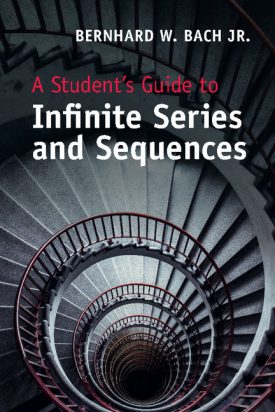
 Bernhard W. Bach Jr.
CAMBRIDGE UNIVERSITY PRESS 2018, 198 pages
PRICE (PAPERBACK) £17.99 ISBN 978-1-107-64048-1
This new contribution to the Student’s Guide series comprises six chapters with a diverse mix of topics. Each chapter ends with a set of pertinent examples drawn from physical applications (from damped oscillations and railway-track curvature to optical cavities and lattice potentials), and there is typically a short recapitulation of the underlying scientific principles at work.
Bach starts out at the very beginning of sequences, assuming little knowledge and introducing terminology and notation in a clear and straightforward way. Simple instances with which the reader is probably familiar – positive even integers, prime numbers, and the Fibonacci numbers – are used to illustrate concepts, before addressing more general cases such as arithmetic, harmonic, and geometric sequences. Quite a lot of time is spent at the outset on the definitions of limits and convergence, cementing some of the foundational ideas required for subsequent chapters. Techniques for quantifying indeterminate limits are discussed by way of some nicely chosen problems. Real world examples such as ‘The Mariner’s Rule of Twelfths’, photographic f-stops, wires in a conduit, and nuclear chain reactions demonstrate to the student, from the end of Chapter 1, that this apparently abstract mathematics can appear time and again in practice.
The transition from infinite sequences to infinite series is made at the start of Chapter 2. Additions to the language are well explained, with subsequent emphasis focusing almost exclusively on converging series. The standard tests used to establish convergence are detailed at some length (including the integral test, the comparison test, the ratio test, and the limit comparison test) and the notion of absolute convergence is introduced. Alternating series and conditional convergence are also discussed briefly. These ideas are subsequently applied in Chapter 3 to power series. Theorems are stated clearly without being burdened by proof, and the text focuses principally on algebraic manipulation. Issues of series-solution accuracy are addressed, as are asymptotic expansions.
Everything to this point has been based on real variables, but Chapter 4 offers a thorough introduction to complex numbers, their basic algebra, and their representations in the Argand plane. That elementary material is a precursor to complex power series and Laurent expansions. Key concepts such as the radius of convergence are considered in an intuitive way without getting bogged down by a ‘theorem–proof’ approach. Bach is quite open about the intricacies of this subject area, and deliberately avoids issues like convergence on domain boundaries. In the same way, analytic functions, singularities, branch points, and poles receive a rather cursory mention and are not developed in any detail. Decisions to avoid such topics are, in my view, sensible and fully justified given the Student’s Guide readership.
Continuing with the theme of applied problems, a substantial Chapter 5 considers series solutions to some standard ordinary differential equations that play an important role in physics (those of Bessel, Hermite, and Legendre). The method of Frobenius is used as a vehicle for deriving the associated orthogonal functions, with emphasis placed squarely on the algebra of series. There is also a nice application to the time-independent Schrödinger equation for a nucleon-nucleon potential energy well.
The final chapter, notably shorter than the others, provides a brief introduction to Fourier decompositions of periodic functions with a single independent variable. Both real and complex forms are considered, and application is solely to the standard square-wave profile. Legendre series are also introduced to represent step functions on the (−1,+1) interval. These topics feel to have been included for completeness, and as a primer to impending courses covering differential equations more formally.
From a practical perspective, Bach’s book favours descriptive clarity over formalism and rigorous proof. As such, it is probably ideal for students at an early stage in their physical sciences or engineering courses. His writing style is relaxed and easy-going, and he is at pains to not overwhelm the reader with any unnecessary background detail. A broad range of material is covered and at a level deliberately accessible for those who have not yet studied more advanced mathematical methods. There are no set exercises (e.g. at the end of each chapter), so one can well regard this guide as a very readable supplement to established general textbooks such as Boas, Chow, and Lea. However, one drawback to this first edition is the quite high number of typographical errors. These are mostly obvious to the more experienced student, but newcomers to sequences and series may find them disconcerting.
J.M. Christian CMath MIMA
Book review published directly onto IMA website (June 2019)