The workshop was organised by Mathew Pugh and Robert Wilson (School of Mathematics, Cardiff University) and was the third workshop in the IMA Teaching and Learning series 2019. The event focused on the provision of, and engagement with, feedback in mathematics and attracted 35 participants from 19 different institutions spanning the length and breadth of the country.
The workshop had two main aims:
- To provide participants with examples of best practice and an evidence base in relation to feedback
- To use the examples as a framework to stimulate discussion and debate, in order to support the development of existing practice.
The first speaker was Mike Robinson from Sheffield Hallam University who set the scene by presenting examples of the multiple ways in which feedback is provided and the different people responsible for providing the feedback. This was followed by further investigation and questioning of who our students are, and what feedback is for? Given this context, Mike presented a range of ideas that, as the title of the talk suggested, were “Feedback ideas that work . . . sometimes”; acknowledging the complexity and variation that exists in relation to assessment and how it can promote learning. Specific discussion included the inclusion (or not) of “a mark” as an element of feedback; the use of criteria and pro-formas; and the importance of keeping feedback focused and explicit (to help students understand what to do with it!).
Following Mike’s opening address, all attendees were invited to share their own thoughts and ideas through short 3-minute lightning talks. Despite some initial reservations (which was not surprising as mathematicians are not typically noted for their social exuberance), participants were keen to provide their own contexts and perspectives on feedback. As a result of the discussions a couple of themes started to emerge, or at least variation within themes. For example, the role of post-graduate assistants (PGA’s) in the assessment and feedback process was discussed, and for a number of institutions it was clear this is a key part of their provision. However, it was evident that some institutions did not have the same “resource” available. Further questions were subsequently raised in relation to training and support for PGA’s. There was similar variation in practice regarding the use of “model solutions”. While the provision is common practice, and the importance of self-evaluation was recognised, the level of completeness (of a solution) was variable. In particular, concerns were raised regarding the potential for this form of feedback to encourage an “illusion of learning”, especially given the perceived over reliance of marking schemes as feedback in pre-university mathematics.
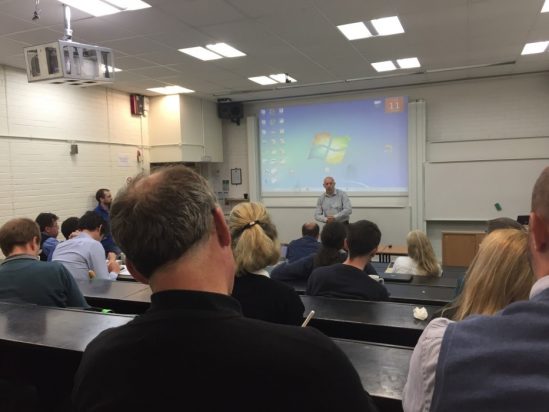
Figure 1: Participants engaging in lightning talks in the morning session
The lunch break provided further opportunity for discussions to continue before Barrie Cooper, University of Exeter, discussed “The Holy Grail”: Fast, Effective Feedback. The basis for this was set up in 4 key principles: Mapping your feedback practices; Being realistic about your resource; Distributing workload; Discussing ideas with students. For example, in terms of mapping, Barrie illustrated how a simple timeline of activities for a semester-based module provided opportunity to reflect on not just the provision of feedback, but the time allocated to students to review the feedback and adjust the work accordingly. Similarly, by including students in the discussions about feedback, they can become part of the solution to providing more timely and effective feedback. Barrie proceeded by sharing examples of how this framework had been used in practice. This included focus on automated assessment and feedback in conjunction with the use of competency based testing; the provision of generic feedback (possibly provided before submission) and how it can be used to stimulate further discussion; and use of feedback keys to encourage students to better understand what errors have been made.
The final speaker of the day was Michael Grove, University of Birmingham, who reported on the outcomes from action research aimed to enhance student feedback, particularly in relation to regular problem sheets. One of the key aspects of the research was that it captured the student viewpoint on existing feedback mechanisms. For example, the importance of a mark on a piece of work was highlighted as it potentially provided an indication of progression, in addition to helping students to recognise when something is not understood. The availability of model solutions was also noted by students, with comments suggesting that this allowed development of self-analysis and reflection. Further results illustrated how the opportunity for dialogue (with peers, tutors, and academic staff) was highly valued by students, as it provided direct and personal feedback as well as insight to different approaches. Outcomes from a pilot scheme looking to embed video based feedback in to problem sheets (and project reports) was also presented. Interestingly, while, this approach was felt to provide more detailed and informative feedback, students indicated its length made it more difficult to engage with. It was also noted that the Postgraduate tutors who had provided the video based feedback reported negatively on the overall experience. In particular, the process was deemed to be very time-consuming in comparison to the provision of “normal” written feedback.
For the plenary session, participants were arranged in to groups to discuss specific barriers and solutions to enhancing the provision and utilisation of feedback in mathematics. Particular points that were noted included the (sometimes) restrictive processes associated with assessment and feedback. For example, the importance of providing quick feedback was noted throughout the day, however, resource to provide the feedback is often limited and potentially delayed given the increase in extenuating circumstances requests. This led to further discussion in relation to formative and summative assessment and how increased focus on formative assessment may potentially provide more immediate, alternative forms of feedback to be considered. Discussion also highlighted issues in relation to student engagement with feedback, with uncollected papers a seemingly common occurrence. This led to further reflection on not just the provision of solutions, comments, marks etc. on a piece of work, but also the opportunities provided to students to learn how to actively review work and action future learning.
The organisers of the workshop would like to thank all attendees for their engagement and contributions throughout the day. Thanks also go to the speakers who really set the scene for lots of interesting and stimulating discussion. We very much hope everyone had an enjoyable and productive day. Final thanks go to the IMA for supporting this event.
Participant feedback:
“ . . . thank you for the fantastic IMA HE Teaching and Learning Series workshop in Cardiff on 11th June 2019. I found the discussion sessions especially useful and have taken a lot of ideas back with me to try . . . “
“The speakers were excellent and discussion topics really useful. It ran very smoothly and I cannot think of a single improvement to suggest. My only complaint – I now have too many ideas that I want to try and not enough time.”