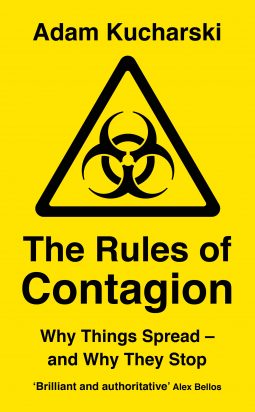
 Adam Kucharski
PROFILE BOOKS 2020, 352 PAGES
PRICE (HARDBACK) £16.99 ISBN 978-1-78816-019-3
I agreed to review this book, serendipitously published in early 2020, because although I am superficially well versed in a range of mathematical topics, the mathematics of ‘contagion’ had escaped my attention, and I was keen to learn more. The stated aim of the book is to help the reader understand the hidden rules that govern the behaviour of outbreaks, both of diseases, news and ideas.
The first chapter is called ‘A Theory of Happenings’ which builds on work by Ronald Ross, a surgeon who wrote in 1910, in which Ross developed mathematical approaches to understanding the spread of malaria, and demonstrated rather neatly that for a malaria epidemic to spread in a community of 1000, with one infectious person, 48,000 mosquitos are required. The model enables a community to work out efficient ways of reducing the chances of infection by malaria, and indeed appears to have been used to eliminate malaria in the UK and Continental Europe in the 20th Century. The chapter goes on to explore other models, including the Susceptible-Infectious-Recovered (SIR) model which can be used to simulate outbreaks of flu-like diseases. Kucharski explores both the mathematical consequences of the model, e.g. graph shapes and logical deductions, and also relates these models to real-world situations, e.g. plotting the SIR model against data from a plague outbreak in Bombay (now Mumbai) in 1906. Later in the chapter concepts which are becoming familiar from the media today, such as ‘herd immunity’ are introduced, and are related to the concepts communicated earlier in the chapter. The chapter concludes with exploration of Ross’ ‘Theory of Happening’, which describes the various curves that model his theory. Finally, the chapter introduces a, hitherto unknown to me, mathematician, Hilda Hudson OBE, who worked with Ross to expand his theory to a wide range of situations, and hence curves.
The second chapter is called ‘Panics and Pandemics’ and covers some of the maths behind stock market shocks, such as the credit crunch and, more historically, the South Sea Bubble. Kucharski then moves into the world of pandemics, building on the work discussed in the first chapter and introducing the concept of Reproduction Number (R ) for a given pandemic. R being the number of new infections a typical infectious person generates, e.g. Smallpox, which has an R of 4-6 in a susceptible population, so a new smallpox victim would typically infect 4-6 other people. The third chapter ‘The Measure of Friendship’ explores issues around how ideas, or infections, spread depending on how many people an individual has contact with, and uses a diverse set of examples to illustrate this, including the legalisation of same-sex marriage and the 2009 influenza pandemic.
Chapter Four, ‘Something in the Air’, uses the work of Victorian doctor, John Snow, in fighting cholera to begin thinking about the transmission processes of infectious diseases, and other issues such as in suicides and shootings. Kucharski goes on to describe how Florence Nightingale used statistics to convince the authorities to change practices in nursing injured soldiers and concludes the chapter with a description of how the underlying mathematics of transmission can help authorities minimise new infections in the early stages of a disease outbreak. The fifth chapter, ‘Going Viral’, describes viral emails and how some people can be more influential than others, and how social media provides a great basis for experimentation in this field. The chapter returns to the R value and explores how, for R < 1 one can predict the total size of an outbreak using the maths of geometric progressions.
Chapter Six, ‘How to Own the Internet’, explores the maths of hacking, malware, bots and computer viruses whilst Chapter Seven, ‘Tracking Outbreaks’, builds on the work of Charles Darwin to understand how diseases change over time and how they can be studied ethically. The final chapter, ‘A Spot of Trouble’ neatly concludes the book, drawing together the threads from the earlier chapters, to think about how we could tackle diseases in the future, and some of the logistical challenges such work will need to overcome. The book finishes with almost 60 pages of notes, references and suggestions for further reading, which would make this book an ideal starting point to begin a more in-depth study.
As a layman when it comes to the rules of contagion, I found this book a fascinating introduction to the subject, which neatly drew together the mathematical theory of diverse real world scenarios in an easily readable format.
Edward Rochead CMath CSci FIMA
Dstl Platform Systems Division
The opinions expressed in this review are not necessarily those of Dstl.
Book review first published in Mathematics Today June 2020