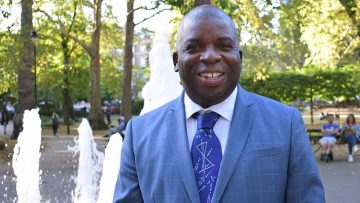
Nira Chamberlain is the IMA’s President and a Principal Consultant at SNC Lavalin Atkins.
Can you briefly describe your career path to date?
I have been a professional mathematical modeller for over 25 years. After completing my MSc in Industrial Mathematical Modelling at Loughborough University, I worked in the Automotive, Aerospace, Energy, Defence, Engineering and Retail sectors. I have worked in France, Germany, Israel and the Netherlands. The universities I have worked with most are Portsmouth University where I did my PhD, Loughborough University where I am a visiting Fellow and the University of Greenwich.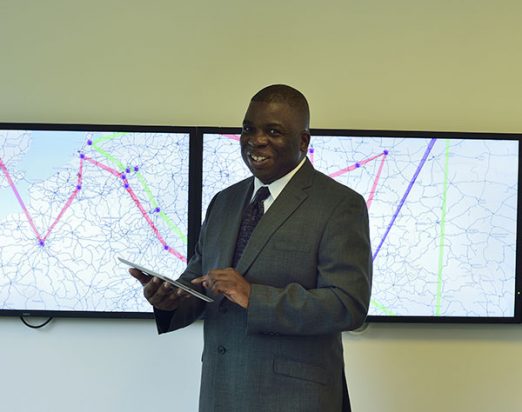
How would you describe your professional expertise?
I write complex mathematical algorithms that solve complex real world industrial and engineering problems.
What is your experience in knowledge exchange (KE)?
As part of my mathematics degree I worked on an RAF base for 12 months writing simulation models. As part of my MSc I worked for a Material Science start up firm – mathematically modelling how materials behave in aggressive circumstances. My PhD was sponsored by my company and there were a number of spin-offs from it. Also I have been an industrial supervisor of two MSc Mathematical Modelling students at Loughborough University.
What would you recommend to an early-career mathematical scientist who is passionate about knowledge exchange?
You must always listen to the subject matter experts. Your job is to turn their problems, thoughts and ideas into mathematics. After this you are able to assist them with your mathematical ideas. I do remember a young mathematician who did a presentation to some pipeline engineers. He started the presentation by saying this: ‘Let us first assume that the pipeline is of infinite length!’ This did not go down well and he never recovered.
Is there a knack to communicating mathematical ideas to people who are not mathematical scientists?
When explaining my mathematical approach in solving real world problems, I tend to use analogies. For one client I would say ‘Do you remember the game snakes and ladders?’ for another I say ‘do you know the story Goldilocks and the three Bears?’. The client relates to the analogy and then has buy in to the mathematics.
Can you tell us an example of knowledge exchange?
Many mathematical undergraduates are familiar with the Travelling Salesman Problem (TSP). However not many are familiar with its close cousin the Travelling Repairman Problem (TRP). In TSP the overall objective is to reduce distance but the TRP is about reducing time. The Repairman will visit a site and stay there to complete the job before moving on. Now in various sectors of industry we are interested in the Dynamic Travelling Repairman Problem (DTRP) where we have to deliver a service to a city, country or globally at minimum cost. An algorithm was developed on an industrial project but was enhanced for an MSc dissertation project working with Loughborough University. This algorithm has many applications and resulted in a conference paper, Agent Based Simulation and Visualisation of Emergency Relief Effort Strategies, presented at the 2015 IMA Conference on Mathematics in Defence. This algorithm could be used to help distribute the future vaccine for coronavirus.
What is the distinction between research, education and KE?
Research projects that I have been involved in tend to be open-ended questions while in industry the problems tend to be designed to meet a specific need. My PhD (partially sponsored by industry) was on ‘Extending the Gambler’s Ruin Problem played over Networks’. So, the question is, how much of an extension to the gambler’s ruin problem do we need in order for it to be played over networks? However in solving the open-ended question, we may solve a number of specific problems on the way. There are spin-offs from my PhD, most notably the Cost Capability Trade Off Model used for the HMS Queen Elizabeth carriers, the Energy Competition strategy model and last but not least the mathematics to stop an AI apocalypse.
Who inspires you?
Amazingly, in the mid-2000s the mathematician that inspired me was actually a fictional one. Professor Charlie Eppes from the crime series NUMB£RS. I like the whole diversity of problems Charlie Eppes got involved in and the way he used analogies to explain his ideas to a sceptical non-mathematical audience. Seasons 1 and 2 were the best.
How do you envisage the rest of your career progressing?
I can see my algorithms will be made up of a higher percentage of Machine Learning. I see the field becoming more diverse away from Engineering. Also, I see myself collaborating with universities more and doing more mathematical outreach.
Reproduced from Mathematics Today, October 2020
Download the article, Interview with Dr Nira Chamberlain CMath CSci FIMA (pdf)