David M. Bressoud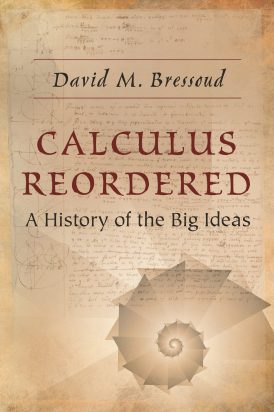
PRINCETON UNIVERSITY PRESS 2019, 242 PAGES
PRICE (HARDBACK) £25.00 ISBN 978-0-691-18131-8
Professor Bressoud has a well-respected stable of previous works in number theory and calculus, mostly at a final-year undergraduate or first-year graduate level and regularly displaying a strong awareness of the history and foundations of the topic under consideration. There are two threads weaving through this work. The main one is a thorough but highly readable summary of the history of Calculus; the second theme is Professor Bressoud’s contention that the modern teaching of Calculus has drawn attention away from its origins and evolution.
Chapter 1 (Accumulation) takes the history from the earliest origins to the Principia. As part of Professor Bressoud’s thesis, it is emphasised that – as we are aware but often fail to appreciate – this era covers investigations into shapes and volumes, with motion something of a latecomer to the proceedings.
Chapter 2 (Ratios of Change) covers a comparatively short period, but takes the reader – via short histories of Interpolation, Logarithms and early Algebra – to Descartes, Fermat, Newton and Leibniz and the development of Differential Calculus. Later developments by Euler, Laplace and Maxwell are also featured under the same heading.
Chapter 3 (Sequences of Partial Sums) covers much the same period as Chapter 2, albeit with – mostly – different contributors and finishing with Fourier. This field is, perhaps sadly, rather passed-over in British schools.
Chapter 4 (The Algebra of Inequalities) links the first three aspects by introducing the problems raised when limits and convergence – and hence continuity – were addressed seriously by the likes of Abel and Cauchy. Although this is a somewhat narrow field compared to those covered earlier, it – given its importance – receives a thorough exposition.
Chapter 5 (Analysis) brings the story up to date – or, more precisely, to the early 20th century with Riemann, elliptic functions and countability presenting a useful resting-place.
Commendable efforts have been made to re-cast the many theorems, proofs and other notable results into modern terminology; the level of difficulty involved is not especially high – all of the first 3 chapters would be accessible to a good A-level student, although some of the later modern references from Cantor onwards in Chapter 4 would be a stretch. All the major actors are introduced at the right point, each with a concise biography, and carefully located in terms of not only their contributions but their links with contemporaries. Good efforts are also made to introduce others where relevant. Diagrams are both plentiful and well-presented. The work up to here could easily be spun-off and would form a most welcome addition to any library of the History of Mathematics.
Chapter 5 presents a number of thoughts on approaches to the introduction of Calculus that avoid the standard approach of working with slopes and small intervals on Cartesian grids. It is very hard to deny Professor Bressoud his basic starting-point about shortcomings in the modern teaching of Calculus, but the majority of readers – unless they are specialist educators – will be sidetracked by practical considerations about how any new approaches could be introduced to an audience of young teenagers outside the well-understood framework used at present. It is also open to discussion how easily such a group could be expected to grasp the notions of – say – volumes and/or partial sums as an alternative. From an English perspective, and using English terminology, matters are not helped by a general lack of clarity as to whether the teaching being addressed is that of GCSE, A-level or first-year undergraduate students.
Professor Bressoud names a number of educators (mostly, it seems, in US colleges) who have apparently successfully adopted a non-traditional approach, but – somewhat frustratingly – leaves the reader hanging by providing little detail of their starting points or how a potential convert might structure things. This is, perhaps moot anyway, given the freedom to roam across topics that a university department has compared to a school. There is a rather short bibliography, comprised almost equally of reprints of/commentaries on historic texts and recent works on theories of mathematical education.
Andrew Ruddle AMIMA
Book review first published in Mathematics Today June 2020