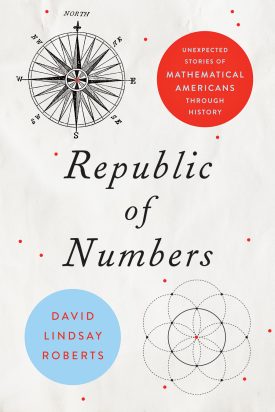
David Lindsay Roberts
JOHNS HOPKINS UNIVERSITY PRESS 2019, 252 PAGES
PRICE (HARDBACK) £22.00 ISBN 978-1-4214-3308-0
Roberts gives an account of mathematical expansion in the United States over a 200 year period. The story is told through the biographies of 23 individual practitioners over 20 chapters. However, he does not claim to provide a representative sample or a complete historical narrative over the period. Many of the 23 chosen are not well-known names, although they make a worthy contribution in their individual fields, across education, the military, research, computing etc.
The most famous is Abraham Lincoln, portrayed in his early years solving arithmetic problems in a handmade book, before going on as a young man to profit from the westward movement of the American population in the 19th century. The movement was facilitated by practical skill, which in his case – ‘Surveying, and then the law, would raise Lincoln out of poverty, with lawyering for the railroads proving especially lucrative’ (p. 31).
In earlier chapters there is a discernible theme of advance from the practical aspect, to mathematics as an established academic discipline. Nathaniel Bowditch is given as an example, having ‘mastered the practical details of ocean navigation and coastal surveying’ (p. 7), while he ‘also acquired a comprehensive understanding of the most advanced European theories on the movements of the stars and planets’ (p. 7).
Roberts effectively discusses the subsequent establishment of research departments that were developed in American universities, following the model initially ‘pioneered in France during the Napoleonic era and then elaborated by German universities in subsequent decades’ (p. 53). He contrasts this model with the already established West Point Military Academy, and its impressive reputation for mathematics tuition.
Roberts addresses the role of conflict as a catalyst for change, the Civil War figuring prominently. He provides ‘sketches of the political, military, economic, and social context’ (p. 3) that help to give a perspective to the wider environment in which the individuals operated. Kelly Miller is a case in point, as the first African American graduate student. He was at one time the only black professor in the country and an early member of the established civil rights movement.
The advance of technology is a recurring theme in the book, resulting from innovation and development in a number of areas. Roberts discusses Herman Hollerith, who in the late 19th century derived a punched card data storage system which was used in the census to record the population and clarify the position of the expanding westward frontier line. Hollerith’s company eventually amalgamated into IBM. Roberts also devotes a chapter to Grace Hopper, who joined the US Naval Reserve in 1943 and went on to become a main player in computer software development.
Frank B. Allen features as one of the more wide-ranging educationalists discussed in the book, a proponent of the New Math school curriculum, an American initiative to address the perception that the country had fallen behind the Soviet Union technologically, following the successful launch of the Sputnik satellite.
The last chapter profiles John Nash, who won the Nobel Prize in economics in 1994 and was made known to the wider public through the film A Beautiful Mind. Roberts considers the work of E.T. Bell, a populariser of mathematics whose books were influential to both the young Nash, and to Andrew Wiles who subsequently solved Fermat’s last theorem. An informative and worthwhile read.
Wallace A Ferguson CMath CSci MIMA
Book review first published in Mathematics Today February 2021