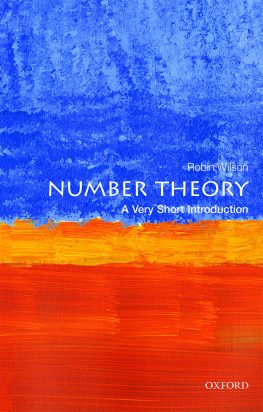
Robin Wilson
OXFORD UNIVERSITY PRESS 2020, 176 PAGES
PRICE (PAPERBACK) £8.99 ISBN 978-0-19-879809-5
Robin Wilson has what is by any standards an impressive set of past and present academic affiliations, and a substantial record of publication focusing especially on graph theory, combinatorics and history. Areas he has covered within this latter broad area have been eclectic by any measure – Lewis Carroll, Turing, the Four Colour Problem and Music as Mathematics to name a few, the warm reviews for all of which note and appreciate the clarity offered to the more general reader.
OUP’s VSI ‘Mathematics’ section currently comprises some 20-odd titles, which taken together could happily form the stimulus for a small but decent school mathematical library. The price paid for brevity – across the whole series – is usually the sacrifice of what can often be perceived as an important facet; in the Mathematics group the lost part usually arises from the required balancing act between background/history as against breadth, accessibility and/or depth. Probability and Networks (nos. 310 and 335 respectively) spread the theory somewhat lightly to bring in helpful real-life illustrations whereas Topology (622) goes into dauntingly fine detail. The History of Mathematics (305) makes itself accessible by using a thematic rather than historical approach.
This helpful volume (VSI 636) manages the balancing act very neatly, offering in Chapter 1 a basic sketch of the early history and terminology by way of introduction, and posing a battery of questions that a reasonable A-level student or aspiring adult might ask. The reader is then invited to work through a number of the more accessible threads of the subject to arrive at solutions. Along the way related contributions from individual mathematicians are brought in, and the basic history is gently expanded.
Thus Chapter 2 covers lcm/gcd, Euclid’s algorithm and divisor tests, Chapter 3 primes and their relationships, Chapter 4 congruences and modular arithmetic, and Chapter 5 Diophantine equations and sums of squares. Comparatively minor but still useful topics such as types of proof are painlessly worked-in along the way.
As Professor Wilson makes clear, the broad topic of Number Theory, whilst having strong roots in Ancient Greece, endured a long silence between Diophantus (c. 250AD) and Fermat (fl. 1630-1660), but then revived strongly thanks to Euler, Gauss (‘… number theory is the queen of mathematics’), Lagrange and Legendre. The subject developed as methods were refined, and previous results and proofs re-visited; the landmark of the proof of Fermat’s Last Theorem is duly celebrated here in a fittingly understated way.
There is – commendably – no great emphasis or speculation on possible future developments or practical applications, the clear understanding being that the attraction of Number Theory is that it sets its own course. The sole exception to this is in Chapter 6, which after opening with a grounding in Fermat’s Little Theorem and factorisation methods moves on seamlessly to explain why encipherment using large primes really does work – this final step being omitted by authors of blander popular treatments.
Chapters 7 and 8 set out succinct summaries of the unproven Goldbach and twin prime conjectures, then close – probably fittingly – with an equally well-presented summary of the Riemann hypothesis. In conclusion, Chapter 9 offers the answers to and brief reflections on the problems posed at the outset.
The style is highly readable, with frequent examples drawn from the wider world, and the workings-out are both clear and – given the subject – minimally technical. Although the book is rather more than medium length by VSI standards, it would lose little by the addition of, say, another two or three chapters in the same style.
The bibliography is not long, but appears to be both broad and well-chosen, covering both history and methods and offering something for all levels of ability.
Andrew Ruddle AMIMA
Book review published directly onto IMA website July 2021