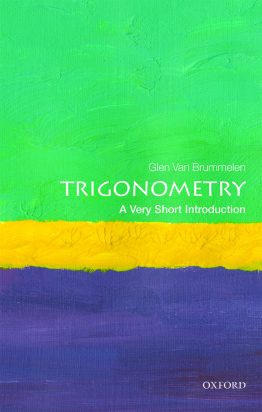
 Glen Van Brummelen
OXFORD UNIVERSITY PRESS 2020, 192 PAGES
PRICE (PAPERBACK) £8.99 ISBN 978-0-19-881431-3
The OUP’s Very Short Introduction series has been going for some 20 years in its present form, and in the first half of 2020 had a catalogue of some 630 books. As the name of the series implies, the books do not seek to take the reader too far into any topic but rather provide a solid base from which the curious reader can move more deeply – if so motivated. The ‘Mathematics’ section of the online catalogue lists some 25 titles, although a purist’s winnowing exercise (Hermeneutics, anyone?) would take this figure down to perhaps 16-18. Taken together, these could happily form the stimulus for a small but decent school mathematical library.
Glen Van Brummelen has a long record of publication, focusing on the early development of trigonometry and astronomy, and is a past President of The Canadian Society for History and Philosophy of Mathematics. His approach here is somewhat more inclusive than for most books in the series, and he does explicitly assert that his intention is to cover the entire subject. His writing style is by any standards easily accessible.
With many VSI books, it is clear that the author has had to leave out a great deal in order to sustain the narrative. This seems not to have been the case with a number in the Mathematics series, possibly a result of the age, nature and ‘shape’ of the subject compared to, say, the Humanities. To take a few at random, Probability and Networks (nos. 310 and 335 respectively) do cover a lot of ground, but spread the theory somewhat lightly to bring in helpful real-life illustrations whereas Topology (622) goes into enough fine detail to deter even a third-year university student. The History of Mathematics (305) is a gem, cleverly using a thematic rather than historical approach.
In the present case, it is hard to work out what has been omitted. Taylor series, vercos and versin, the Golden Ratio (Φ) and the derivation of angle sum formulae are all part of the warp and weft of the subject’s development and have been included in a way that will not scare the general (slightly educated) reader. However detailed treatments – even though consistently very well-written – of non-Euclidian geometry (24 pages), together with the pentagramma mirificum, Fourier, de Moivre and complex numbers, the unit hyperbola and Machin’s formula will stretch the reader without a decent Pure Maths A level pass. Equally, some of the written-out proofs – such as that for Euler’s identity – could have been omitted with no great loss to the general reader. To alleviate the hard work somewhat, we are taken on occasional short digressions into everyday concepts, such as how a calculator works out trig values.
The conventional introduction to a mathematical topic is of course via the historical route, and this particular approach is generally very well-handled, albeit in a somewhat fragmented way at times as non-mainstream topics are picked up and explored with names dropped in where required. Good efforts are consistently made to emphasise links and co-operation between individuals.
A number of topics are especially well-handled, and a pleasure to read. The construction of sine tables does take the reader on a circuitous trip, but works in a good deal of history – all highly relevant – to what might otherwise have been a long and slightly obscure set of calculations. Similarly, the hyperbolic functions – whilst arguably being ultra vires – are presented in a logical and detailed way as the offspring of Euler’s formula, with a healthy addition of real life by way of shapes of arches.
There is a helpful selection of illustrations, in terms of both well-drawn diagrams and pictures of significant texts. The bibliography is eclectic but broad, and includes a number of helpful brief commentaries and further suggestions.
Andrew Ruddle AMIMA
Book review first published in Mathematics Today October 2021