 Mircea Pitici (Editor)
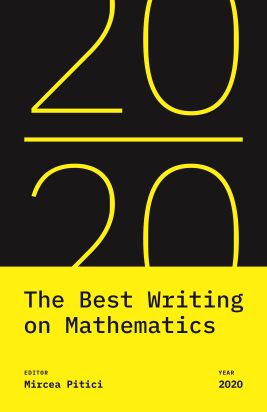
PRINCETON UNIVERSITY PRESS 2020, 264 PAGES
PRICE (PAPERBACK) £20.00 ISBN 978-0-691-20756-8
The eleventh volume of this well‐established series follows the previous instalments in providing a broad variety of topics for the casual reader to choose from. The styles of writing are quite varied, as are the levels of mathematical knowledge required. As one would hope from a book of ‘writings on mathematics’, the articles selected here do not shy away entirely from the technical details of their topics, but they do often keep them to a minimum. Thus, the generally interested reader with only a slight familiarity with mathematics will probably be able to get something from most of the articles here, though a handful will be a little more challenging and require perseverance. Areas of mathematics that lend themselves to explanations via geometrical figures or diagrams are well represented, but since this allows for a broad range of mathematics, no particular topic dominates.
The book opens with an article by Steven Strogatz, outlining how a fairly simple application of calculus has been used in the fight against HIV. Peter J. Denning and Ted G. Lewis then explore the fine dividing line between order and chaos, while Bruce M. Boghosian explains the mathematics behind wealth inequality. A comparison of different methods for presenting and analysing information on car fuel economy is the subject of Stan Wagon’s article, and an introductory game‐theoretic discussion of the mean voter theorem (the principle that it is the voter in the middle of a probability distribution of political opinions who selects the winner of an election) is given by Jørgen Veisdal. John Baez’s article explores the links between algebraic geometry and physics.
Two articles that sit side‐by‐side partway through the book provide a good example of the great contrast in styles that are represented here: Erica Klarreich’s quite journalistic account of the solution of a long‐standing problem in computer science is followed by Richard Montgomery’s insider’s overview of some approaches to particular cases of the three‐body problem. The latter article is particularly interesting in the way that it highlights the role that abstraction has to play even in such a clearly ‘applied’ problem.
Geometry of various kinds takes up several articles in the middle of the book: Chris King discusses fractals, Colin Adams introduces hyperbolic 3‐manifolds, and, in one of the heavier articles in the book, Boris Odehnal addresses the question of what higher‐dimensional geometries are good for.
The second half of the book becomes, if anything, even more varied in the selection of topics: we find Dave Linkletter writing on the Rubik’s cube, Patrick Honner on the efficiency of algorithms for multiplication, and Donald Teets on Gauss’s computation of the date of Easter. Ben Orlin’s illustrated discussion of the 1994 publication by a biologist of calculus‐related ideas that had been known to mathematicians for centuries leads into a discussion of the nature of modern academic publishing practices. Finally, the book is brought to a close by two articles on the philosophy of mathematics (Paul Thagard on the interactions between mathematical knowledge and reality, and Mark Colyvan on what constitutes a good mathematical argument) and one last one on statistical inference (Gerald J. Hahn et al.).
The brief descriptions above should give a sense of the diverse nature of the articles selected for the book (they are diverse in topic, but much less so in other ways – there is only one female author, for example). My own personal preferences were for those articles that took an informal approach to their subject, particularly when they were dealing with a subject that I hadn’t previously known much about. Alongside the article by Montgomery on the three-body problem, particular highlights for me were Jim Henle’s enthusiastic account of the mathematical games and puzzles devised and compiled by the American boardgame designer Sid Sackson (1920–2002), and James Propp’s intriguing article on the ‘tenth Heegner number’ which only became an object of mathematical interest because of a quirk of the order in which certain ideas were developed. The latter article is an excellent example of light‐hearted but mathematically rigorous popular writing on mathematics. Happily, it is far from being the only such example in this book.
Christopher D. Hollings FIMA
Book review published directly onto IMA website