Fernando Q. Gouvêa
THE MATHEMATICAL ASSOCIATION OF AMERICA 2013, 328 PAGES
PRICE £31.00 (HARDBACK) ISBN 978-0-88385-355-9
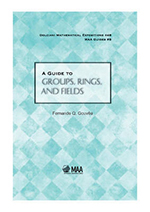 As the author of this book notes in his very first sentence, ‘algebra has come to play a central role in mathematics’. There are a vast number of textbooks available on ‘algebra’ in its broadest sense, each with its own particular focus. In the book under review, the author has endeavoured to provide a summary of the major topics of current abstract algebra, and thereby supply students with a handbook where they might quickly check definitions or the statements of theorems. To this end, the author has omitted all proofs, apart from some sketches (‘shadows of proofs’) here and there. Another goal of the book is to provide a unified picture of algebra, so that students might see ‘how it all hangs together’: the author intends to furnish insight, rather than focus on formal structure. This is billed as a practical text, aimed at users of algebra, and so need not be (and probably shouldn’t be) read in the order in which it is presented. Indeed, the author frequently, and knowingly, employs concepts that have not yet been defined.
The book opens with a short historical chapter, which charts the different ways in which the word ‘algebra’ has been used over the centuries, from ‘classical algebra’ to ‘modern algebra’. This first chapter also contains some musings on what the author terms ‘ultramodern algebra’, the technical essence of which is, for him, provided by category theory. Chapter 2 therefore introduces the basic notions of the latter. Indeed, category-theoretic considerations run like a thread throughout the entire book – it is these that often provide the unifying point of view mentioned above.
Chapter 3 contains some definitions of basic notions (groups, rings, actions, …), but the core content of the book is to be found in the very lengthy chapters 4, 5 and 6. The first of these concerns groups, and appears to cover every major group-theoretic topic, including, for example, orbits and stabilisers, various different special types of sub-groups, Sylow’s Theorems, generators and relations, and linear groups, amongst many others. The chapter ends with some representation theory for finite groups, phrased largely in terms of homomorphisms and vector spaces. The author revisits these representation-theoretic ideas in chapter 5, which deals with ring theory. Here, however, the representation theory of the preceding chapter is rephrased (some would say more naturally) in terms of modules. The roughly 110 pages of chapter 5 also cover a great deal of wider ring and module theory, with much material on commutative rings, rings of polynomials, radicals, semisimplicity, factorisation, and so on. The themes of chapters 4 and 5 are united in the final chapter, chapter 6, which deals with the theory of fields and skew fields, a particular highlight of this chapter being, of course, Galois Theory.
I must admit that in places the relentless procession of technical definitions and theorems caused me to lose track of the motivation and the promised unifying insight – though it must be remembered that I was reading the book in a manner not intended by the author, namely cover-to-cover. However, I’m not sure whether the author’s omission of proofs is entirely compatible with his goal of providing insight: mathematical intuition often comes not from the statements of results, but from their proofs. Nevertheless, the book supplies a fairly comprehensive whistle-stop tour of modern algebra, although, owing to its lack of proofs, it is certainly not one from which it is possible to learn algebra, but nor does it purport to be. Rather, it is a book that should be regarded in the manner suggested by its title: as a practical handbook to complement other, more specialised texts. A detailed contents list, as well as decent subject and notation indices make this an easy book to navigate, and the many suggestions for further reading do perhaps serve to off-set some of the concerns mentioned above.
Christopher Hollings MIMA
Book review published directly onto IMA website (February 2014)