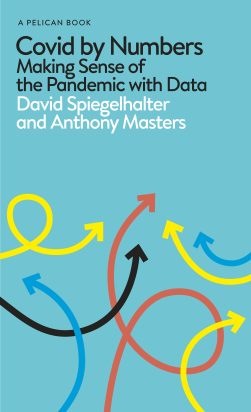
David Spiegelhalter and Anthony Masters
PELICAN BOOKS 2021, 320 PAGES
PRICE (HARDBACK) £10.99 ISBN 978-0-241-54773-1
Having been overwhelmed with data related to Covid-19 throughout the pandemic response – presented in some helpful, and in some not-so-helpful ways – it is tricky, two years on, to take a step back and make sense of it all. Who better, then, to guide the us through the vast array of numbers related to the pandemic than the authors of this book? Dr Anthony Masters is a Chartered Statistician and a Statistical Ambassador for the Royal Statistical Society; and his co-author, Professor Sir David Spiegelhalter is the Chair of the Winton Centre for Risk and Evidence Communication at the University of Cambridge. They do a great job of explaining data and statistical ideas in reliably accessible terms, both online and elsewhere in the media.
As you might expect from the title, the book is comprehensive in its coverage of the Covid numbers, with a focus on the outbreak in the UK. Chapters set out, in turn, data on the virus, diagnoses, the morbidity and mortality related to the virus and the impact of the measures implemented to control the virus. This is an accessible book aimed at a broad audience base – numbers are well presented and are easy to follow without the need for any expert knowledge. Where they are mentioned, epidemiological or statistical terms are clearly and precisely explained.
The authors make the point that ‘statistics are often about people’ (p. ix) and they do a great job of relating what the numbers reported have meant in terms of the pandemics’ impact on all of our lives. The book sets out data on the direct impacts of Covid – the numbers of those who were infected and the numbers of those who sadly lost their lives – as well as describing the broader behavioural and economic impact that the pandemic, and our response to it, has had.
Using the numbers, the book underlines the extraordinary effort of those involved in the response to Covid-19 across health and care services and beyond. It also underlines the important role UK-based Covid data and analysis has played in fighting the virus, reducing Covid-related harm, and saving lives. In addition to the success of the Oxford AstraZeneca vaccine, the authors also point to the RECOVERY trials collaborative. They describe the collaborative as ‘one of the UK’s greatest contributions to world health’ (p. 92) for its role in identifying Dexamethasone as an effective Covid-19 treatment that is estimated to have saved a million lives worldwide, amongst other achievements.
The decision to publish a book describing Covid by numbers at a time at which the fast-moving pandemic was by no means over is an interesting one. The authors make it clear that the period over which they are focussing their analyses starts as the first cases of Covid were recorded in the UK in early 2020 and ends in May 2021 and so omits, for example, data on the full implementation of the vaccine programme and the impact made by the Omicron variant of the virus. However much of what is written holds up well. The book provides an excellent overview of what Covid data exists in the UK and how best to read or use that data to understand the pandemic and serves as a useful tool to continue to understand changes to the virus and the pandemic response.
If I were to grumble about anything it would be the formatting of the book. The hardback which I read is small and there was, at times, a lot of page turning required to take in the figures alongside the text which supports them. The referencing, all provided as URLs in my edition, also meant that further exploration of the data that is presented is tricky.
These are, however, minor issues for a book that does an outstanding job of pulling together, making accessible, and making sense of the numbers that describe the pandemic that has had such a significant impact on the way many of us have lived our lives in the UK and around the world since early 2020. Highly recommended!
Daniel Stewart
South West Public Health Training Programme, UK
Book review first published in Mathematics Today October 2022