The Festival was held during the very warm spell of weather, Thursday 7 to Sunday 10 September, on the University of Exeter Streatham Campus and then in the city centre over the weekend. The two events organised by the mathematical sciences section took place at the university. On Thursday we held the Presidential Lecture by Professor Christina Pagel FIMA. Then, on Friday, the Open University (OU) led an interactive event on tilings of the plane. This was organised with Dr Reem Yassawi (Queen Mary University of London, QMUL) and the OU team led by Dr Andrew Neate FIMA, including Dr Vicki Brown, Dr Vinay Kathotia and Kellee Patterson along with Phd students Francesca Carter and Daniel Clarke. The Festival was noteworthy for the high proportion of interactive events, which took place in the spacious ground floor of the Forum Building.
The Maths of Healthcare
Christina Pagel is a member of Independent SAGE and has had an active media presence over the last three years, usually (but not always) discussing the Covid-19 pandemic. She has given brief weekly public updates on the latest Covid-19 data and research, streamed live on YouTube and Twitter (now X) since 2020. Content is aimed at a general audience and briefings attracted tens of thousands of viewers during 2020 and 2021, and since 2022, briefings are still attracting 8000–15000 views a week.
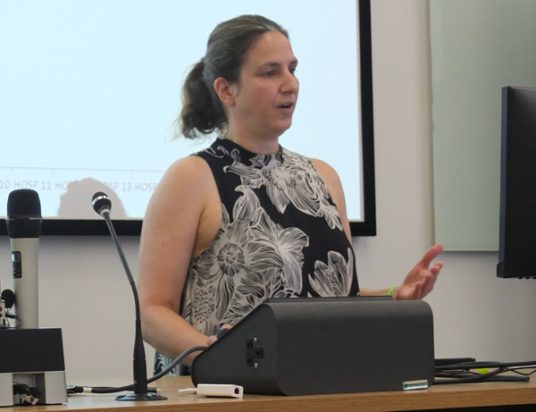
Christina works in the Clinical Operational Research Unit of the Department of Mathematics at University College London (UCL). For her Presidential Lecture, The Maths of Healthcare she chose two topics far from her work on Covid-19: outcomes of children’s heart surgery and testing and screening for non-specific health conditions.
Raw data from hospitals on the survival rate of young children after heart surgery might suggest that some hospitals are ‘doing badly’ while others are ‘very successful’. Indeed this data was taken up by the Daily Telegraph on 29 March 2013 to suggest that ‘20 children may have died needlessly’. However more sophisticated analysis of the data, taking into account for example the seriousness of the children’s condition prior to surgery, produced different results, showing that child deaths at the hospital in question were only ‘a litte high’. This ‘risk adjusted survival outcome’ data has been published using methods developed at UCL since 2013 and a special website was set up to help parents to understand the relative risks of surgery at different hospitals (see [1]). There is current work on long-term survival rates.
Non-specific health symptoms are rated on a scale of 1 to 8, and for a score of at least 4 expensive follow-up tests are considered necessary. Of course late diagnosis of missed disease makes news, but lowering the threshold leads to more unnecessary treatments that may themselves be harmful, causing anxiety for patients and using more expensive tests. Patients may be taking drugs they don’t need, making more money for pharmaceutical companies (especially in the US). How do we balance all these conflicting issues? Christina discussed this problem in detail, including the possibility of large scale screening of people with no symptoms, spelling out the pros and cons from the points of view of patients, GPs, hospital medical teams and the NHS as a whole. This is work in progress.
Einstein’s Hat interactive event
The interactive event on tilings was partially motivated by the recent discovery by David Smith of a ‘monotile’, a single planar shape (a tile) which, together with its reversal (turning the tile over) covers the plane aperiodically. This completes the project most commonly associated with Sir Roger Penrose FRS CMath FIMA whose ‘kites and darts’ accomplished an aperiodic tiling with two tiles in the 1970s. The monotile has been likened to a hat, hence the title of this interactive event, ‘Einstein’s Hat’, based on the German ‘ein Stein’ meaning one stone. Indeed a single tile, the ‘Spectre’ was also exhibited. It tiles the plane aperiodically without being turned over. Actually proving the tiling is aperiodic is hard; see [2].
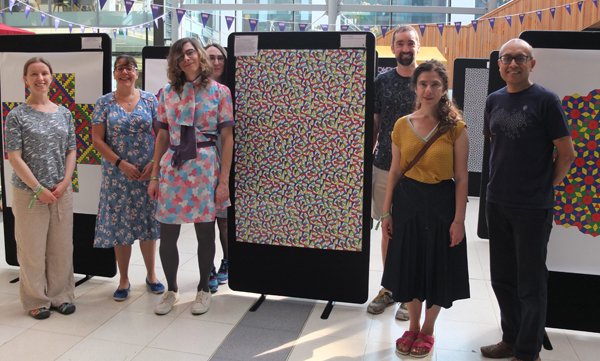
The event included an exhibition of posters and artworks based on aperiodic tilings as well as a remarkable quilt of the hat tiling provided by local Devon artist Emma Laughton. Members of the public, including children, were clearly interested in trying out the many activities, fitting together tiles, admiring the stunning posters and talking with the team (see photo), over the whole day when the event was staged. Some of the posters were particularly associated with Uwe Grimm from the OU, who died in 2021.
Peter Giblin OBE FIMA
University of Liverpool
References
- Pagel, C. et al. (2017) Improving risk adjustment in the PRAiS …, Health Serv. Deliv. Res., vol. 5, no. 23.
- Smith, D. et al. (2023) An aperiodic monotile, arXiv:2303.10798.
Reproduced from Mathematics Today, December 2023
Download the article, British Science Festival at the University of Exeter (pdf)