Do you have a mathematics anniversary? A specific date or particular year when you made a significant mathematical discovery or perhaps first realised that maths was your passion. My significant year was 2004 and my 20th mathematical anniversary has found me reflecting on how my career, as well as the mathematical landscape in the UK, has altered since then.
In April 2004, I obtained a place at the University of Greenwich to study mathematics as a mature student. However, 20 years previously – there’s a pattern here – I had failed A-level maths due to losing all motivation when my maths teacher advised me against applying to read maths at university. Despite previously being on track for an A grade, I was only taking single maths A-level and so deemed unsuitable for studying the subject further.
After a gap in my mathematical journey, I began training as a numeracy specialist in further education. Encouraged by my then tutor, I approached my local university to enquire if I could study for a degree in mathematics. After two stressful weeks of reacquainting myself with A-level maths, I passed the entrance test at Greenwich and embarked on a brand new career.
So what are some of the changes to the mathematical landscape in the UK over the last 20 years? As a student I saw the benefits of the More Maths Grads project. Although I wasn’t personally involved, I could see how this was enthusing my lecturers. I became a student ambassador and was employed at an increasing number of outreach activities. Writer and broadcaster Simon Singh had just launched the Undergraduate Ambassadors Scheme (UAS) and, in my final undergraduate year, I was part of the second cohort at Greenwich to take part. I based my UAS project on the need to increase the number of maths graduates, little knowing that I would still be agitating for this some 20 years later. At least I am now rather better placed to influence it.
The explosion of popular mathematical literature, building on the legacy of earlier pioneers, has brought maths to a wider audience. There are too many brilliant maths promoters to name here, but they include IMA–LMS Zeeman Medal winners, such as Hannah Fry, Matt Parker, Ian Stewart, Rob Eastaway and Marcus du Sautoy. There is now more visibility of maths on other media such as TV, radio, podcasts, social media and YouTube channels, including Numberphile.
In education we have an increasing amount of good quality online mathematical and teaching-focussed resources, various school and family-facing initiatives such as Maths Inspiration’s Maths Fest, the introduction of maths weeks, as well as the expansion of the well-established Royal Institution Masterclasses. Much of this, alongside the huge impact of Nira Chamberlain’s Black Heroes of Mathematics talks and conferences, is helping to increase the diversity of those choosing to take maths further and ensuring the importance of maths is better understood.
Since 2012, the IMA has been tasked with administering the Mathematics Teacher Training Scholarships programme for the Department of Education, designed to support and incentivise individuals to pursue careers as qualified mathematics teachers. We have seen the introduction of the Core Maths qualification (with extra funding announced recently), designed to broaden the variety of young people studying maths beyond GCSE. We also have a prime minister consulting on a new baccalaureate-style qualification framework, the Advanced British Standard (ABS), that requires students to study maths (and English) to the age of 18.
But despite these, and many other, positive changes (I appreciate that the last point is not short of controversy) mathematics still faces challenges. There remains a huge shortage of maths teachers and mathematics still tends to be a subject that too many people love to hate; with many claiming failure loudly and with pride.
On a recent ski trip to Norway, I was personally struck by how the incorrect use of mathematical terms can lead to misunderstanding. When I had previously been told to keep the radius of my turns a particular size, I had envisioned a curve with a constant radius, that is part of a circle. This meant I assumed (as a beginner/intermediate skier) that my turns should be like Figure 1.
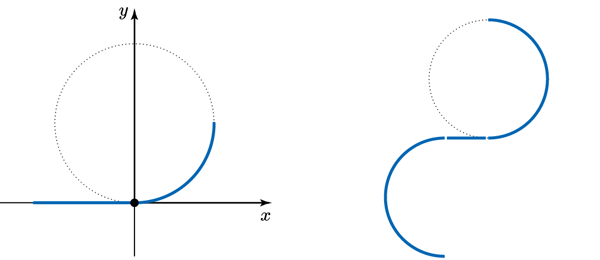
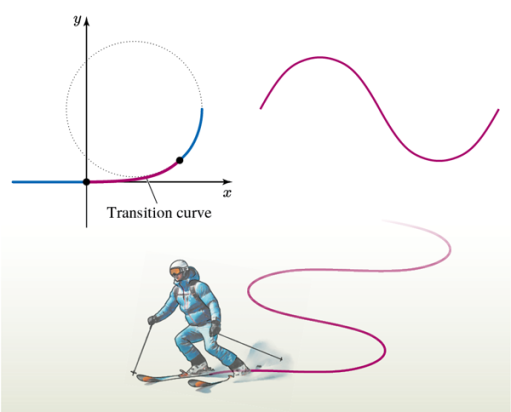
However, through discussion and watching other skiers, I had an epiphany moment and realised that the term radius had been misleading. The optimal turn shape required for basic skiing requires a dynamic radius as shown in Figure 2 and crucially one that does not form part of a circle (Figure 1). This is similar to the transition curves well-known in the building of railways. These curves ensure a [1, p. 19]:
Continuous change of unbalanced lateral acceleration between the sections of the route with different curvature.
This enables trains (and skiers) to change direction without the need for sudden movements which, when accelerating, can lead to jerks. Looking into this (it’s an area that I was unfamiliar with) I have found that new curves are still being discovered and I wonder if skiing might be an interesting application?
A report on Number Confidence and Social Mobility [2], found that around 60% of people with low mathematical attainment think that their lack of numerical skills have affected their workplace progression. A webinar audience, discussing this report, seemed surprised that this was so high. However, I was more concerned by the 40% who did not think that their career prospects had been adversely affected, as this might be something that they hadn’t noticed. When I worked in industry it was clear that those with greater numeracy were able to learn how to use data in a way that enabled them to start making better business decisions and were thus more useful and progressed more swiftly. The opposite could be seen for those with weaker numeracy.
Today’s increasing use and reliance on data for making business decisions, can leave organisations vulnerable when there is a general lack of understanding of numbers and statistics. One often sees misleading articles and incorrect graphs reporting statistics and many mathematics communicators have called out these errors over the years. However, it is worrying that many errors will be going unnoticed as these mistakes can and do affect business, and government, decisions.
Of course this is nothing new. Those who know me will appreciate that I have conducted research on Florence Nightingale’s work on data. One of her earlier bat-wing diagrams was declared open to misinterpretation – see Figure 3. The problem was that she intended the comparisons to be made between the different lengths of the lines/radii whereas people were comparing the areas in between. Such was the concern that she was asked to clarify the correct interpretation with an explanatory note placed in later editions of the publication [3]. In a private letter to her sister she confided that it was only [4]:
Ignorant people [who] conceive that the comparison is intended to be between the areas.
However her later diagrams correctly compared areas, which she conceded as being more ‘mathematically correct’ [4].
![Figure 3: Diagrams representing the Relative Mortality in the Hospitals in the Army in the East [3, Diagram K].](https://ima.org.uk/wp/wp-content/uploads/2024/03/Figure-3-Diagrams-representing-the-Relative-Mortality-in-the-Hospitals-in-the-Army-in-the-East-3-Diagram-K-e1712654384452-406x412.jpg)
This brings me back to education. There is a serious need to raise the level of the mathematical competency of the general population whilst at the same time continuing to ensure that those capable of higher-level maths are given the appropriate teaching, nurturing and encouragement to take the subject further.
Much has been written about the leaky mathematics pipeline [5] (which is also an issue in other STEM subjects such as chemistry) and more recently on the effect of some universities closing their mathematics degrees. Without radical intervention, where are the maths teachers going to come from? We need to attract good teachers to educate, and more importantly enthuse, the next generation of mathematicians in the UK. Maths is too often thought of as an elitist subject – you must get an A/A* at A-level and probably should take Further Mathematics. I didn’t and many students I have taught didn’t either. In fact, one of the most able students I have taught only achieved a D at mathematics A-level.
A recent report, commissioned by the Heads of Departments of Mathematical Sciences (HoDoMS) and the Council for the Mathematical Sciences (CMS), says that based on their research [6, p. 23]:
It is clear that mathematical sciences graduates have high rates of employment, irrespective of their pre-university entry qualification.
In my opinion enabling a greater variety of institutions to offer mathematics degrees to a more diverse student body is required to enable us to meet the demand for enough mathematicians in the UK. This will provide the possibility of increasing the number of school teachers, as well as delivering sufficient excellence in academic research and fill the vast array of exciting careers available to mathematicians in industry.
The IMA has a new five-year strategy with a substantial focus on education. As the chair of the Higher Education Committee I want to help enable the IMA to achieve its ambitions. If this is something that you would like to be part of, please respond to the call for new members.
I am also excited by the possibility of a new Academy for the Mathematical Sciences. This has the potential to provide a much-needed single voice for mathematics with education at the heart, rather than periphery, of the structure. There are obstacles ahead but with this comes opportunities and I am optimistic for the next 20 years.
Noel-Ann Bradshaw CMath FIMA
University of Greenwich
References
- Koc, W. (2019) Smoothed transition curve for railways, Transportation Overview, no. 7, pp. 19–31.
- Tyers, C. and Aston, J. (2023) Number Confidence and Social Mobility, National Numeracy.
- Nightingale, F. (1858) Mortality of the British Army, at Home, at Home and Abroad, and During the Russian War, as Compared with the Mortality of the Civil Population in England, Harrison and Sons, London.
- Nightingale, F. (1858) Letter to Parthenope Nightingale, Wellcome 8997/78.
- Noyes, A. et al. (2023) The Mathematics Pipeline in England – Patterns, Interventions and Excellence, University of Nottingham.
- Ortus Economic Research Ltd (2023) Mathematical Sciences Recruitment and Graduate Outcomes – A Diversity Perspective of the Landscape of Mathematical Sciences in UK Universities, CMS and HoDoMS.
Reproduced from Mathematics Today, April 2024
Download the article, The Importance of Mathematics Education (pdf)