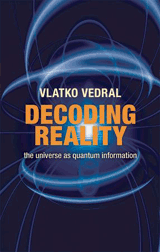
Vlatko Vedral
OXFORD UNIVERSITY PRESS 2010, 240 PAGES PRICE (HARDBACK) £16.99, ISBN 978-0-19-923769-2
 If a poll was held to identify the most significant written phrase what do you think would win it? Perhaps something from a famous poem about how one should treat triumph and adversity? Or maybe something from Shakespeare about which is the noblest path of action?
Whatever the winner was I think it is safe to say that the phrase ‘information is physical’ is unlikely to register even a single vote. Yet that phrase was the starting point for the research discussed in this book; research that if the author is correct will fundamentally alter our understanding of the universe and our place in it.
The basic premise, if the term basic can be used for something with such a grand scope, is that information, and not matter, or energy, or even love, is the building block from which everything in the universe is constructed. It is argued that ‘information is the underlying thread that connects all phenomena we see around us.’
A neat editorial design allows the author to begin by discussing how the concept of information addresses the question of how the universe was created from nothing, that is creation ex nihilo. From a philosophical perspective this is important as it avoids the need to invoke an infinite regression of creator beings. From a design point of view it provides a neat bound for one end of the book; the other end relates to the universe ending in nothing, that is destruction ab toto.
Not surprisingly, the initial part of the text covers Claude Shannon’s groundbreaking work, which created the field of information theory. Particular attention is paid to the concept of entropy, whereby things that are more surprising (i.e. that have a lower probability of occurring) have a higher entropy, or information content. The relation between this information-based concept and the more traditional role of entropy in physics is developed later in the book.
In the main part of the text the author discusses, in an information- centric way, various ‘pillars of our reality.’ Separate chapters cover: biology; thermodynamics; economics; sociology; quantum physics; computer science; and philosophy. This diverse collection of topics, which cover the full spectrum of scientific inquiry, demonstrates the grand scale of the text. This breadth is reinforced by the sources of supporting information: the first two quotes come from a psychologist and a philosopher, respectively; later chapters relate the implications of the theory to various religious philosophies.
The wide-ranging nature of the text allows the author to relate his theories to areas of modern scientific debate including, for example, climate change. Whilst this is easy to do – the information- centric view proposed in the book would not be very powerful if this was difficult – these small digressions seem somewhat forced. They add little to either discussions about climate change or the author’s own narrative.
Although the topics being considered are amongst the weightiest ones that mankind wrestles with the text remains accessible and entertaining. For example, the way that the members of the scientific community build on each other’s efforts is aptly summed up as, ‘there are no true loners in the world of knowledge – no scientific Clint Eastwoods.’ The author also notes that, ‘being insane doesn’t exclude being intelligent, as half of my department can testify to.’
The view promoted in the text is clearly a controversial one. However, regardless of whether a consensus eventually emerges that information is truly the key to everything, there is no denying that it provides a different perspective from which a range of challenging and important problems can be viewed. Even though it is easy to read, the book is genuinely thought-provoking. Given its aims it is hard to think of higher praise than that.
Rob Ashmore CMath FIMA, CSci
Defence Science and Technology Laboratory
Mathematics Today June 2012
The views and opinions expressed herein are those of the author and do not necessarily reflect those of the Defence Science and Technology Laboratory.
Decoding Reality: The Universe as Quantum Information can be purchased at Amazon.co.uk