MoMath, the National Museum of Mathematics, has been on my wish list since its opening in 2012, and in April 2025 I finally made the long-anticipated trip to visit it in New York City. As I happened to be across the pond, I took the opportunity to visit my youngest son, who had recently relocated to New York for work.
The museum had moved from its original location on East 26th Street to a temporary spot on 5th Avenue near Madison Square Park – it is very central and easy to get to. However, by the time you read this it will have relocated to its new larger permanent home a short walk away on 6th Avenue.
To make the most out of visits to museums and galleries, I usually prepare in advance, but the hectic world of higher education had overtaken me, and I found myself at the museum without any idea of what to expect. This is not ideal when you are neurodivergent, albeit my diagnosis had not yet been confirmed. My first impressions were of noise and chaos. My visit was on a weekday and so understandably coincided with several groups of very active school-aged children. Although there were a few helpers and teachers around, it seemed that the kids were treating the museum as a play area without much thought or understanding of the mathematics behind the activities. They all seemed to be having a very enjoyable time, but the noise, chaos and crowds meant that I struggled to explore some of the activities.
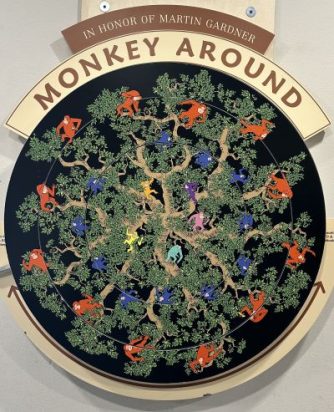
For those of you who have been to a MathsJam, MoMath is like one big MathsJam but without the talks. You may also be familiar with the Maths Arcade run in several UK universities; again MoMath is similar to this but permanent and much, much larger. The museum contains several large exhibits, like the Monkey Around puzzle, a glorious wall-based version of the geometric illusion that allows you to move a couple of levers and see the numbers of red and blue monkeys change before your eyes. I found this strangely addictive and mesmerising, despite other versions of the puzzle being familiar to me.
Several low tables were strewn with numerous wooden table-based activities and problem-solving games, like large wooden versions of Rush Hour and Solitaire, which, if the museum had been emptier and calmer, I could have become engrossed in for many hours. Rush Hour, the brainchild of Nob Yoshigahara, is a sliding block puzzle with different levels. Set up like the worst road gridlock scenario imaginable, you have to slide the various trucks and lorries forwards and backwards until you can release your little car out of the enclosed area.
A range of mathematical topics are explored in the museum’s activities. Even as a mathematician I would have appreciated a bit more background information on the exhibits, which would have made it more accessible to those with less knowledge than myself. The activities and visuals allow visitors to explore the worlds of fractals, geometry and symmetry. There are tactile puzzles that demonstrate Pythagoras’ theorem, group theory and harmonic progression, and there are areas for single participants or groups.
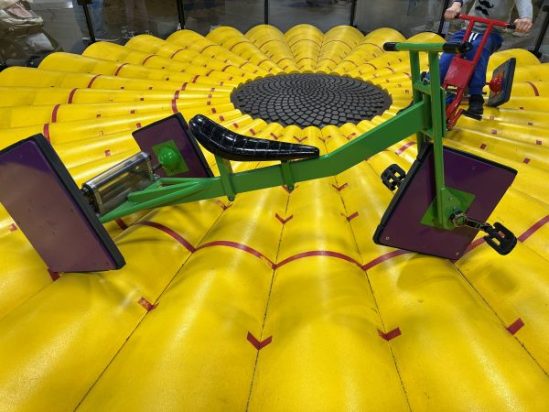
One of the activities that looked particularly enjoyable was a large square-wheeled tricycle along with the appropriate undulating surface to create a smooth ride. A long queue of raucous children deterred me from trying this, but it was fascinating to watch them have a go.
I have to confess that for me, in my overstimulated state, the areas where I lingered longest were the shop and the exhibition, primarily as they were quieter and calmer. The shop was well stocked with a vast array of maths puzzles, clothes, books, games and STEM-related trinkets. Some of these I had already seen and, indeed, own. However, many were new, and seeing them in person was definitely preferable to buying unseen puzzles online.
On the day I visited there was a delightful exhibition of crocheted topological constructs by Shiying Dong. Some of my favourites included the saddled rings, a mushi and a woolly quintron. There were even videos on the wall showing how some of these, like the Borromean rings, had been created. Despite my enthusiasm at the time, I have to shamefully admit that I have yet to dust off my crochet hook and have a go. Reluctantly, I suspect that this is one of those activities that will have to wait a few more years until I retire.
As mentioned at the start of this article, MoMath moved to a permanent location in February 2026. This new space doubles its size with 31 new experiences added, including a dedicated space for preschool children and an educational area for talks and events.
As I left, I wondered who the MoMath experience is aimed at, clearly not an introverted, neurodivergent mathematician (at least not when noisy and crowded), but it must be a wonderful space for school groups and families to explore mathematics together. For those with maths anxiety or who may think that mathematics is bewildering and not for them, the exhibits show that maths is everywhere and that it is fun, enjoyable and beautiful.
For those of you less familiar with New York, there are other sites of interest to a mathematician. I took the opportunity to visit a few of the more unusual buildings and architectural constructions. One of my favourite buildings is the Flatiron Building, a triangular-shaped skyscraper, named unsurprisingly for its resemblance to an old-fashioned iron. Built in 1902 by architect Daniel Burnham, it has 22 storeys (this was high when it was built) and is a classic New York landmark. Sadly, in 2025 it was in the process of being transformed from office space into residential apartments and so was shrouded in scaffolding and netting. Nonetheless, I still subjected my son to a detour just so I could stand and look at it in wonder for many more minutes than he appreciated.
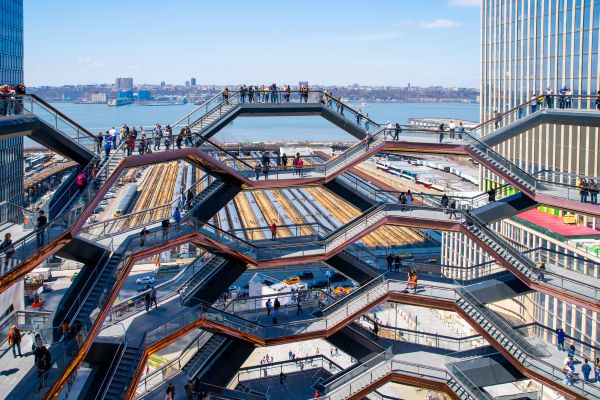
A new discovery was the Vessel at Hudson Yards. Like many of New York’s buildings, it provides excellent views of the surrounding area, albeit not as breathtaking as the nearby Edge or Empire State Building. An extraordinary glass and bronze-coloured metal structure, it features a network of connected staircases that enable tourists to experience a variety of views of the city at different heights and angles, making it a great way of getting in your 10 000 steps.
Another find on this trip was the Belvedere, a small castle on a huge rocky outcrop in the middle of Central Park. Built in 1872, it was initially designed as an open-air lookout tower with no covered doorways or windows. In 1919, the US Weather Bureau converted it into a weather station and added the much-needed doors and windows. Although the bureau has since moved out, it remains an official weather station with sensors near the castle and an anemometer on the tower. The visitor centre still contains a lot of interesting exhibits related to astronomy and its meteorological history.
No trip to New York would be complete without visiting the 9/11 Memorial. This was my first visit, and I was mesmerised by the large twin waterfall pools that provided a calming, sobering and slightly hypnotic space for reflection, despite being in the busy area of Lower Manhattan. The engineering behind their design is as beautiful as the aesthetic effect. The system uses 16 pumps and 500 000 gallons of water. The water drops in large continuous sheets, rather than droplets, over four 30-foot drops irrespective of the weather conditions. The names of the 2 983 people who were killed in the 2001 and 1993 terrorist attacks are inscribed on the bronze panels edging the memorial pools. They have been sensitively grouped using a complex algorithm that took into account their relationships with colleagues, family and friends.
Despite my trip to the Big Apple being brief, my mathematical musings made the times I spent on my own much more enjoyable. As my son is now moving to Austin, Texas, I guess I will have to see what the largest contiguous US state can offer a mathematical mind. Do let me know if you have any insight.
Noel-Ann Bradshaw CMath FIMA
University of Greenwich
Reproduced from Mathematics Today, June 2026
Download the article, National Museum of Mathematics and Other Mathematical Sites in New York City (pdf)