Tim Chartier
Princeton University Press 2014, 152 Pages
PRICE (hardback) £16.95 ISBN 978-0-691-16060-3
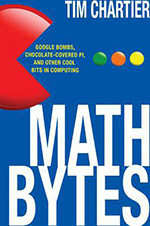 We know that mathematics (or, as the Americans would have it, math) underpins a large number of disciplines, but, perhaps, Computer Science is the one that depends upon it most. Hence, there ought to be a wealth of material for this book, which sits at the crossroads of these two subjects, as indicated by the punning title.
As might be expected, a large range of topics are covered. For example, the text begins with a discussion of approximate solutions to Fermat’s Last Theorem, including one that featured in an episode of The Simpsons. This linking of mathematical topics with popular culture is a recurring theme, which is used astutely to add further interest and relevance to the text.
Another recurring theme is the appearance of ‘challenges’, which are sprinkled throughout the work. The book’s recreational nature would not have sat well with the more traditional approach of including exercises at the end of each chapter (even if answers were provided in the back) so the introduction of the challenges is a well thought out device for maintaining the reader’s attention. For the most part the challenges are set at an appropriate level; there is one, however, that is little more than colouring by numbers, something that would probably be more appropriate for a primary school child rather than inclusion in a book like this one.
The collection of subjects that are covered is, by design, somewhat eclectic. It includes: how exponential growth of tweets (and retweets) can influence a movie’s opening weekend; Sierpinski’s triangle and other fractals; using gears and rubber bands to create a text font; the maths behind the Angry Birds game; and using chocolate (specifically M&Ms) to illustrate calculus. Not surprisingly, some of the topics, like Google’s PageRank algorithm, have been covered before. Others, however, are newly developed for this text; the creation of mazes from routes that solve the Travelling Salesman Problem (TSP) is an excellent, insightful and entertaining example here.
In the preface the author notes that the book is intended for broad audiences, which is a challenging feat to attempt. To a large degree the attempt can be considered a success – a reader with just the smallest amount of interest in either maths or computing will find something of interest here. However, striving for a broad audience inevitably leads to compromises for more specialist (and hence smaller) audiences.
From my perspective, I felt several times that the author had laid the groundwork for a good discussion of a theme but, rather than develop this, they hurried on to the next item. One case in point occurs when discussing the TSP. Reference is made to a prize contest organised by Proctor and Gamble in 1962, which asked for an optimal route through 33 cities. This could have been a useful springboard into the industrial utility of mathematics, or on to modern maths-related prizes like the Clay Mathematics Institute’s Millennium Problems. At comfortably less than 150 pages I feel that space could have been made for a number of discussions like this. A different editorial approach could also have freed up more space; it’s not clear to me, for example, that a photo of Google’s founders adds much to the book.
I don’t mean to sound too critical: there are already lots of interesting discussions within the text, including linking the Jiuzhang Suanshu (a Chinese manuscript dating from approximately 200 BC) to the development of matrix methods. And, overall, there is more good than bad here. I definitely learnt a few new things and was entertained as I did so. Furthermore, anything that spreads the message that mathematics is both interesting and useful has to be a good thing, so I wish this book every success.
Rob Ashmore CMath FIMA CSci
Software and Systems Dependability Team, Dstl
The views and opinions expressed herein are those of the author and do not necessarily reflect those of Dstl.
Book review published directly onto IMA website (December 2014)