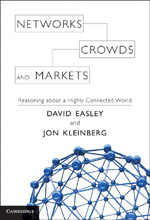
David Easley and Jon Kleinberg
CAMBRIDGE UNIVERSITY PRESS 2010, 744 PAGES
PRICE (HARDBACK) £30.00 ISBN 978-0-521-19533-1
 The growth of connectedness in modern society in recent years seems to have escalated at a spectacular rate. The rapid technological growth of the internet and global communications, as well as the spread of epidemics and financial crises, affects the whole world with surprising speed and intensity.
This book developed following a course the authors gave at Cornell University to introduce the topic to a broad student audience. It is intended to be used as an introductory undergraduate level text with no formal pre-requisites. The book is organised into seven parts. The first two parts look at graph theory and game theory and how network structure and people’s decisions can affect outcomes for others. Sections three and four develop these ideas and look at structures of markets and networks. Sections five and six study the dynamics of these fundamental processes, including ways people are influenced by the decisions of others. In the final section the social effects of this complexity are considered.
The book considers many interesting everyday issues which are covered by the authors engaging and informative style. For example, the problem of driving through a network of road junctions when the traffic is bad:
‘The delays experienced depend on the pattern of traffic congestion arising not just from the driver’s choice of route, but also from the choices made by all other drivers. The network plays the role of a shared resource, and the combined actions of its users can either congest this resource or use it more efficiently.
In fact, the interactions among people’s behavior can lead to counterintuitive effects; for example, adding resources to a transportation network can in fact create incentives that seriously undermine its efficiency, in a phenomenon known as Braess’s Paradox.’
Interesting social group effects are also covered in the way the behaviour of others conveys information.We have all made decisions on the quality of a restaurant on the basis of how crowded it is when we arrive, but this sort of reasoning raises many issues which are discussed in the book.
‘As people make decisions sequentially over time, the later decisions can be based in complex ways on a mixture of private information and inferences from what has already happened, so that the actions of a large set of people can in fact be based on surprisingly little genuine information. In an extreme form of this phenomenon we may get information cascades, where even rational individuals can choose to abandon their private information and follow a crowd.’
The book also covers the well-known small world phenomenon of ‘six degrees of separation’ and the idea that we are all connected by at most six people. This concept grew from work in the 1960s by Stanley Milgram and his colleagues. Their work is often misquoted and it is refreshing to read a more considered view.
Milgram is less often quoted on his worries about this theory ‘If we think of each person as the centre of their own social world, then six short steps becomes six worlds apart! That makes six a very large number.’
Steve Humble FIMA
NCETM
Mathematics Today October 2011
Networks, Crowds, and Markets – Reasoning about a Highly Connected World can be purchased at Amazon.co.uk