Paul J. Nahin
PRINCETON UNIVERSITY PRESS 2011, 400 PAGES
PRICE £20.95 (HARDBACK) ISBN 978-0-691-14425-2
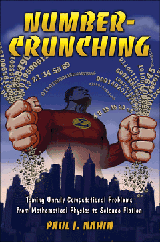 In 1841 Augustus De Morgan challenged his students to calculate the real root of a particular cubic equation to more than thirty decimal places – which they did! Richard Feynman once said, “For my money Fermat’s theorem is true” after having produced a probabilistic ‘proof’ of the theorem!
These are a couple of minor titbits that Paul Nahin, professor emeritus of electrical engineering at the University of New Hampshire, has included in this book. Basically, it is a continuation of his previous book, Mrs Perkin’s Electric Quilt; both of them inspired by the intimate connections between physics and mathematics. He highlights the important role played by computers in the modern study of these two subjects, where he sees computer science as providing a bridge between them.
He discusses several interesting problems, including oscillating masses, the three-body problem and various electrical circuit systems, for which he provides numerical solutions. However, this doesn’t mean he ignores all analytical features. Indeed, the book is full of equations describing analytical solutions, where they exist. Unlike many writers of popular mathematics books, Nahin is more than happy to spray the pages with equations! Since these are surrounded by lucid and informal explanations, they add significant value to the book, in my view.
Nevertheless, it is the numerical approach that takes prominence. Nahin produces his numerical solutions using MATLAB, and provides MATLAB code for his solutions. However, he mostly provides enough detailed explanation of what each part of his coding does, that it should be a straightforward matter for someone using a different tool, such as Maple or Mathcad, say, to reproduce the results.
Nahin includes a chapter on science fiction, in which, among other things he asks “What if Newton Had Owned a Calculator?” To answer this, he provides a short story he wrote thirty years ago called Newton’s Gift in which a time-traveller takes a calculator back to Sir Isaac! I won’t spoil the surprise by revealing the outcome here – read the book to find out!
Most of the chapters contain a section providing a number of challenge problems for the reader. Answers to these are provided at the end of the book. All chapters contain a section providing additional notes that would otherwise have interrupted the flow of the main body of the text.
There is one annoying drop-off in the book. Appendix A provides a MATLAB program that purports to reproduce figure 3.8.3 of the main text – a reproduction of the classic Fermi-Pasta-Ulam computer experiment showing energy transfer with time between various normal modes of vibration of a series of springs and masses. Unfortunately, Appendix A doesn’t work as it appears in the book because a routine called fput1 is missing. For those who might wish to run the program the missing routine is reproduced below, courtesy of Professor Nahin:
function dy = fput1(t, y)
N = 32; alpha = 0.25;
D(N +1) = y(2) – 2 * y(1) + alpha * ((y(2) – y(1))^2 – y(1)^2);D(1) = y(N +1);
D(2 * N) = y(N -1) – 2 * y(N) + alpha * (y(N)^2 – (y(N) – y(N -1))^2);D(N) = y(2 * N);
for I = 2:N-1
D(N +I) = y(I +1) + y(I -1) – 2 * y(I) + alpha * ((y(I +1) – y(I))^2 – (y(I) – y(I -1))^2);
D(I) = y(N +I);
end
dy = D’;
Whether or not you are the computing type, there is a lot to enjoy about this book.
Alan Stevens CMath FIMA
Mathematics Today June 2012
Number-Crunching: Taming Unruly Computational Problems from Mathematical Physics to Science Fiction can be purchased at Amazon.co.uk