, which is not a square.
 , which is not a square.
What is the smallest positive integer value of  such that
  is a square number?
Are there any larger possible values of  ?
?
To show that  has a unique solution in integers for
  .
.
Since  , with
  we have that
  and
and  are co-prime.
For 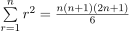 to be square the (co-prime) terms in the numerator must be square numbers multiplied by coefficients with product 6.
|
 |
|
Reason why not possible |
|---|---|---|---|
 |
 |
 |
|
 |
 |
|
 which can’t be square since congruent to 11(mod12). which can’t be square since congruent to 11(mod12). |
|
|
 |
is an odd number but is even. |
|
 |
 |
 which can’t be square since congruent to 3(mod4). which can’t be square since congruent to 3(mod4). |
|
 |
 |
is an odd number but is even. |
 |
|
|
 but this is not divisible by 3: but this is not divisible by 3: and and  . . |
|
|
|
 which can’t be square since congruent to 5(mod6). which can’t be square since congruent to 5(mod6). |
 |
|
|
is an odd number but is even. |
|
|
|
which can’t be square since congruent to 3(mod4). |
This leaves only  .
.
Since  then
then  and so
  and
and 
 and by the line above this is 1 or 2.
 . Note
  does not lead to a solution (since
  is not square) so the factors could be
 |
 |
Reason why not possible |
|---|---|---|
| 1 | |
 would not give an integer for would not give an integer for  . . |
| 2 | |
|
| 3 | |
 would not give an integer for . would not give an integer for . |
| 6 | |
 . This leads to . This leads to  and so and so  which does not have integer solutions. which does not have integer solutions. |
|
6 |  . Only possibility is . Only possibility is  but doesn’t lead to a solution. but doesn’t lead to a solution. |
This leaves only  . Substitute
  in
in  leads to
  . Then
  giving
  .
.
![\[\sum\limits_{r=1}^{24}{{{r}^{2}}}={{\left( 2\times 5\times 7 \right)}^{2}}={{70}^{2}}.\]](https://ima.org.uk/wp/wp-content/ql-cache/quicklatex.com-8b3f724c24135921dfe537f76c5eca3f_l3.svg "Rendered by QuickLaTeX.com")
For N>1 the next solution is N=24 (sum=4900 ie 70×70)
It is worth noting that N=1, N=24 are the only solutions. An extensive proof can be found by Prof. G.N. Watson in ”Messenger of Mathematics” 1918, Volume 48, Pages 1-22 (an electronic version can be seen at: http://archive.org/stream/messengerofmathe4849cambuoft#page/n9/mode/2up)