Fritz Gesztesy, Helge Holden, Johanna Michor, Gerald Teschl
CAMBRIDGE UNIVERSITY PRESS 2008, 438 PAGES
PRICE (HARDBACK) £85.00 ISBN 978-0-52-175308-1
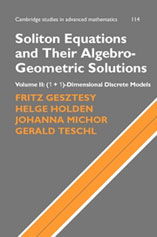 One definition of the soliton is “a pulselike nonlinear wave (solitary wave) which emerges from a collision with a similar pulse having unchanged shape and speed” [1]. More informally it is a “self-reinforcing solitary wave that maintains its shape while it travels at constant speed” [2]. The name is derived from ‘solitary wave solutions’. The phenomenon was first described by John Scott Russell who observed such a wave on a Scottish canal in 1834. Some types of tidal bore, a wave phenomenon seen on rivers including the Severn have been described as “a leading wave…followed by a train of solitons”. Solitons now appear in many other areas of physics: nerve impulse propagation; solid state physics; non-linear optics and communication through optical fibre networks [3].
The modern history of solitons begins in 1955, and this is the starting point for the book. In one of the early computer simulations Fermi, Pasta and Ulam analyzed numerically the behaviour of oscillations in certain nonlinear lattices. Surprisingly the system seemed to return periodically to its initial state. It was not until 1965 that the term soliton was coined by Zabusk and Kruskal for the pulselike solitary wave solutions of the Korteweg-de Vries equation. They discovered, in the context of heat conductivity in solids, that these solitons interacted elastically (p2).
Volume II is independent of volume I which was concerned with continuous models (in both space and time). This volume deals with non-linear differential-difference systems continuous in time and discrete in space. The (1+1) in the title refers to one space and one time dimension.
The scope of the book is clearly stated: “.. we aim for elementary, yet self-contained, and precise presentation of hierarchies of integrable soliton differential-difference equations and their algebra-geometric solutions” (p4). As the title suggests it is strictly concerned with the equations rather than their physical application. Three hierarchies (or chained systems of equations) are studied in this volume: the Toda lattice hierarchy, the Kac-van Moerbeke hierarchy, and the Ablowitz-Ladik hierarchy – these form the three main chapters. Each of these is considered in both the stationary and time-dependent contexts.
The material is presented clearly and in a very rigorous fashion with terms defined and results proved formally, but it is nonetheless readable. There is also a great deal of background material including several hundred references. At the end of each chapter there is a section of notes which gives some historical context and background.
Four appendices are given expanding on topics which are referred to elsewhere in the book such as Algebraic Curves and their Theta Functions, and Lagrange Interpolation. These are of value on following the main body of the text and helpful diagrams are used to explain Riemann surfaces. A list of symbols is included which usefully references the pages where they are used.
A section of errata and addendum for Volume I is given at the end. Although independent the two volumes follow a similar format. A website is available with updated errata and comments for both volumes.
Some relief from the formal mathematics is provided by a light-hearted quote at the start of each section from sources as diverse as Lennon/McCartney, St. Augustine and Sherlock Holmes!
This volume is aimed at graduate students and researchers. It requires strong expertise in mathematical analysis and difference/differential equations, but no specific knowledge of solitons. It would suit mathematicians interested in exploring soliton equations, but also those interested in the techniques of algebraic geometry in their own right.
REFERENCES:
1 Scott, A.C., Chu, F.Y.F. and McLaughlin, D.W. (1973) The soliton: A new concept in applied science, Proceedings of the IEEE, vol. 16, no. 10, pp. 1443 – 1483.
2 Wikipedia (2010). [online] Available from http://en.wikipedia.org/wiki/Soliton. [Accessed 23rd June 2010]
3 Girvan, R. (2005) SOLITONS Making waves – singly, Scientific Computing World, [online] Available from: http://www.scientific-computing.com/features/feature.php?feature_id=42. [Accessed 23rd June 2010]
Francis McGonigal CMath MIMA
Birmingham City University
Mathematics Today June 2011
Soliton Equations and Their Algebro-Geometric Solutions (Volume II: (1 + 1) – Dimensional Discrete Models) can be purchased at Amazon.co.uk