Mircea Pitici (Ed)
PRINCETON UNIVERSITY PRESS 2016, 392 pages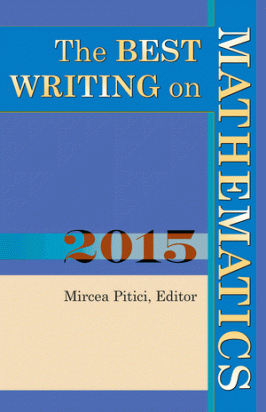
PRICE (PAPERBACK) £19.95 ISBN 978-0-691-16965-1
This volume in the annual series continues the trend of getting progressively thicker, and thus contains an even greater range of mathematical writing than in previous years. As in earlier volumes, certain themes emerge from the collection without being signposted explicitly.
Mathematical puzzles and games feature strongly in this year’s volume, with, for example, articles by Arthur Benjamin and Ethan Brown on magic squares, by Toby Walsh on Candy Crush, and by Lisa Rougetet on Nim; Marianne Freiberger uses billiards to introduce interesting mathematical ideas, whilst Erik R. Tou employs juggling in a similar manner. In connection with puzzles, we also find an appreciation of Martin Gardner by Colm Mulcahy and Dana Richards, as well as Pradeep Mutalik’s ‘How Puzzles Made Us Human’ on the buzz that we get from solving problems – mathematical and otherwise.
Geometry, broadly construed, is another theme of the book: for instance, Eli Maor and Eugen Jost discuss the properties of the logarithmic spiral, amongst other constructions, whilst Burkard Polster considers non-circular shapes of constant width. Also on a geometric theme, a further article provides a new look at perspective in the work of Albrecht Durer.
A couple of articles contain musings on the processes of mathematical thought, with some consideration given also to aesthetics in mathematics: for example, Carlo Cellucci asks the question of what constitutes beauty in mathematics. In relation to this, we also find articles on the nature of mathematical proof: John Conway and Alex Ryba discuss the merits of different proofs of a particular geometric problem, whilst Gila Hanna and John Mason consider the pedagogical uses of alternative proofs.
Other topics touched upon in the volume are randomness, probability, and statistics (as in previous volumes), not to mention synthetic biology, educational reform in the USA, and the origins of the pigeonhole principle.
A highlight for me was the fascinating article by Michael Barany and Donald MacKenzie, which provides insights into the role played by blackboards in the development of mathematics – they argue that blackboards are more than just a means of communication, and have shaped mathematical thought in a subtle manner. Another favourite was Mark Balaguer’s ‘A Guide for the Perplexed: What Mathematicians Need to Know to Understand Philosophers of Mathematics’ – an easily digestible introduction to the philosophy of mathematics.
As in the previous compilations, the level of mathematics varies across the articles, but remains mostly accessible to the reader with a basic mathematical competence. Once again, many mathematical tastes are catered for here, so the casual reader should not only find something that interests them, but might also develop new interests along the way.
Christopher Hollings MIMA
Book review published in Mathematics Today August 2017