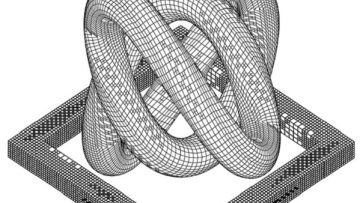
Welcome to this bumper issue of Mathematics Today! We are in the fortunate position of having many features awaiting publication, so we are postponing our planned special issue on medicine and biology until next year in order to catch up on this surplus. As a result, we now present a miscellaneous selection of articles to entertain you, perhaps while relaxing in a deckchair on a sunny afternoon. The topics covered include optical fractals, acoustic patterns, communications optimisation, space filling, partial transformations, wind turbines and Professor Leslie Fox, who was born in 1918 and founded Oxford University’s Computing Laboratory.
At the time of writing, the weather is beautiful, my wife and I have acquired another cute puppy, Beatrice, and I am recovering from a delightful walk over Blencathra in the Lake District with my niece, who is preparing to tackle Mount Kilimanjaro. The only flies in the ointment took the form of a swarm of midges that unusually enveloped the Cumbrian fell’s spectacular summit, doubtless attracted by the perspiration and sandwiches of its visitors. Despite considerable delays on rail and road, I also attended an excellent IMA conference in Manchester, which enabled me to meet up again with friends and colleagues.
During a trip to Cambridge earlier this year, I was enthralled by some of the magnificent historical architecture that the city has to offer, which includes 67 Grade I and 47 Grade II* listed buildings. The oldest of these is St Bene’t’s Church, whose tower dates back a thousand years. There is also some commendable modern architecture, such as the buildings that comprise the University’s Centre for Mathematical Sciences, where the IMA will co-host an induction course for new lecturers in the mathematical sciences this September. What particularly caught my eye though is one of the many Grade II listed buildings, a simple wooden footbridge over the River Cam at Queens’ College; see below.
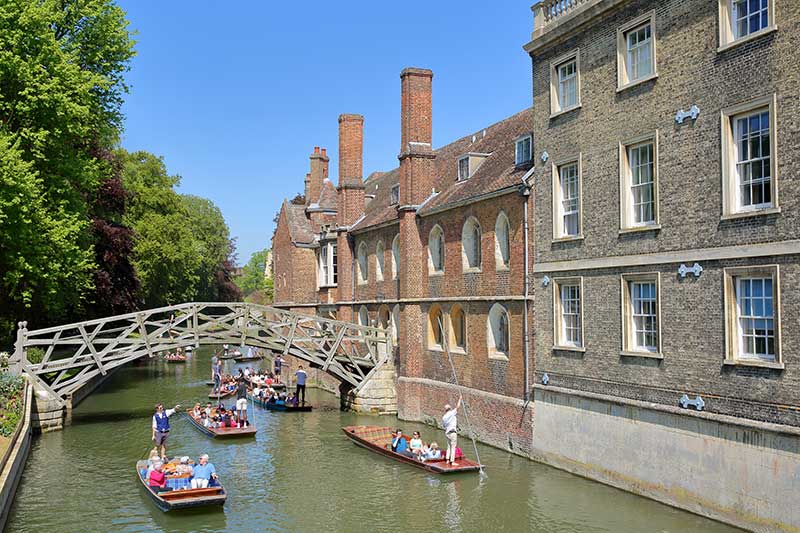 This reconstruction of an original built in 1749 is popularly known as the Mathematical Bridge. It skilfully creates the impression of a curved arch using seven straight timbers that are arranged tangentially to a circle of radius 32 feet, at consecutive angles of 11.25 degrees (1/32 revolution). Eight radial trusses connected by suitable handrails then triangulate the construction to render it rigid and self-supporting. Interestingly, the tangential timbers experience forces of compression while the radial timbers experience forces of tension. A similar method was used to build the arches of London’s original Westminster Bridge between 1739 and 1750, so allowing ships to pass underneath during construction.
These patterns reminded me of arts classes as a child, when I was challenged to mark a circle on a wooden plaque and hammer  equally spaced nails around the circumference. Selecting a power of two enabled the use of rulers without protractors to bisect angles at each stage. We then had to wind a continuous piece of golden cord around the nails to construct a regular polygon. The rotational symmetry of this geometric figure ensures that an excellent approximation to an inscribed, concentric circle is thus induced by tangential line segments, just as for the Mathematical Bridge. My original craftwork still lingers in a wardrobe at my parents’ house, though the schematic diagram in Figure 1, created using GeoGebra, displays the pattern more clearly – annular chess anybody?
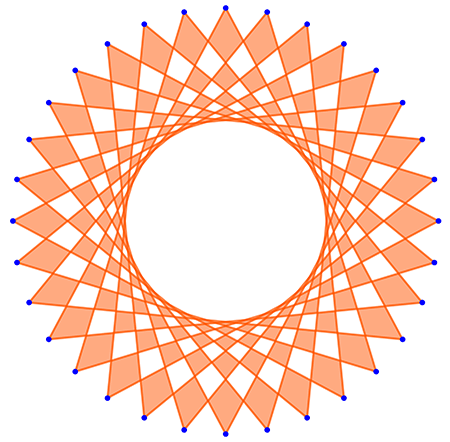
The relative diameter of this tangentially induced circle depends on the number  of vertices and the interval
  between each pair of connected vertices. Inspection of Figure 1 shows that
  and
and  for my effort. If and only if and are relatively prime, as they are here, then a single piece of cord and a single knot are sufficient (a Hamiltonian cycle). Otherwise, we require
  pieces of cord and knots, where is the greatest common divisor of and . This follows as
  and
and  are relatively prime so require one knotted cord. Rotating the figure thus generated successively by an angle of
  degrees to create a total of copies then produces the complete pattern. This continuity property is unimportant for bridge design, as timber is inflexible and requires separate line segments.
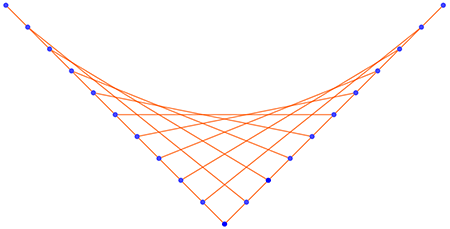
An easier, more impressive curve to construct with lines is a parabola, as illustrated in Figure 2. This quadratic envelope is created by connecting lines of the form
![\[p x + ( 1 - p ) y = p ( 1 - p )\]](https://ima.org.uk/wp/wp-content/ql-cache/quicklatex.com-2c347d292eaed3f4e1e1065ae5071740_l3.svg "Rendered by QuickLaTeX.com")
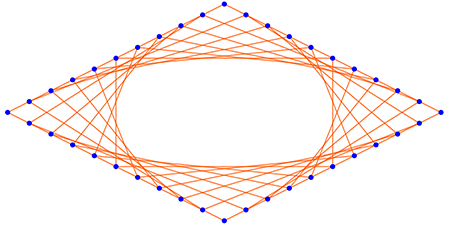
for ![p \in [ 0,1 ]](https://ima.org.uk/wp/wp-content/ql-cache/quicklatex.com-e70028c6e080df3c5b363d20d5af0c47_l3.svg "Rendered by QuickLaTeX.com") and arises because the derivative of a quadratic function is a linear function. String art of this nature has long been a popular pastime and generates an infinite variety of interesting shapes, such as the diamond in Figure 3. Even an old bicycle wheel rim provides an excellent experimental frame for connecting holes at varying intervals to create new patterns.
and arises because the derivative of a quadratic function is a linear function. String art of this nature has long been a popular pastime and generates an infinite variety of interesting shapes, such as the diamond in Figure 3. Even an old bicycle wheel rim provides an excellent experimental frame for connecting holes at varying intervals to create new patterns.
However, these techniques also have widespread applications in computer graphics and in computer-aided design and manufacturing. Indeed, Microsoft uses these ideas to generate its TrueType fonts and smooth curves in charts. Bézier was a French engineer who worked for Renault and used these curves to design car bodies. His techniques made use of an algorithm developed by compatriot De Casteljau, who worked for rival car manufacturer Citroën. This algorithm enabled efficient evaluation of the Bernstein polynomials, which appeared in 1912 and can be defined in terms of the binomial coefficient  as
as
![\[B _ { i , n } ( p ) = C ( n , i ) p ^ { i } ( 1 - p ) ^ { n - i }\]](https://ima.org.uk/wp/wp-content/ql-cache/quicklatex.com-54a575f9c8d3d00987895f9bb892c8de_l3.svg "Rendered by QuickLaTeX.com")
for and  .
.
I was pleased to read that several IMA Fellows received prestigious honours this year, including Professor Peter Giblin (University of Liverpool), who was awarded an OBE for services to mathematics in the Queen’s Birthday Honours List (see page 125). Professor Sir John Ball (University of Oxford, IMU Past President) received the King Faisal International Prize for Science, Professor Simon Tavaré (University of Cambridge, LMS Past President) was elected as a Foreign Associate of the National Academy of Sciences, and Professor Nicholas Higham (University of Manchester, SIAM President) was awarded a Royal Society Research Professorship. I am sure that you will join me in congratulating these exceptional mathematicians for their notable achievements.
Congratulations are also due to the five new Council Members who were elected at the IMA’s AGM on 27 June (see page 133). Looking ahead, a second joint meeting between the IMA and LMS will take place on 11 September in London, to celebrate 100 years since German mathematician Emmy Noether published her first theorem about conservation laws. The speakers at this event include one of our vice presidents, Professor Elizabeth Mansfield (University of Kent). Incidentally, she and one of our honorary secretaries, Michael Grove (University of Birmingham), joined other IMA fellows as invited speakers at the 2018 Conference for Heads of Departments of Mathematical Sciences.
Several IMA fellows have been appointed to the Research Excellence Framework 2021 Mathematical Sciences sub-panel, including its Chair, Professor Alison Etheridge (University of Oxford). From September, Professor Sir Ian Diamond (University of Aberdeen) begins a term of office as Chair of the Council for the Mathematical Sciences, which comprises the IMA, LMS, RSS, EMS and ORS. He succeeds Professor Sir Adrian Smith (University of London), who takes over as Director of the Alan Turing Institute this autumn. Another IMA success on the horizon is a fifth phase of Mathematics Matters case studies that is currently well underway. These brief research reports describe important, topical applications of mathematics. Previous phases have proven to be very popular and highly influential.
Finally, the Mathematics Today Editorial Board is sincerely grateful to the IMA’s outgoing Assistant Director, Dr John Meeson, for his constant support and varied contributions. We welcome his successor, Alan Peacock, and look forward to working with him in future.
David F. Percy CMath CSci FIMA
University of Salford
Reproduced from Mathematics Today, August 2018
Download the article, Editorial, August 2018 (pdf)