Mathématiques sans Frontiéres is an annual international mathematics competition for schoolchildren, centrally run by the Académie de Strasbourg since 1989. The interclass competition involves a number of mathematical puzzles from a variety of scientific disciplines where one of the puzzles is posed, and must be answered, in a foreign language. The competition was originally devised to open borders between France and her neighbouring countries, between mathematics and modern languages, and between students of all abilities within the same classroom. It promotes an interest in mathematics, teamwork, full class participation, problem solving, and the practice of a foreign language.
Each class may tackle the time-constrained questions as they see fit, either approaching each question as an entire class, individually attempting each question, or splitting the questions between small working groups. The range of type and difficulty of the questions suggests that the latter approach often provides the best vehicle for success, which was recently highlighted by a participating pupil in Scotland [1].
Competing teams are sent a training test in December, with the competition questions arriving in the Spring. The entries are marked (locally) by a team of volunteers. Schools often make use of their Modern Languages departments and last year Cumbernauld Academy used the competition as a great excuse to try to a wide variety of European foods [2]!
The number of countries which participate varies each year, and the number of schools which participate within each country also varies. This year’s competition consisted of 10 questions (for junior entries) or 13 questions (for senior entries). It welcomed 42 entries from 28 different schools across Scotland (with England, Wales and Northern Ireland not competing). The top-performing Scottish entries were announced at an awards ceremony at Heriot-Watt University, where representatives were treated to an interactive lecture on actuarial science from Gavin Reid (Heriot-Watt), alongside their prizes of branded pens, certificates, and chocolates.
As mentioned, one of the questions is posed, and must be answered, in a foreign language. Participants from the UK are given the choice of using French, Italian, German, or Spanish. This year, the French translation of the modern language question was the most popular choice of the Scottish entries:
Aline, Hélène, Zoé, Pierre et Jules veulent traverser une rivière au plus vite. Ils disposent d’une barque ne pouvant contenir que trois personnes au maximum. Aline et Pierre sont des rameurs expérimentés. Seuls ou à deux, ils peuvent traverser en deux minutes. Malheureusement, les trois autres amis sont tellement maladroits que dès que l’un d’entre eux se trouve à bord, la traversee dure huit minutes. Combien de temps faudra-t-il au minimum pour que les cinq amis se retrouvent de l’autre côté de la rivière? Expliquer.
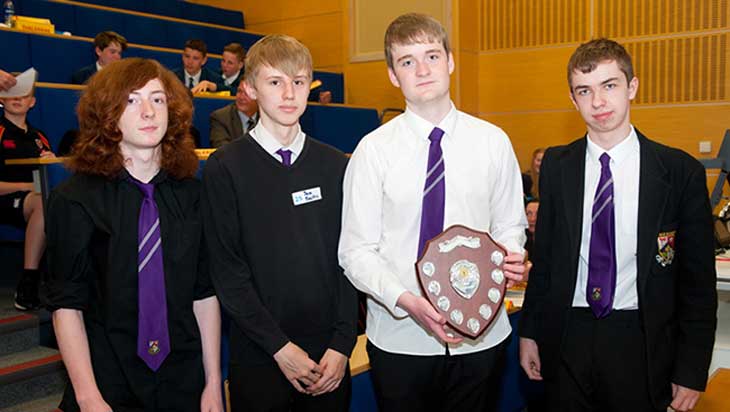
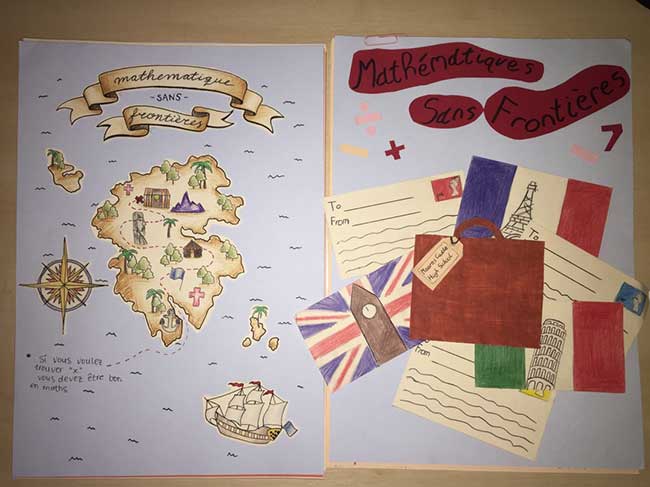
Last year’s Scottish winners Mearns Castle High School [3] were held off by a fantastically strong set of entries this year. Nevertheless, they perhaps deserved a prize just for their artwork (see Figure 1). There was a new Top 3 entry from Girvan Academy (winners of last year’s inaugural Maths wi nae Borders competition – see @MathsWNBorders). However, the outright winner of this year’s competition was Kilmarnock’s Grange Academy senior entry, who are now are immortalised with an entry on the Mathématiques sans Frontiéres trophy (see Figure 2). They will also be awarded with a school visit from popular science communicator Dr Emily Grossman (https://www.emilygrossman.co.uk/).
If you are interested in finding out more about Mathematiques sans Frontieres or wish to enter the 2019 competition, please contact Dr Alan Walker (alan.walker@uws.ac.uk) or see us on Twitter @MSF_Scotland.
Alan J. Walker CMath MIMA
University of the West of Scotland
References
- Eaglesham, E. (2017) Mathematical competitions: a pupil’s perspective, The Scottish Mathematical Council Journal, vol. 47, pp. 14-15.
- Byers, S. (2017) Mathématiques sans Frontiéres at Cumbernauld Academy, https://tinyurl.com/Byers2017 (accessed 21 June 2018).
- Smith, C. (2018) Mathématiques sans Frontiéres Report 2017, The Scottish Mathematical Council Journal, vol. 47, p. 39.
Reproduced from Mathematics Today, August 2018
Download the article, Grange Academy Win Maths Prize (pdf)
images from author