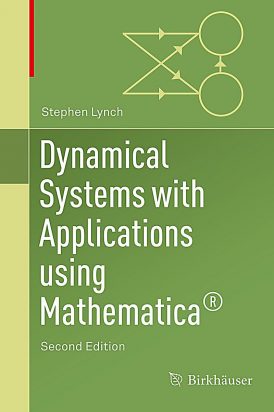
 Stephen Lynch
Birkhaüser 2017, 585 pages
PRICE (HARDBACK) £63.99 ISBN 978-3-319-61484-7
Lynch’s book provides a thorough and very readable introduction to dynamical systems. It addresses all the topics that one would expect, including both continuous-time and discrete-time models and at a level appropriate for experienced undergraduates and early postgraduates. Relatively little prerequisite knowledge is assumed (mainly standard linear algebra, real and complex analysis, calculus, and ordinary differential equations), and while some previous programming experience might be helpful it is certainly not essential. Additional material in this second edition includes chapters on delay differential equations, binary oscillator computing, and simulations using Wolfram SystemModelerTM.
The journey begins with an introduction to Mathematica (this edition is appropriate for version 11.2) which provides tutorials covering some of the fundamental commands and syntax, control structures, plotting, and culminating with hints for programming. A number of quite general elementary exercises provides initial experience and builds confidence, and new users are encouraged to refer to the rather extensive online help and documentation provided by Wolfram. This is not primarily a book about Mathematica, but it well illustrates the advantage of using that very powerful software package for attacking dynamical systems and visualising their solutions.
With these preliminaries dispatched, the subject is gradually developed in a logical and systematic way through 21 following chapters. Each of these chapters comprise an ‘Aims and Objectives’ preamble, the main text, and a set of well thought-out exercises at the end. They are often also punctuated by various programmes (deliberately kept as simple as possible) to develop problem-solving techniques in Mathematica.
Starting out with differential equations and phase-plane methods, the mathematical narrative is complemented at each step by showing how solutions may be graphed and manipulated on computer (perhaps the most instructive approach for students reading dynamical systems for the first time). Considerable attention has been paid to the production of the figures, which are clear and often generated using programmes supplied within the main text. Most of the material considers applied problems, for instance predator-prey models in Chapter 4 or classic non-linear oscillator equations in Chapter 5. Subsequent topics include Hamiltonian systems, stability, bifurcation theory, and an introduction to chaos.
Later chapters move onto discrete dynamics, with consideration of various maps (logistic, Hénon, Gaussian, etc.) providing a segue way to iterative processes such as Julia sets, the Mandelbrot set, and fractals more generally (Cantor sets, von Koch shapes, etc., and with a new section on Newton-Raphson fractals). There is a chapter on the chaotic dynamics that can take over optical systems (e.g., ring/Fabry-Pérot cavities and fibre resonators), which lends the book additional context for how nonlinear phenomena underpin many modern technological developments. Other ‘real-world’ applications include image processing with Mathematica (new to the second edition) and neural networks.
With subject matter such as dynamical systems, it would be very easy to get lost inside all the corresponding mathematical details, in-depth proofs and the like. Instead, at each stage, Lynch focuses exclusively on the key ideas that are necessary for grasping the physical phenomena at hand with definitions and theorems presented in a concise but still understandable way. This sort of practical approach to learning not only keeps the book to a reasonable size, but it also makes for a more enjoyable reading experience all-round. Those more interested in the mathematical minutiae need not fret; each chapter contains quite an extensive list of important references (including a selection of books and research papers) for further enlightenment.
At the end of the book, there are two particularly helpful chapters. The first comprises a small repository of extended problems that might be used for coursework or examination-type questions involving Mathematica computations, while the second provides answers to all the exercises appearing throughout preceding chapters. The former is a thoughtful touch, providing instructors with some carefully-crafted examples that have been tried-and-tested as real assessments over the past two decades.
To conclude, Dynamical Systems with Applications Using Mathematica (second edition) is a well-written tome that one can expect to have wide appeal, not just to students of applied mathematics but also to those from disciplines such as physics and engineering. For instructors, it provides a myriad of worked examples and gives what is, in my view, a blueprint for the successful teaching of nonlinear dynamics.
J.M. Christian CMath MIMA
Book review first published in Mathematics Today August 2018