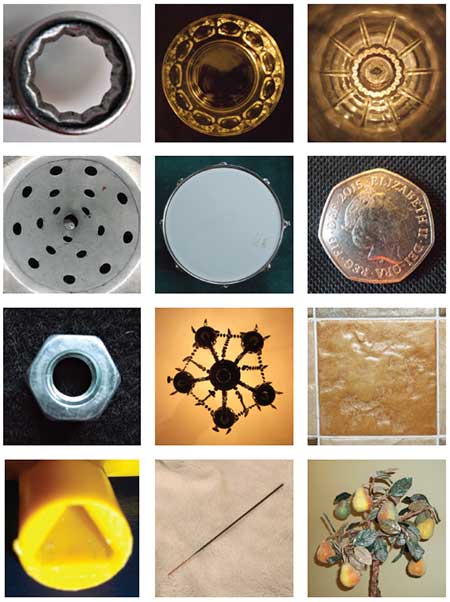
On the twelfth day of Christmas, my true love sent to me: 12 dodecagons, 11 hendecagons, 10 decagons …. Although there are better gifts to receive, my challenge was to find examples of the first twelve regular polygons at home. This is trickier than you might imagine – can you identify the objects in Figure 1? Admittedly, most of the polygons are implicit and the ‘monogon in a pear tree’ is merely a degenerate point on a tacky decoration. I soon gave up on the original plan for an Advent calendar and knew in advance that seeking regular polyhedra with one to twelve faces would be futile!
The octagon shown here is formed by the tension rods of a side drum that I formerly played in a marching band. We practised our marches, solos and tattoos regularly, though I enjoyed the challenges of playing paradiddles. These exercises involve basic patterns of drum strokes, such as rapid, even repetitions of the combinations left-right-left-left and right-left-right-right. Although aware of other variants, I was astonished to discover recently that the Percussive Arts Society lists 40 international drum rudiments. Figure 2 displays the musical notations for such fiendish delights as the single paradiddle, pataflafla, single flammed mill, single drag tap and single ratamacue, respectively. Doubles, triples and other combinations exist for when you have mastered these!
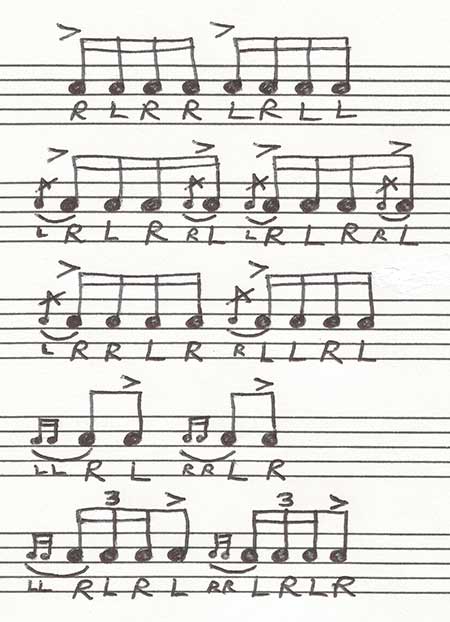
Apart from the obvious choice of which hand to use, drum beats can also be played softly or loudly, quickly or slowly, in continua between these extremes, with grace notes or rolls, regularly or in triplets, and with accents or syncopation. Perhaps the real surprise is that there are not many more drum rudiments. Classifying the lot and suggesting new possibilities must surely be worthy of an undergraduate mathematics project!
Drum beats can also be played with or without a snare, on the skin, rim or sticks, using various tips, tapers and thicknesses, and with different materials including wood, brushes and hands, so it is amazing what variety exists for such a simple, unpitched percussion instrument. As for analysing the pitch, Sir Frederick Crawford wrote a fascinating article [1] on shaping the sound of a drum. If you are interested in investigating the extra dimensions of melody and harmony, I refer you to Malcolm Savage’s excellent paper [2].
The head of a drum is formed by a membrane that is typically stretched across a circular rim and tensioned by rods. My attention was drawn to a similar structure in a completely different context this summer. A friend spotted a YouTube video clip of an aqua lens that has some intriguing properties (https://www.youtube.com/watch?v=eeSyHgO5fmQ – contains flashing images) . The presenter constructed a wooden frame of four posts with connecting beams in the shape of a square, across which a clear plastic sheet was stretched. Water was poured onto this flexible membrane, which bowed under the weight. The lens then concentrated the sunlight on a focal point centrally below the sheet, thereby eventually igniting a plank of wood!
This experiment leads to interesting questions about the shape of the membrane. Firstly, the horizontal cross-sections are circles, as outward pressure of the water is the same in all directions. These circular profiles hold for any supporting frame if the membrane is sufficiently flexible. Secondly, the shape of the water-supporting sheet itself is less obvious. A spherical cap would develop in the absence of gravity, for the same reason as above, though gravity is present here and causes more bulging in the centre of the wetted sheet than at the edges.
We know that the functional form of a cable fixed at its ends is a catenary, because of tension caused by gravity, and that the functional form of a cable between two columns of a suspension bridge is a parabola, because of the additional tension caused by the weight of the suspended platform. Our situation is analogous because of the weight of the water, so the vertical cross-section through the centre of the sheet might be parabolic, though the three-dimensional nature of the aqua lens casts some doubt on this.
Arches are vertical reflections of cables and arch bridges are vertical reflections of suspension bridges, so stable shapes for these constructions are catenaries and parabolas respectively. Thus, the shape of a membrane without water (such as a drum skin) might be the same as that of a stable dome, which is likely to be a catenoid formed by the surface of revolution for a catenary. Similarly, the shape of a membrane supporting water might be that of an ideal underground dome, though who knows what that is?
If we could determine this elusive shape, we could then calculate the focal length and so the height of the supporting frame required to focus the sun at the height suitable for starting a barbecue or boiling a kettle. The lensmaker’s equation for focal length assumes spherical surfaces and perhaps that is sufficient for most practical applications.
If the idea were to reflect the sun’s rays, then an elliptic paraboloid would be the ideal shape for a lens, as this is the surface of revolution for a parabola. It is also the shape adopted by rotating liquids and antenna dishes. However, we are refracting the light and a parabola is no longer optimal (an initial search suggests that the best lens is biconvex and formed by an ellipse and a hyperbola). Moreover, there is no reason why this sheet should adopt the shape of an optimal lens. Experts on calculus of variations for surfaces doubtless know the shape of a wetted membrane, so please write in to resolve my confusion!
The IMA supports the findings of the Bond Review on Knowledge Exchange in the Mathematical Sciences, which was published earlier this year. In order to investigate the suggestions and opportunities that the report proposes, Aston University will host a new IMA conference with this theme in early December. The conference co-chairs are Alan Champneys (University of Bristol) and Richard Pinch (incoming VP Professional Affairs), and the programme includes talks by Philip Bond (lead author of the review), Nira Chamberlain (outgoing VP Professional Affairs), Dietmar Homberg (Past Chair of ECMI), Hilary Ockendon (University of Oxford) and Heather Tewkesbury (Smith Institute).
The 3rd IMA Conference on the Mathematical Challenges of Big Data will also take place in December, at a venue in central London. Although the rules of grammar suggest that big data are objects such as
23.5, 68.1, 79.4
the Oxford English Dictionary officially recognises this expression as a mass noun that refers to ‘extremely large data sets’, so let’s go with the flow, albeit reluctantly. Big data plays an increasingly important role in all our lives, as technology is ever more able to quantify the world around us. Consequently, the first two conferences in 2014 and 2016 were very well attended. Some excellent speakers have again been invited thanks to a prestigious programme committee, so we hope that this year’s event proves to be equally successful.
With great regret and much sadness, I must inform you that former IMA President Professor Michael Walker OBE died recently. He was a wise, kind person who did much to support the IMA and he will be sorely missed. An obituary appears on page 224.
Finally, the President of the European Mathematical Society, Pavel Exner, is encouraging mathematicians to apply for research grants from the European Research Council. Maths applications have declined over recent years, with the adverse effect that less funding will be available for our subject in future. Although only about one in eight applications is successful, do consider this source if you need financial support for a major project. The UK hasn’t left the EU yet! Season’s greetings and best wishes for a happy new year.
David F. Percy CMath CSci FIMA
University of Salford
References
- Crawford, F. (2016) Can one shape the sound of a drum? Mathematics Today, vol. 52, pp. 280–284.
- Savage, M. (2014) Beautiful music: an amazing mathematical fluke? Mathematics Today, vol. 50, pp. 88–90.
Reproduced from Mathematics Today, December 2018
Download the article, Editorial, December 2018 (pdf)