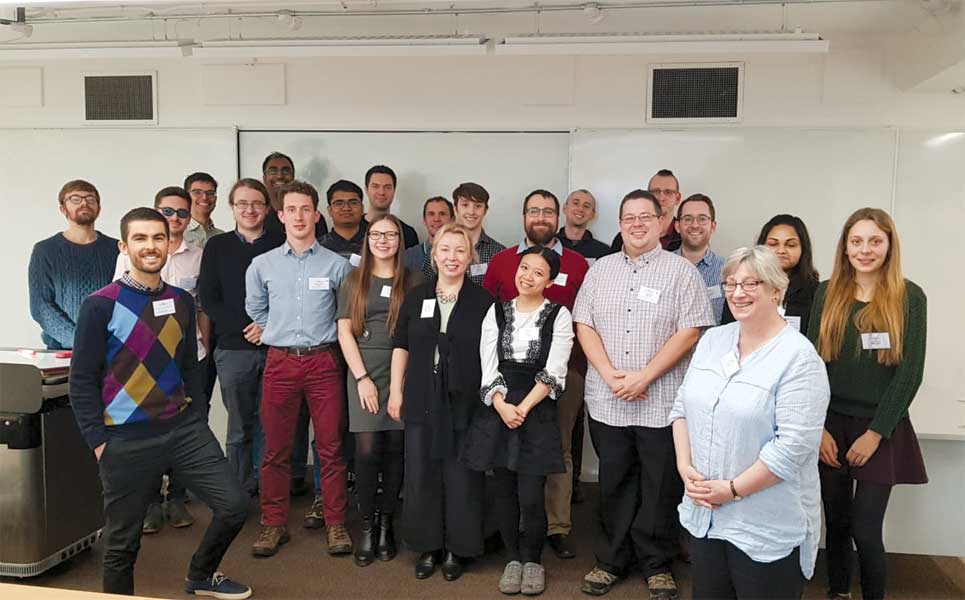
After the Spring 2018 conference in Durham having been hit by the notorious Beast from the East, it was reassuring to see so many Students, Associates and other members of the Early Career Mathematicians’ community gathered in University College London at the start of November. My personal thanks goes out to all the speakers and volunteers who gathered to put on the full day of talks.
Our first speaker was Sean Jamshidi from the UCL Chalkdust magazine (chalkdustmagazine.com). Sean outlined how the magazine was formed, how they provide articles and puzzles as well as the intended audience. This talk complemented smaller discussions on the ‘Outreach’ group, and various ways of providing children and young adults with a variety of routes into mathematical learning. With the advances in social media, there are far more avenues to reach a wider audience if one has the time and inclination. This comes in particularly handy when planning practical maths demonstrations and pooling teaching resources.
The second speaker on the day was Professor Christina Pagel, who provided a talk on her work assisting NHS vaccination surveys and providing a series of metrics to compare and contrast paediatric heart surgery statistics. These methods are used to audit NHS hospitals on a regular basis. As a side piece of analysis, Christina also detailed a piece of Brexit analysis recently published on www.politics.co.uk, which is well worth a look. It is difficult to obtain objective evidence of Brexit opinion; however, Christina’s research puts forward the argument that there are no clear cut ‘Leavers v Remainers’ groups. Instead, there are many factors being prioritised by as many as eight different sub-groups. All of these sub-groups need to have clear direction in a successful Brexit strategy in order to reassure the UK voting population that their priorities are being taken seriously. Throughout her talk, Christina emphasised that any mathematical results and surveys that are used to make policy decisions need a high level of early buy-in so that results are not misinterpreted by people with a biased agenda.
Our third speaker was Professor Reidun Twarock (IMA Gold Medal winner 2018), who provided an explanation of the process of virus replication and an overview of the symmetries and mathematics involved in viral development. A major area of mathematical research is in trying to develop routes to prevent virus protein casings from folding up along these mathematical symmetries, thereby preventing the virus from forming and destroying the viral infection. As also mentioned in Professor Pagel’s talk, the field of mathematical biology is expanding at a very fast rate compared to that of 30 years ago, and this is having a knock-on effect in areas such as immunology and virology, which have areas that are becoming a lot more quantitative in nature.
Lastly, separated by a brief ‘Unconference’ session covering topics such as mentoring, PhD applications and industry-based careers, we were lucky to have both Jalpesh Sachania and Kristian Kiradjiev in to discuss mathematics in Electronic Arts (gaming) and the Oxford Industrially Focussed Mathematical Modelling (InFoMM) Centre respectively.
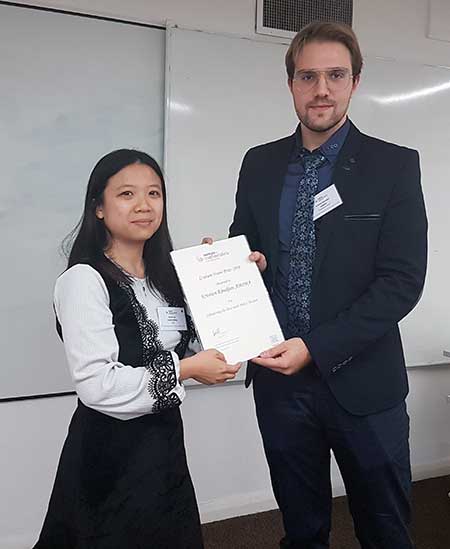
Jalpesh provided a talk around how to build, control and manipulate physics within computer games in order that avatars look realistic, water flows as it should and balls seem to bounce realistically. Kristian (who is our Graham Hoare prize winner – see page 256 for his prize-winning article) provided a talk on Pick’s theorem to find the area of a latticed 2D object before going into some of the links between the work of the InFoMM and wider industrial partners.
In both of these talks it was clear that a substantial amount of the work of a professional mathematician is not the stereotypical proof-making. It is instead a more active role looking at communicating complex ideas in a way that industry and nonmathematicians can both understand.
In conclusion, my thanks to the speakers and volunteers, and hopefully we can have such a large turn-out for the Spring 2019 conference. The Early Career Mathematicians can be reached through email (ecm@ima.org.uk), or the IMA Facebook page, where links to the topics above may be found. To the wider membership, if you wish to comment or elaborate on some of the topics above (or others), please start that debate and let’s keep the conversation going!
Greg Taylor AMIMA
ECM Promotion Leader
Reproduced from Mathematics Today, December 2018
Download the article, ECM Autumn Conference (pdf)