The 1st IMA Conference on Knowledge Exchange was held on 3-4 December 2018 at Aston Conference Centre. The meeting, which I co-chaired with Dr Richard Pinch, incoming IMA VP for Professional Affairs, took place against the backdrop of the Bond Review on Knowledge Exchange (KE) in the Mathematical Sciences.
The first day was given over to five plenary speakers and nine contributed talks from practitioners in knowledge exchange within the mathematical sciences.
The morning opened with a talk from Professor Dietmar Homberg from the Weierstrass Institute, who gave an international perspective on his research in optimisation, Industry4.0 and the role of the European Consortium for Mathematics with Industry (ECMI). His key message was that rather than KE, we should focus on co-creation of knowledge with industry. The Era of Mathematics (the subtitle of the Bond Review) is not necessarily the era of mathematicians, and we need to engage with those from other disciplines, for example engineers.
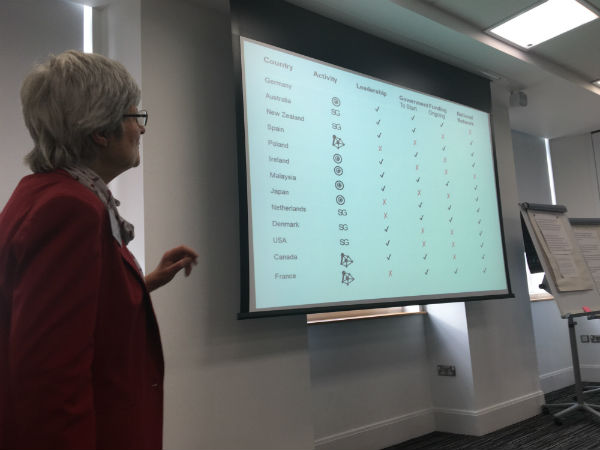
Dr Hilary Ockendon (University of Oxford) spoke about industrial mathematics around the world, and looked at the four properties of those countries that had been successful: having clear leadership; initial government funding and ongoing support; and a national network, rather than a single institution. She strongly supported the recommendation in the Bond Review that there should be a National Centre for Impactful Mathematics, which she suggested should be named after Sir James Lighthill, the first IMA President.
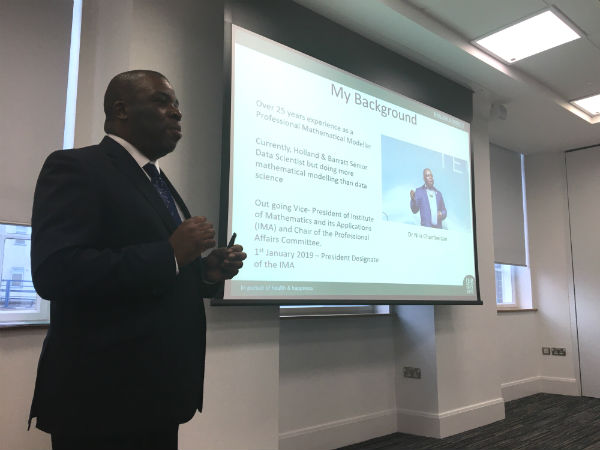
In the afternoon, Dr Nira Chamberlain, outgoing IMA VP for Professional Affairs and President Designate, gave an entertaining personal history of his role as a mathematician within industry. He advised those seeking to collaborate with industry to recognise, not undermine, the in-house professional mathematicians.
The next plenary was from Dr Vera Hazelwood who asked the question: what is KE? She drew on examples from 14 years working for the Smith Institute and her recent role for ResearchFish. She talked about the stages required to get mathematical insights into public policy, and that sometimes simple ‘plug and play’ models can make more impact that complex models and raw data.
The keynote talk was given by Professor Philip Bond himself who compared international experience in the US that had identified the five disciplines of innovation: starting with the identification of need, through creation of value, identification of a champion and a team, and finally alignment within the organisation in question. He then reflected on the review he chaired in terms of these requirements to innovate and the need for mathematics to contribute to improving UK productivity through optimisation. The recommendations of the review could be summarised in terms of three challenges: the need for new infrastructure, for new incentives and for greater engagement of government through the research councils.
Other notable contributions included Professor Paul Harper (Cardiff University) on behalf of the Operational Research Society (ORS). He highlighted the sheer volume of KE that happens routinely in OR through taught masters and research programmes around the country. He stressed the need for more connections to be made with the other mathematical sciences.
Professor Tony Mulholland (University of Strathclyde) spoke of his own journey into industrial collaboration through inverse problems and the structures in place in his university.
Professor Chris Budd (University of Bath) spoke on his personal experience in communicating mathematics, highlighting the numerous ways to get involved.
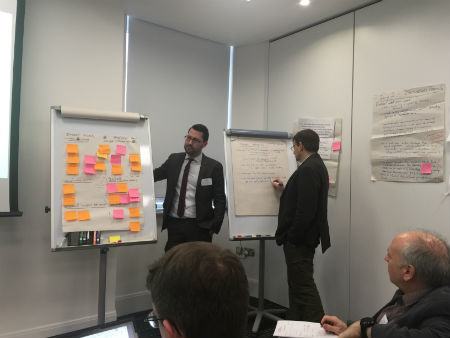
Day 2 was given over to facilitated discussion in three separate breakout groups. This was interspersed with three short presentations, including from Matt Butchers who leads Industrial Mathematics within the KTN. Among other things, he covered the Industrial Strategy Challenge Fund, which promises £2bn a year until 2020. He talked of a workshop that is at the planning stage at the International Centre for Mathematical Sciences (ICMS) in Edinburgh, which aims to help energise the mathematics community to respond more positively to the opportunities within this fund. The three breakout groups each considered two questions. First, what does good look like, and second what SMART objectives are required to achieve it.
The first breakout examined what a National Centre for Impactful Mathematics might be; what it would fund and who would be involved. Much detail was fleshed out, it being stressed that any such organisation should enhance rather than conflict with pre-existing local industrial-academic relationships. It was agreed there would need to be an outward facing hub with many regional spokes based at individual universities. The Centre would provide a focal point for supporting Study Groups with Industry and integrating with Isaac Newton Institute (INI) and ICMS activities.
At the time of the meeting, various ideas were being pursued in discussion with EPSRC. In the absence of significant funding, a lesser aim could be to seek greater synergy of the various existing networks, such as the standing committee of the BAMC and the leads of the mathematics-related Centres for Doctoral Training.
A second breakout considered the features of a university mathematics department that is fully engaged in KE. The need for an academic Innovation Champion role was recognised to go beyond just supporting REF impact case studies. Such people would need to work closely with university business development and account managers. Teaching of hands-on mathematical modelling as part of the curriculum also appears to be a necessary ingredient, as does having an industrial advisory board and seminars by KE practitioners. The necessity of proper workload models and promotion criteria was stressed. Several exemplars were identified along with pathways to implement positive change.
The final breakout considered the question of career support for mathematics KE professionals. Georgina Wark from PraxisAuril explained the training and support that is available from her organisation, which is a founding member of the international professional standard for KE professionals. Based on a model at Strathclyde, the need for clear progression pathways was agreed, and a position paper would be drafted by several delegates.
Alan Champneys CMath FIMA
University of Bristol
Reproduced from Mathematics Today, February 2019
Download the article, Knowledge Exchange After the Bond Review (pdf)