Messieurs-dames bon soir, dobry wieczór, god kväll, buenas tardes (or perhaps bona tarda), guten Abend and good evening.
Even an after-dinner speech needs a theme. I originally thought I might talk about the importance of collaboration and the sense in which there is an international mathematical sciences community which is incredibly productive and which needs to be appreciated and protected. Each of the greetings above represents the nationality of someone I have worked with, and many of these colleagues I also count as friends. In two weeks I’m off to the SIAM Conference on Applications of Dynamical Systems in Snowbird partly to connect with that international community. These collaborations have been immensely important to me professionally and personally.
I am currently Scientific Director of the International Centre for Mathematical Sciences (ICMS) in Edinburgh. The ICMS is funded by UKRI to run five-day research workshops and other activities for and with the UK Mathematical Sciences community. My decision to apply to be Scientific Director of ICMS was motivated by the importance that I attach to international partnerships in research. By the way, the next deadline for applications to run research workshops at ICMS is October. It’s a relatively painless experience – only five pages or so – and we have funding, so use us! We also have funding for other activities such as research in groups, see our webpage at icms.org.uk.
In the end though, I decided that collaboration and friendship is a bit worthy and so I will concentrate on another aspect of life: mistakes.
First, not everything that looks like a mistake is a mistake, so I’d like to talk briefly about these pseudo-mistakes. Gil Strang of MIT is often held up as a really good example of a maths lecturer. One of the features of his classes is the number of erroors he introduces. But these are not mistakes, they are carefully chosen and distributed so that the audience pays attention and follows what he is saying. It introduces an element of uncertainty as to whether we are getting the correct message, and this makes us follow the line of argument much more carefully, rather than simply accepting everything the Professor says.
If this example is a strategy disguised as a mistake, then a second category of pseudo-mistake occurs when a question has no right answer. In my experience, this can paralyse some mathematicians in management roles, since our training is to get things right. Situations in which it may be more important to make a decision than to be absolutely sure which is the correct decision often arise when the future is sufficiently uncertain that every option involves losses in some circumstances and gains in others.
So, back to proper mistakes. Mathematicians are curiously contradictory about mistakes. On the one hand all of us realise how important it is to make mistakes as an integral part of the process of learning and creating. On the other hand, we are curiously averse to owning up to our own mistakes. Pontryagin apparently had a recurring nightmare about finding a mistake in one of his published papers. I’m not sure whether that was before or after he found a mistake in one of his published papers. This was an interesting mistake and led to the identification of a new topological invariant (the Kervaire invariant – Google it!). In 1888 Poincaré had to get Mittag-Leffler to track down and shred the first edition of a Prize article in Acta Mathematica because he had mistakenly thought that stable and unstable manifolds could not intersect transversally in his problem. Tracing through the criticisms of the young editor, Phragmén, he says to MittagLeffler (quoted in [1]):
the two parts of that surface (which I yesterday still believed coincided with each other) … intersect along infinitely many asymptotic trajectories and furthermore their distance is an infinitesimal of higher order than
however big
is. … I don’t conceal from you the trouble this discovery gives me.
Of course, this was an early example of a model that required a new method (asymptotics beyond all orders) and led to a new theory (chaos). More details of this error can be found in June Barrow-Green’s paper [2] that directly precedes [1].
Writing this I am struck by its relation to Alain Goriely’s description of applied mathematics as being characterised by ‘three intertwining areas: modelling, methods and theory’ [3]. There is a fourth dimension I think, and this is much more personal: attitude. In some ways applied mathematics is divided by opinion about what constitutes good or bad, useful or boring, over-complicated or over-simplified modelling, i.e. the balance between the three themes Goriely identifies. I will return to this later in my talk.
Let’s make one thing clear: these examples show that even the best mathematicians make mistakes, and often they do it publicly and sometimes for very interesting reasons. Mistakes can also be life changing, and not necessarily in a good way. In the mid-noughties Daniel Biss was an assistant professor in Chicago, but it transpired that several of his papers, including those in the top journals Annals of Mathematics, Inventiones Mathematicae, and Advances in Mathematics, contained mistakes which invalidated his results. He left mathematics to pursue a successful career elsewhere … as a politician.
I think there are three obvious categories of mistakes within the mathematical sciences: straightforward mathematical errors, making the wrong choices (in topic or in career), and doing the wrong thing, either individually or as a group.
Like many applied mathematics talks, I’m going to give some motivating examples, introduce a bit of well-established theory, and then look at newish applications in the light of this theory.
We have already talked a bit about errors. I have at least one paper which contains an error, and I would like to thank (at least, I am told that ‘thank’ is the correct term) Alastair Rucklidge for pointing it out to me. It is not serious but it is irritating. I have rather more mathematical papers that contain typos, which is really frustrating and could have been avoided had I been a better proof-reader. Somehow my own writing seems really boring to read for the twentieth time, although I’m sure it is great the first time round.
My major short-coming is more a question of discipline: I am really, really bad at finishing things. I am very good at writing first drafts, but then it becomes a question of time and priorities, and somehow lots of things never get finished. I should be clear: this is not meant to be a cool, let’s all do the same as Paul thing. It’s silly and wasteful. It can also be very annoying. I have started thinking about it as ‘how would I feel if someone else publishes this before I do?’ This is meant to motivate me to finish papers, and I use it regularly on more junior colleagues even though it does not work tremendously well on me. A couple of years ago I published some nice work I did in 1991 and which was still interesting. A lot of other things I did around the same time have been partially published by others in the intervening years and it is very very annoying. Moral: finish stuff.
The contrasting error to this is that of not actually developing an idea you’ve had. I’m more relaxed about this since it would be impossible to follow up every idea (see the bit about not finishing things above). I rather enjoy seeing something I’ve thought a bit about being developed independently by someone else; it shows it wasn’t a bad idea.
There are also career choices about getting or not getting positions. I’ve had jobs at Cambridge, London (Queen Mary), and Manchester (originally UMIST). If I’d stayed in Cambridge I’d have been fatter and would have a better chance of being asked to give a plenary at the BAMC in Bath; if I’d stayed in London my cough would be worse, and if I had left Manchester I’d be elsewhere. I also work a lot in Edinburgh now which is great fun. In all places I’ve had some wonderful colleagues, and although there’s always an element of a ‘what if?’, on balance I’ve been lucky with my institutions, which is not to say that any of them are perfect.
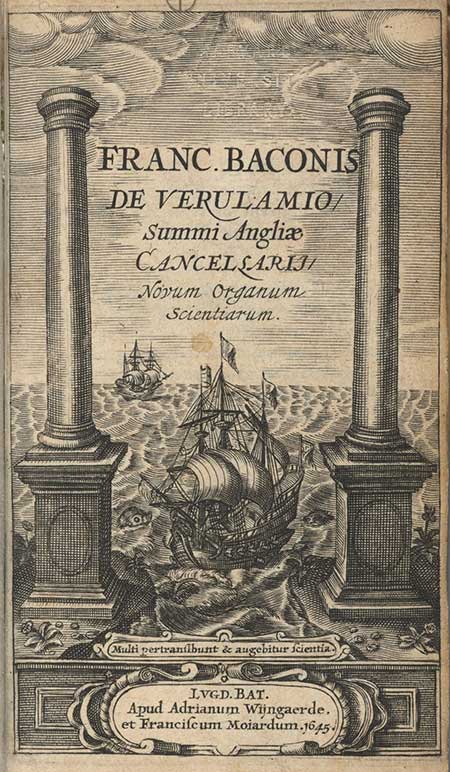
I want to pause here to introduce some theory. The idea of modern scientific method, and the importance of understanding potential sources of error, was pioneered by Francis Bacon in the early 1600s. Or Roger Bacon, a Franciscan monk working on curricula for learning, in the 13th century depending on who you read. Whichever, it’s still a Bacon. I’ll concentrate on Francis, who was a politician, and who decided to take up writing about ideas full time following a conviction for bribery which forced him to step down from affairs of state. If you’re a Baconian you also believe that by this time he had already written most of the plays attributed to Shakespeare, so it’s less clear why he takes up writing about science. Bacon was an early essayist, and the title of this talk echoes the chapter headings he uses in [4].
In his major work on how to think about the world around us, Novum Organum published in 1620 [5], Francis Bacon identified four sources of error in thinking about science which he called idols (that’s idols not idles, though sloppy thinking is behind them all – presumably the Christian not-worshipping of false idols is behind the name). They are collectively known as the Idols of the Mind, and they are:
Idols of the Tribe
These are born of the human inability to access fully the physical world – we easily develop flawed beliefs and over-interpret the data.
Idols of the Cave
These are errors due to a persons’ experience and environment, they involve the creation of entrenched views to which we are committed without evidence, and sometimes without being aware of them (the cave representing our iconoclastic individualism).
Idols of the Marketplace
These are the errors due to language and communication, erecting barriers to entry and leading to confusion of purpose.
Idols of the Theatre
These are errors due to not questioning received wisdom, i.e. accepting the ‘performance’ of others.
These idols are about the human condition, they are about attitude and awareness, and there are two aspects of this I’d like to explore to end this talk.
The first is the danger of labels. We seem to find it very easy to divide into binary camps: pure vs applied (Idols of the Tribe), male vs female and BAME vs white (Idols of the Cave), IMA vs LMS (Idols of the Marketplace), and, with the Bond Review in mind [6], academic vs industrial (Idols of the Theatre). They can be reformulated in more useful ways as mathematical sciences, equality and diversity, the Royal Society of Mathematical Sciences (presenting a united front with the independent learned societies) and impactful mathematics, though there’s probably a better term for this.
The second is unconscious bias. The Idol of the Cave is pretty much a direct description of what we now call unconscious bias, and I think it’s quite remarkable how accurately Bacon describes the problem. It is equally remarkable that it has taken 500 years for Bacon’s lucid description to be applied to women in science and diversity more generally. Acting on this is not simply correcting a mistake but, in the words of Eugenie Hunsicker (Chair of the LMS Women in Mathematics Committee), a moral imperative. I had thought that things were improving, but recent experience suggests that there are still areas of mathematical sciences that have not recognised the importance of understanding their own unconscious bias. And if you think you are perfect then check out the online tests at Harvard (implicit.harvard.edu/implicit/uk/takeatest.html), they provide a real eye-opener on why the bias is called unconscious.
We as a community are responsible for how the mathematical sciences are perceived amongst ourselves and from the outside. We should not be waiting for someone else to tell us what to do. This ties into the remarks I made earlier about attitude as the fourth and most controversial part of applied mathematics à la Goriely (should that be au?), as well as having its origin in Bacon’s Idols. To over-simplify, and using all the wrong language as the only way to express all the wrong attitudes, pure mathematicians agree that everything they do is hard and important and this is felt across all sub-disciplines. Statisticians are divided between theoreticians and interpreters of experiments. But applied mathematicians cannot agree on anything and, worse, we think that anyone outside our small group of confederates is not doing applied mathematics. The result? Applied mathematicians have the lowest success rates for grant proposals of all three groups and we spend energy explaining why UK applied mathematics isn’t as bad as UK applied mathematicians themselves seem to imply. This holier-than-thou attitude does no one any favours.
So what have we learned? Everyone makes mistakes but we don’t have to accept our own mistakes passively. Proof-read your articles carefully, think about priorities and time, make conscious decisions about what you are doing, don’t develop or encourage a bunker mentality and be aware of your own biases. This involves training (a very unpopular word because much of it is very poor, but it is seriously important nonetheless).
Finally, a bit of apple pie. This is a wonderful community to be part of. To those that are relatively new: welcome and I hope that you have as good a time with the friends you make now as I have had with those I have made over the past 35 years. To those that have been friends for a long time, cherish those friendships and common interests, and support the more junior members of the community who have so many more demands on them than we had at their stage. And so a toast: to mathematics and its applications, and to us all. Cheers.
Paul Glendinning FIMA
International Centre for Mathematical Sciences
Notes
This article is an edited version of my after-dinner speech at BAMC 2019, in the Assembly Rooms, Bath, 25 April 2019. Thanks to Jonathan Dawes, Chris Budd and all the team at Bath for their hospitality.
References
- Andersson, K.G. (1994) Poincaré’s discovery of homoclinic points, Arch. Hist. Exact Sci., vol. 48, pp. 133–147.
- Barrow-Green, J. (1994) Oscar II’s Prize Competition and the Error in Poincaré’s Memoir on the Three Body problem, Arch. Hist. Exact Sci., vol. 48, pp. 107–131.
- Goriely, A. (2019) Applied Mathematics: A Very Short Introduction, OUP.
- Bacon, F. (1597) Essayes.
- Bacon, F. (1620) Novum Organum.
- Bond, P. (2018) The Era of Mathematics, epsrc.ukri.org/newsevents/pubs/era-of-maths/
Reproduced from Mathematics Today, June 2019
Download the article, Of Mistakes (pdf)