In the latest piece from the west of England, Alan Champneys discusses the connection between Ashley Combe Lodge, the toll gate to a picturesque back road that circumvents the notorious Porlock Hill in West Somerset, and Augusta King, one of the most influential British mathematicians of the 19th century. A discussion of her achievements reveals just how much was stacked against her as a woman. But who was Augusta King and why have you not heard of her? Even today, recent events have brought into focus how society can belittle the achievements of those who are not white men. It is often thought that the mathematical sciences community does better than many other STEM disciplines in moving towards genuine inclusivity, but there remains much to be done.
One of my favourite places in the South West is the coastal region where Exmoor meets the sea, at the border between Devon and Somerset. The contrasting scenery of barren moors, steep-sided wooded valleys, high cliffs and views across the Bristol Channel to South Wales is matched with equally dramatic history. Driving east out of the village of Porlock, there is a view across Porlock Bay, which since the breach of the maintained pebble ridge in 1996 is now actively left for nature as a unique saltwater marshland habitat. The ‘main’ road out of the village, part of the A39, ascends 221 m in just under 1 mile (1.6 km) with a gradient that rises to 1 in 4 in places, making it the steepest A road in the UK. Porlock’s village museum maintains a gruesome photographic archive documenting some of the numerous accidents that have occurred on the hill.
Porlock Hill takes the A39 inland. To the north, on the seaward side, lies Ash Farm where Samuel Taylor Coleridge is thought to have written his most famous verse, Kubla Khan, before being interrupted by a ‘visitor from Porlock’ (probably his doctor bringing fresh opiates). To the south, the land falls away steeply to Malmsmead where Oare Water and Badgworthy Water combine to form the East Lyn River. This is the setting R.D. Blackmore chose for his novel Lorna Doone. The deep dark upper Badgworthy Water valley became the lair of the Doone clan and Oare village church was where (spoiler alert!) the evil Carver Doone attempts to murder the novel’s heroine.
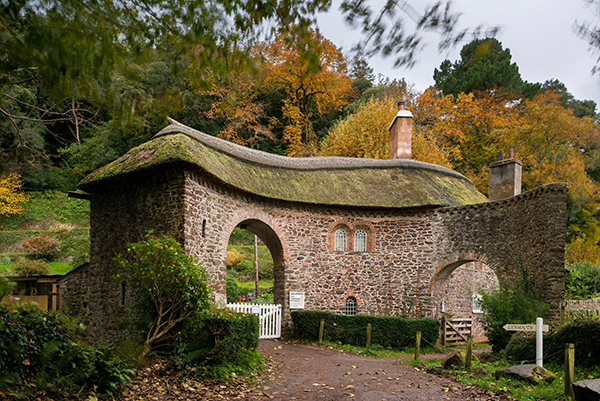
For those who do not fancy the steepness of Porlock Hill there is New Road, a gentler well-maintained but narrow toll road. Or, for the even more intrepid there is the yet narrower, potholed Worthy Toll Road that starts by the coast at Porlock Weir. The toll gate itself is an arch that takes the road under beautiful, thatched Ashley Combe Lodge. Only recently did I discover the connection between this strange building and one of the 19th century’s most influential female mathematicians, Augusta King, regarded by many to be the founder of computer science as a discipline.
If you have not heard of Augusta, let me tell you a few details of her life and her connection to this beautiful spot.
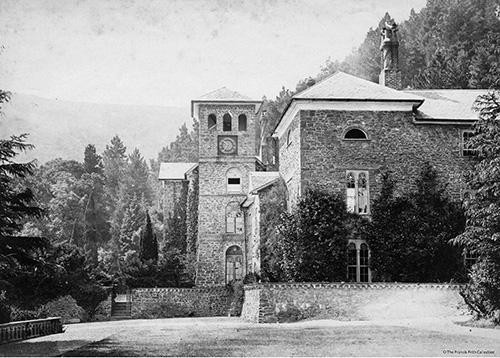
Turning right on foot at the lodge, the South West Coast Path continues through the thickly wooded slopes of the hills towards the tiny hamlet of Culbone, whose church is said to be the smallest parish church in England. The path begins as a sunken track, passing through two tunnels. Not a disused railway bed, this was in fact designed as the discreet rear entrance to the former Ashley Combe House to keep tradesmen out of the view of the master and mistress. Built by the family of Baron William King, the house was extended in Italianesque style as the honeymoon cottage for his marriage to the 19-year-old Augusta. With terraces overlooking the sea and another tunnel to the private beach, it became the regular summer retreat for this golden couple and their three children. Apart from the lodge and tunnels, only the terraces survive, one of which is known as the Philosopher’s Walk, after Augusta’s reputed pivotal conversations there with her friend, the computing pioneer Charles Babbage.
OK, I will come clean. Augusta was known by the pet name Ada, given to her by her father Lord Byron, shortly before he abandoned the family for good when she was only a few weeks old. Although Ada was the only legitimate child of the notoriously promiscuous Byron (whom another lover, her mother’s cousin Caroline Lamb, called ‘mad, bad and dangerous to know’), she never met him again, not even being permitted to view his portrait until long after his death. After a few years of marriage, William was elevated to an earldom, taking the name of Ada’s own family’s extinct Barony of Lovelace. Thus, Ada became Lady Lovelace.
Ada Lovelace, as we now know her today, was born in 1815 to the noteworthy social reformer Annabella Milbanke (later to become Baroness Wentworth). Ada was born into the high society typified by the writings of Jane Austen, two years after the publication of the latter’s most famous novel. But such is the level of scandal and intrigue in the life of Ada, her children, her infamous parents and their relatives, I doubt 19th century society would have welcomed as fiction the truth such as it was. But such scandals are not the topic of this article. Rather, I want to focus on what Ada did that makes her worthy of modern attention.
Ada was a precocious young woman. She was fiercely clever and was encouraged by her mother and grandmother to study mathematics, along with science and the arts. She showed a fascination for making things and a vivid imagination. She studied under physician William King (no relation to her future husband) and the science educationalist and translator of Laplace’s work, Mary Somerville. She revelled in mathematics, especially geometry and algebra, reaching, it would seem, a level beyond most men entering university.
In 1833, shortly after being presented at court, Ada attended a party at the house of the polymath Charles Babbage (whose oldest son was the same age as Ada). She and her mother were invited back for a demonstration of Charles’s unfinished Difference Engine. Ada’s letters at the time show that she was captivated by this mind-blowing collection of cogs, wheels and rods. The Difference Engine was designed to evaluate polynomial functions using finite differences, inspired by the laborious effort required to produce logarithms and other tabulated functions. The machine was never fully functional; the surviving pieces, along with a modern reconstruction, are exhibited in the Science Museum.
Having failed to secure funding to complete the Difference Engine, Babbage had already turned to a much more ambitious project, the Analytical Engine. In modern parlance, this would have been the first computer, with a CPU (the ‘mill’) for performing arithmetic calculations and a memory (the ‘store’) capable of storing up to a thousand 40-digit numbers. Crucially the operation of the mill could be altered by inserting punch cards containing a program (‘formulae’ and ‘data’), and the output could be recorded on a printer, a curve plotter or a bell. Needless to say, it was never built.
In 1840, Babbage was invited to give a lecture on his ideas in Turin. The results were written up, in French, by Luigi Menabrea. As a society lady who had already garnered a reputation in science through her correspondence, Ada Lovelace was invited to translate the paper. During a nine-month period in 1842–43, she worked hard. She appended a set of notes to the article [1], which are about three times as long as the translation itself. Signed only with the initials ‘A.A.L.’ (for ‘Augusta Ada Lovelace’), this commentary is the most definitive source on the envisaged Analytical Engine, the significance of which most contemporary scientists had failed to grasp. Modern eyes also recognise Ada’s notes as a remarkably prescient piece of writing, which many argue contains the world’s first computer program.
But it was not until the late 20th century that the importance of Ada’s work came to be fully recognised. It seems that her contribution was largely airbrushed from history, not least because of Babbage’s fall from grace, but also because she was a woman, because she died young and because early biographers of the celebrated Lord Byron blamed Ada’s mother and, by implication, Ada herself for spreading vicious rumours about the great man’s private life.
I recall in the late 1980s reading Douglas Hofstadter’s remarkable book, Gödel, Escher, Bach [2]. Published in 1979, this tour de force blends early ideas on artificial intelligence, recursion (or ‘strange loopiness’), art, logic, mathematics and possible explanations of consciousness. The character of Charles Babbage features as one of the characters in the book’s encapsulating final dialogue. Early in the book ‘Lady Lovelace’ is mentioned for her notes on Babbage’s Analytical Engine.
I remember my reaction being that it was strange that a society lady of letters, Byron’s daughter no less, should be the only contemporary to have written about Professor Babbage’s genius. I had also heard of the computer language Ada, but had not made the connection, being unaware that in 1980 the US Defense Department had chosen this name to honour Lady Lovelace. If I had, I might have reasoned that this was an example of positive discrimination, which gives credit to women who might have made bigger contributions given the opportunity (for example, it was not until 1869 that the first female students were to sit for a degree in the UK). After all, Ada was really a chronicler, wasn’t she, not an inventor?
Shame on me. It seems I had succumbed to the common unconscious bias of belittling the achievements of women in science, technology, engineering and mathematics (STEM).
Consulting Hofstadter’s book again now, I realise the unconscious bias was all mine, not Hofstadter’s. He is at pains to talk of Ada’s unique early insights on artificial intelligence. While talking of the potential for Babbage’s device to perform not just numerical calculations, but algebra, logic and complex mathematical manipulations, she writes [1, p. 722]:
The Analytical Engine has no pretensions whatever to originate anything. It can do whatever we know how to order it to perform. It can follow analysis; but it has no power of anticipating any analytical relations or truths.
One of the first to have uncovered Ada’s work in the 20th century was Alan Turing. In the 1950 paper that introduces the Turing test, he refers to ‘Lady Lovelace’s objection’ to true computational intelligence, often now paraphased as ‘Only when computers originate things should they be believed to have minds’. In recent years, after the rise of chatbots that can process language and appear intelligent, the notion of the Turing test has become somewhat deprecated. It has been suggested that a better test of a truly intelligent computer is what has been called the Lovelace test (see e.g. [3]). This requires that the machine can originate a valuable novelty:
- that it has not been specifically programmed to do;
- where the process is repeatable and reproducible;
- that the programmer cannot explain how the code managed it.
The first attempt I came across to truly disentangle the scientific contribution of Ada Lovelace from that of her contemporaries is a lengthy blog post by Stephen Wolfram [4], published on the 200th anniversary of her birth. He visited various places in the UK to uncover primary source materials and concluded:
It was much harder than I expected. Historians disagree. The personalities in the story are hard to read. The technology is difficult to understand. The whole story is entwined with the customs of 19th-century British high society. And there’s a surprising amount of misinformation and misinterpretation out there.
Wolfram, in his idiosyncratic style, unpicks the computer program contained in [1]. Even that had previously been the subject of some debate because the problem solved seemed to have been suggested to her by Babbage, who had also formulated the problem algebraically. But as Wolfram is at pains to show, those were the trivial steps; it was Ada who understood how to break the problem down into computational steps. She recognised the need for different forms of input and, crucially, gave the first example of what we would now recognise as a loop as well as introducing a notation for nested loops.
The problem that Ada uses to illustrate the Analytical Engine’s capabilities was the computation of Bernoulli numbers. Discovered by Jacob of the Bernoulli clan and simultaneously and independently by Japanese mathematician Seki Takakazu, this sequence of rational numbers  occurs in many parts of number theory, notably within expressions for the coefficients of the formulae for sums of powers

for different integers  . The Bernoulli numbers are expressed succinctly via the Taylor series expansion of the function
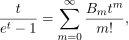
and can be defined recursively by defining  and
and
(1) 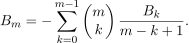
Ada used the recursion relation (1) to construct her program. Defined that way, all Bernoulli numbers with odd index are zero, except for  , and the numbers with even index alternate in sign; see Table 1. Ada showed explicitly how the Analytical Engine could, in a series of 24 steps, produce the first 6 non-zero Bernoulli numbers.

Wolfram also discovered evidence in her correspondence that Ada saw the far reaching possibilities of the Analytical Engine, while also recognising the weakness in Babbage’s character that made her fear it would never be built. She proposed to Babbage that she project manage the whole enterprise so that his invention could be brought to fruition. Sadly, Babbage refused. By the 1840s, Babbage had become a disappointed and embittered man, seemingly more content in maligning anyone who would listen for not funding his work. He even argued with Ada over the content of her commentary, wishing that it contained a polemic against the UK government, which she deftly avoided.
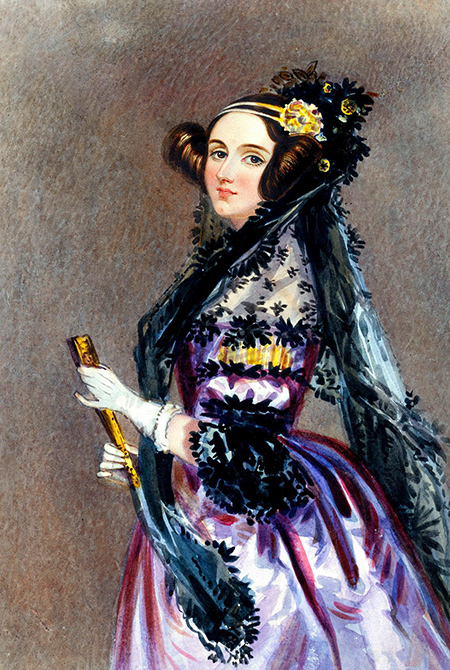
In 2018, Oxford professor of mathematics Ursula Martin along with historians of mathematics Adrian Rice and Christopher Hollings [5] published a scholarly interpretation of Lovelace’s mathematical work, using the archive of Lovelace’s correspondence in Oxford’s Bodleian Library; see also [6, 7]. Of particular note is the analysis [7] of Ada’s correspondence with Augustus de Morgan in 1840–41, to whom she turned to learn more mathematics after the birth of her children and Mary Somerville’s relocation to Italy. These letters had been used by previous biographers to point to Ada’s mathematical naivety. By correctly dating the letters based on their mathematical content, Martin and her colleagues [7] show how while at the start of the correspondence Ada had been unaware of the basic notation of function theory and calculus, by the end she had reached what de Morgan claimed was the level of a Cambridge mathematics graduate.
Yes, Ada was prone to elementary errors (so am I!), but she clearly had a keen eye for detail, correcting de Morgan’s mistakes including those in his own published work. She was capable of independent thinking, had a vivid imagination and a remarkable ability to explain the mysteries of mathematics in prescient poetic language. She speculated on the extension of complex numbers to three or four dimensions (a topic of interest to de Morgan too) and by the end was able to read and engage in discussion with de Morgan about his current research. It was the year after this that she wrote her celebrated notes on the Analytical Engine.
Ada was reportedly excited by her first publication. She envisaged many more. But it would appear she inherited Lord Byron’s larger-than-life spirit, and had many passions including metaphysics, music and poetry. There were societal expectations on her as a woman, not least that she should devote herself to taking care of her family.
Later in life, she developed an interest in gambling, and like the IMA’s esteemed immediate past president Alistair Fitt CMath CSci FIMA (see e.g. [8]), tried to
apply mathematical principles to her hobby. The result was not a success and she ended up greatly in debt to a betting syndicate, having to be bailed out by her family. She nevertheless maintained active correspondence with many leading scientists of her day including Charles Wheatstone and Michael Faraday, the latter of whom described her as the ‘rising star of Science’ [4].
Another barrier was that Ada never really enjoyed good health, with numerous ailments since childhood. She died aged 36, coincidentally the same age as her father and in the same manner – as a result of blood letting, an extreme medical practice at the time. In her case though she was gravely ill with what seems to have been uterine cancer.
In 2009 the technology and social media pioneer Suw Charman-Anderson proposed the concept of an Ada Lovelace Day to raise the profile of women in STEM. She took inspiration from Canadian psychologist Penelope Lockwood, who found that women gain more inspiration from female role models than men gain from male role models. See, for example, Suw’s book [9] and, specifically for mathematics, the article by June Barrow-Green [10] for such empowering stories. The second Tuesday in October was chosen for the Ada Lovelace Day, not to mark an anniversary of any significant event in Ada’s life, but because it was a convenient date that did not clash with other events in a typical academic calendar. Since its inception more than 10 years ago, Ada Lovelace Day is now celebrated worldwide, across the technological industries, in universities and in the popular media.
From its woeful beginnings, the UK has more recently been catching up on the under-representation of women in STEM. The Athena Swan initiative run by UK universities has helped raise awareness and introduced practical steps at all career stages. But there is much more to be done. The mathematical sciences are sometimes said to be doing better in this regard than other STEM disciplines. The US-based Association for Women in Mathematics was founded in 1971, echoed by similar organisations in Europe and elsewhere. In the UK, the London Mathematical Society’s Women in Mathematics Days have been a successful initiative and won the Royal Society’s inaugural Athena Prize in 2016.
As I have been writing this piece, the issue of institutionalised racism has been thrown into focus following the ghastly killing of George Floyd in the USA. The ensuing events, including the toppling of the statue of Edward Colston in Bristol, has got me thinking more generally about prejudice and unconscious bias. I am delighted that the IMA now has its first black president, Nira Chamberlain CMath CSci FIMA. I am sure the effervescence he exudes for mathematics will help inspire under-represented groups in the next generation who might not otherwise have imagined a career in the mathematical sciences. I am also increasingly aware of the concept of neurodiversity and the need to avoid unhelpful stereotypes that certain mathematicians or computer scientists are ‘nerdy’ or ‘on the spectrum’.
But I wonder if we, as a discipline, are still sometimes guilty of the grossest form of unconscious bias. That of elitism. Do not get me wrong; there is nothing wrong with high achievement nor the celebration of excellence. But, how often do we carelessly describe the rest of society as being composed of non-mathematicians? Think about it. What information does that negation convey: that there are two classes of people, those who have a special status worthy of esteem and those who do not?
Maybe, like me, you will have heard conversations in common rooms or at conferences that suggest there is a secret ranking list within the mathematical sciences. At the top are the singularly gifted or ‘stellar’ mathematicians. This is followed by those who are merely ‘very good’ and then those who are ‘solid’. At the bottom we have ‘not very good’ and ‘not a proper mathematician’. Me? I am proud not to be a proper mathematician, and I do not care who knows it.
Alan Champneys CMath FIMA
University of Bristol
References
- Lovelace, A. (1843) Translator’s notes to L.F. Menabrea’s memoir (Sketch of the Analytical Engine invented by Charles Babbage Esq., pp. 666–731), Sci. Mem. Selected from Trans. Foreign Acad. Sci. Learned Socs., vol. 3, pp. 691–731.
- Hofstadter, D. (1979) Gödel, Escher, Bach: An Eternal Golden Braid, Basic Books, New York.
- Ryan, M. (2019) Ada Lovelace, her objection, Turing tests and universal computing.
- Wolfram, S. (2017) Idea Makers: Personal Perspectives on the Lines Ideas of Some Notable People, Wolfram Media, Champaign, originally published as Untangling the Tale of Ada Lovelace.
- Hollings, C., Martin, U. and Rice, A. (2018) Ada Lovelace: The Making of a Computer Scientist, Bodleian Library Publishing, Oxford.
- Hollings, C., Martin, U. and Rice, A. (2017) The early mathematical education of Ada Lovelace, BSHM Bulletin, vol. 32, pp. 221–234.
- Hollings, C., Martin, U. and Rice, A. (2017) The Lovelace–De Morgan mathematical correspondence: A critical re-appraisal, Historica Mathematica, vol. 44, pp. 202–231.
- Fitt, A.D. (2014) ‘The mathematics of sports gambling’ in Parc, S. (eds.) 50 Visions of Mathematics, Oxford University Press.
- Charman-Anderson, S. (ed.) (2015) A Passion for Science: Stories of Discovery and Invention, 2nd edition, FindingAda, UK.
- Barrow-Green, J. (2019) The historical context of the gender gap in mathematics, in The First World Meeting for Women in Mathematics (WM)², Springer, New York.
Reproduced from Mathematics Today, August 2020
Download the article, Westward Ho! Pride and Prejudice (pdf)