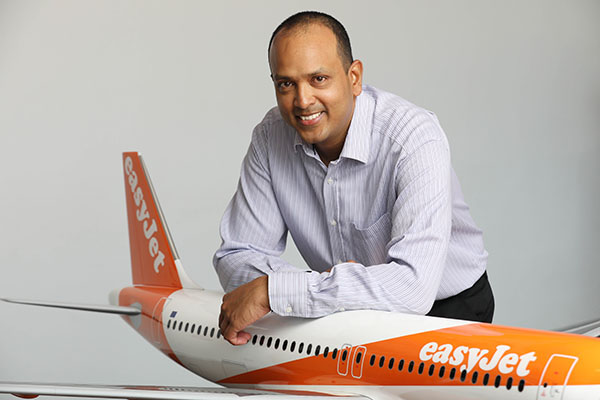
Ben Dias is the Data Science and Analytics Director at easyJet. He is also an IMA Councillor, part of the Membership Committee and a former Chair of the Early Career Mathematicians’ Committee.
Can you briefly describe your career path to date?
From when I was a young lad, I always wanted to be a scientist solving new problems, but I wasn’t sure if I wanted to work in academia or industry. So in between my degree in Mathematics and Astronomy and my PhD in Computer Science (both at UCL), I worked as a Research Assistant at one of Unilever’s R&D labs. They funded my PhD and after that I was hired as a Research Scientist in the area of predictive consumer mathematics.
I moved to Tesco, where I initially took on a role within a small team of three Mathematical Modellers who developed a forecasting algorithm for Tesco online. We started small, did loads of experiments, delivered some fantastic value to the company really quickly, which led to us doubling the size of our team every year as the demand for Data Science grew.
After building my own Data Science team from scratch at Royal Mail, I was head hunted for the Data Science Director role at easyJet. The biggest allure for me was the focus and high-level sponsorship for Data Science at easyJet where I could solve yet another new management problem of how to transform a legacy Data Science team. And staying true to the scientist in me, I continue to run experiments, test, learn and grow.
What is your experience in knowledge exchange (KE)?
When a company hasn’t engaged with universities, I invite talks from academics, which leads to MSc Studentships and then grow to incorporate PhD Studentships. I have also brought companies and knowledge exchange partners together to solve specific problems. I’ve had success with studentships and bespoke consultancy collaborations mainly because of my extensive network of academic contacts, most of which I have gained via the IMA.
What is the biggest barrier to Knowledge Exchange (KE)?
The biggest is the lack of a match-making process. I mean the companies don’t know who in academia to contact, and the academics don’t know which company to reach out to. I would recommend using the IMA to build your network of contacts. To do this, you have to get involved. Join a committee, volunteer for something, attend the Early Career Mathematicians’ conferences, etc. The network won’t come to you! You need to go and find them, and you need to put in a bit of effort! But it’s totally worth it. So consider it as an investment instead of a cost. It is key that we continuously reach out to industries and companies we haven’t interacted with before in order to keep increasing KE.
What would you recommend to an early-career mathematical scientist who is passionate about knowledge exchange?
Go and present your work to as many business audiences as you can. When you present to an industry audience, focus primarily on the outcome instead of the really cool mathematics. And get your Chartership ASAP and use your IMA post-nominals in your presentation to impress the crowd. If the company have a technical team, they might be interested in the mathematical detail. So always offer them a separate more technical presentation.
Go in with multiple options, always including a ‘free’ option (e.g. where an MSc student can work on a company problem). These initial free collaborations are a great way to build a relationship with the company that can grow into funded collaborations.
Is there a knack to communicating mathematical ideas to people who are not mathematical scientists?
Use analogies. You should constantly be trying to come up with as many analogies as you can to explain your work, and test them out on your friends and family. Always hook your audience with the outcome of the mathematical idea before going into how it works.
It’s also important to know your audience in as much detail as possible beforehand, so that you can get the right mix of technical and non-technical detail in the presentation. The more tailored the presentation is to the specific audience, the more successful it will be.
What have you learned that you wish you knew earlier?
That the IMA existed! I only heard of the IMA when I attended a presentation by Peter Grindrod after I started working at Unilever. He used his CMath in his presentation and so after the presentation I asked him what that was. I was so excited to find out that I could actually become a Chartered Mathematician, that I joined the IMA straight away and started working towards my Chartership.
Can you tell us an example of knowledge exchange?
Unfortunately most of my examples are commercially confidential. However, an early example from Unilever R&D, was to develop completely new personalisation algorithms for the grocery domain. For this we collaborated with Professor Paulo Lisboa CMath FIMA and his team at Liverpool John Moores University.
They brought to the exchange their expertise in applied mathematics research, and my team from Unilever brought the business and consumer knowledge, the data and the productionisation skills (i.e. the engineering skills required to deploy a mathematical model into production so that real consumers can receive live recommendations as they shop). Together we developed many different personalisation algorithms to achieve several different goals at different times during an online grocery shopping session. We initially worked in collaboration with LeShop to gather real evidence of the added business value of the new personalised recommender system we developed together. As the results were published, I can reveal that our recommender algorithms increased LeShop’s total revenue by 0.5% every month. Although 0.5% seems like a small amount, when you consider the magnitude of the monthly turnover of a successful e-commerce business like LeShop, the actual value generated is substantial.
We not only generated business value, but we also contributed to the scientific literature. The knowledge transfer element also worked really well, as my team at Unilever received the knowledge that we required to continue to support the live algorithms and continue to improve them.
This led to collaborations between Unilever and Liverpool John Moores University that continued after I left the company, and it also sparked new collaborations between Liverpool John Moores University and Tesco when I moved to work for Tesco.
What lesson has your work life taught you?
Everything depends on people and how you treat them. Treat everyone as a person and an individual first. Always make time to smile and ask them how they are doing, before discussing anything else.
Also be curious about how everything works. The more you know about how things work, the more ability you have to influence and drive transformational change. So try not to assume anything. Never stop asking questions and always listen with an open mind. This is especially important when solving real world problems, as you can otherwise end up creating a solution that is not feasible because of a constraint you were not aware of.
Finally, you need to take ownership of, and responsibility for your own career. The right job is rarely handed to you. In some cases the right job for you won’t even exist. But there is nothing to stop you creating it, whether as a new start-up or even in a big company. I have created many new roles both for myself and to attract and retain the right people.
How do you maintain a healthy work/life balance?
By building exercise into my work day. I have as many of my 1-2-1 meetings as possible, outside walking with the other person. Walking meetings are generally more positive and effective.
I also share parental duties such as the school run with my wife. At the start it wasn’t the norm for dads like me, and I had to fight for it. I even went down to working 3 days per week to be able to spend more time with my son at the start. But these days with Diversity and Inclusion being high on everyone’s agenda, it’s quite easy to request a flexible working arrangement so that you can achieve a greater work-life balance.
Getting enough sleep, though, is still a work-in-progress for me. That’s a hard one to crack, but I’m working on it.
Reproduced from Mathematics Today, October 2020
Download the article, Interview with Dr Ben Dias CMath CSci FIMA (pdf)