Karrie Liu works as a freelance mathematician in the life sciences industry. She has also served on the IMA’s Council and Chaired the Early Career Mathematicians’ Committee from 2018–2019.
Can you briefly describe your career path to date?
I am a mathematics graduate working in healthcare. I worked directly for the NHS before moving to a pharmaceutical company as part of an in-house analytics support team dealing with forecasts, predicting how the patient profile varies in different places, for example. Explaining to other people what my job is, and how maths can help in a situation is an important part of my work.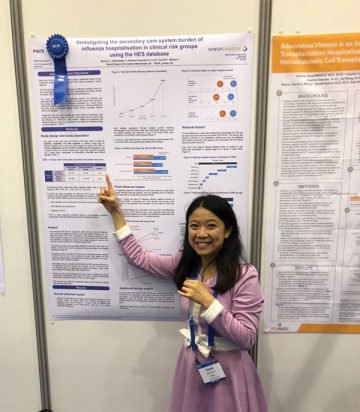
What is your experience in knowledge exchange (KE)?
I often work with people who are not from a scientific background. Many think numbers are scary, or something that they will never understand. When I am working with people, such as clinical staff, my role is to translate the information using the terminology that they understand. The KE changes direction there because I understand the numerical side of the problem, but I will not understand the situation as well as they do. For example, the NHS are looking at A&E usage. They understand why the patient comes in by the symptoms, but for me, I understand that on Monday morning we have a lot of patients who are aged between 24–40 years, say, but I don’t understand the reason why they are coming in. So, we work together to see the whole problem.
What would you recommend to an early-career mathematical scientist who is passionate about knowledge exchange?
You need to see yourself as a person who will translate information to different groups of people, so your communication skills need to be good. Sometimes, it is about soft intelligence because it is difficult to explain without using scientific terminology. So it’s important to learn how to deal with different groups of people. Normally, my mother is my test audience if I need to talk to someone who is not as scientific as I am. If my mum understands then a lot of people will.
Experience is important, so meet lots of people and don’t be afraid of asking questions.
What have you learned that you wish you knew earlier?
Well, loads. I know maths can be seen as a language, and is not just numbers. I only realised that when I was four or five years into my career. I wish someone had told me that being good at maths is quite powerful.
I am really shy, but I learned that it’s okay to share things with someone when you don’t fully understand. As long as you want to learn, then people love to talk to you.
When I first became involved with the IMA it panicked me a little bit because everyone was a professor and I would say that they are still human beings and there is no need to be afraid. If you have a question that you want to ask them, then they are really happy to answer you. An early career person may also struggle with senior people in the workplace, but when you are talking about exchanging knowledge titles are not important. When I first met Nira, the president of the IMA, my heart was bouncing. I was like, ‘What am I doing here, and why would you listen to me?’ Then, when you know people and are more comfortable you realise that actually they are not as scary as you think.
Can you tell us an example of knowledge exchange?
At an away day with a primary school, I used a map to show where the hospitals are and the problem is where to place the ambulances so the patient gets seen as soon as possible after they ring 999. The target is for every ambulance to arrive within eight minutes.
When I gave this example in a primary school, you could see their excitement when they realise that actually they can help the world with maths. I thought that was really cool because they didn’t realise that they could use maths to help society.
Do you feel that a change of attitude is required in order for KE to be more effective? If so, who needs to change their attitude?
I think it is you. The person that needs to change is you. You, as in the person who wants to learn. People need to understand that no-one knows everything in the world. Take the time to consider why other people think differently, and see if you can find a common ground before you speak. I would say that you do that before you form your opinion; you should listen first, before speaking.
What is the distinction between research and KE?
I would say research is going into the unknown to find a new methodology on the problem, if there is a problem there and you want to find a way to solve the problem. Knowledge Exchange is different because that is when you have already got some learning, and it is about what you already know and you can take it further, and can share that experience with each other.
What motivates you?
It is partly wanting to show other Asian girls that if you really love something you can do it. I don’t know how people measure success and what is successful, but I really love maths, and I do think that I can have a good career with maths.
I am from two different cultures and when I recently won a TechWomen100 Award, my adoptive British parents were really supportive, saying, ‘You are doing a great thing. You got nominated – great. Now, you win it – great’. My birth parents are not really supportive of me doing mathematics and say, ‘you are a girl and you don’t have to do things like that. You should get married.’ The more I learn, the more I want them to understand that maths is a good thing. Maths is a great thing when it makes sense to you.
Reproduced from Mathematics Today, October 2020
Download the article, Interview with Karrie Liu CMath FIMA (pdf)