 Jason Rosenhouse
PRINCETON UNIVERSITY PRESS 2020, 352 PAGES
PRICE (HARDBACK) £25.00 ISBN 978-0-691-17407-5
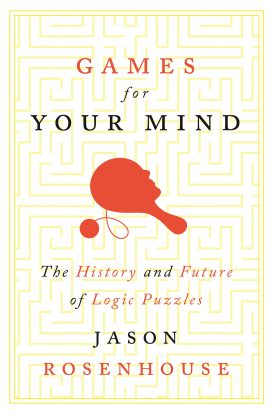
This book explores the history and future of logic, told through the works of an ancient Greek philosopher, a Victorian English author, and a 20th Century American mathematician.
Logic puzzles are nothing new. Indeed, the Study of formal logic was inaugurated by Aristotle sometime during the 300s BCE, in works collectively known as the Organon. While Aristotelian logic has been around for a long time, the idea of popular logic puzzles designed for public consumption outside of academia can most reliably be traced to Lewis Carroll in his short book called The Game of Logic, published in 1886. Rosenhouse describes the process of ‘empuzzlement’ that Carroll went through: the procedure through which ‘flaccid and boring textbook discussions of difficult material are transformed into fun and engaging puzzles’ (p. 50). This was of course the precursor to his more comprehensive Symbolic Logic a decade later, and Rosenhouse nicely guides us through the key ideas of both of these works.
The other protagonist in Games is Raymond Smullyan. His aim was to achieve empuzzlement for propositional logic what Carroll had for Aristotelian, which was done through the device of an island were each inhabitant is either a knight or a knave, indistinguishable from each other, with knights always telling the truth and knaves always telling a lie. Indeed, Smullyan’s discourses take us on an empuzzled journey through Gödel’s incompleteness theorems in what could be regarded as the highlight of the book, before the final few chapters conclude with a miscellany of other puzzles based on nonclassical logics.
This book continues Rosenhouse’s works of taking seemingly simple puzzles and peeling the onion further. The format will not be unfamiliar to those who, for example, have read his 2012 book on Sudoku puzzles which, while on their face are logic problems relatively easily solved by some rigorous algorithmic thinking, on further analysis give way to a richer mathematical tapestry of graph theory, polynomials and minimal starting set cardinality.
Games is not a purely historical survey of logic problems, but also shows that logic and philosophy are inextricably linked, so that it is difficult if not impossible to ever have the last word. I would hesitate to go quite as far as to describe the book as a ‘textbook’, but at the same time I would not place it firmly in the camp of ‘popular’ mathematics books. Full of worked and illustrative examples of logic puzzles and deductive thinking, from the familiar ‘all cats are mammals’ and Monty Hall problems (the latter of which Rosenhouse had devoted another book), to many-valued logic, and even classic literary examples from Voltaire and Agatha Christie, there are also almost 100 puzzles peppered throughout the book for the reader to puzzle over in delight with full worked solutions. Even the most seasoned logic puzzle enthusiast is sure to find fresh material here.
While a formal introduction to formal logic this book is not, an entertaining semi-informal introduction to formal logic feels like a fair description.
George C. Matthews
Book review published directly onto IMA website