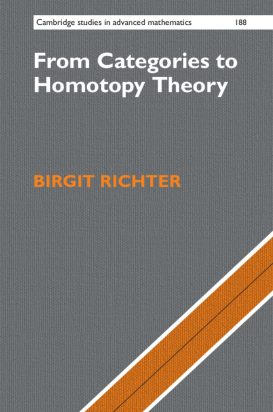
 Birgit Richter
CAMBRIDGE UNIVERSITY PRESS 2020, 400 PAGES
PRICE (HARDBACK) £49.99 ISBN 978-1-108-47962-2
As suggested by the name, homotopy theory first originated in the setting of algebraic topology but has now split off into a separate technical discipline which has been applied to algebraic geometry, homological algebra and category theory. Although there are many accounts of category theory in the mathematical literature, this book attempts to bridge the gap between the basic theory and the application of categorical methods to homotopy theory, which has been the subject of some recent exciting developments. Some important topics such as model categories are not covered, but the book does consider aspects which are related to ∞-categories (∞-categories and derived categories both subsume Quillen model structures). In general, there are many explicit computations which are designed to help students learn how to apply the abstract theory to concrete examples, with the author favouring intuitive diagrammatic proofs.
Chapter 1 recalls all the basic definitions and constructions from standard category theory. A key part of the definition of a category is that one needs a class of objects along with a specification of the morphisms (arrows) which one uses to go between them. In particular, the law of composition of morphisms is a necessary part of the definition of a morphism and composition must be associative such that a(bc) = (ab)c, for morphisms a, b, and c. Undergraduate students will confirm that getting associativity to work even for basic structures is not easy and in some sense it is the deepest part of algebra. Chapter 2 studies natural transformations and the Yoneda lemma, which gives us control over the objects in a category. Chapter 3 covers limits and colimits. As with many of the abstract constructions, almost all students will already have seen specific examples of both of these (for example, the wedge sum of two pointed toplogical spaces is a type of colimit, as is the free product of two discrete groups). Kan extensions are the subject of Chapter 4: these are useful constructions which extend a functor to a different category. Chapter 5 considers comma categories and the Grothendieck construction, which plays a key role in applications. Chapters 6 and 7 collect facts on monads, comonads, and abelian categories. Chapter 8 studies symmetric monoidal categories and Chapter 9 considers enriched categories (in the jargon, if we say that a category is enriched in something, we just mean that the hom-sets are in some category which has more structure than the category of sets Set).
Part II of the book switches to homotopy theory, beginning with simplicial objects in Chapter 10, where a simplicial object in a category C is a functor from the simplicial category to C, and moving on to quasicategories, Segal sets, and joins of simplicial sets. This chapter also discusses the geometric realisation of a simplicial set. These were first introduced by Milnor, who proved that such a realisation is a CW complex, a familiar type of topological space. Chapter 11 introduces the classifying space, a topological space associated with a small category. This space is constructed by forming a simplicial set from the category (called the nerve) and then taking the geometric realisation. Chapter 12 gives a quick introduction to operads. Roughly speaking, an operad tries to capture the important aspects of an algebraic structure without specifying an object which has that structure (as an example, the collection of symmetric groups forms an operad in the category of sets called the associative operad). Chapter 13 focusses on classifying spaces of symmetric monoidal categories and Chapter 14 gives an overview of modelling approaches to iterated loop spaces via diagram categories. Chapter 15 considers functor homology (one could think of this as taking a homology theory and then giving it a more abstract interpretation). Finally, Chapter 16 discusses homology of small categories, describing Thomason homology and cohomology of categories and ending with some results on comparison of functor homology and homology of small categories. The exposition is clear and to the point throughout, and the book would be very useful for beginner graduate students in homotopy theory.
Hollis Williams
Book review published directly onto IMA website