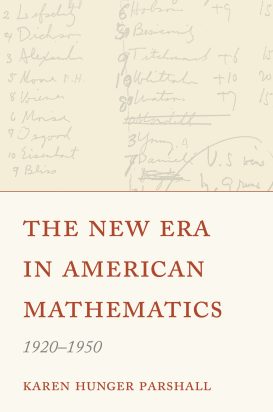
Karen Hunger Parshall
PRINCETON UNIVERSITY PRESS 2022, 640 PAGES
PRICE (PAPERBACK) £42.00 ISBN 978-0-691-23524-0
Professor Parshall’s academic history is perhaps a little unusual; having graduated from the University of Virginia in 1978, she returned in 1988 and has remained there ever since. She has also been a visiting Professor at universities in Australia and Paris. Her publications list is not as long as some, but to the historian it offers a good number of interesting diversions. Her work has produced two substantial volumes on J.J. Sylvester – The Letters and a biography – and a number of works on the History of Algebra. Her longest-running focus has been tracing the evolution of the mathematical research communities, both within America and internationally. The story over the period mentioned in the title divides quite clearly into distinct sections, giving three parts. There are many interlocking threads which can, sadly, only be briefly summarised.
Part 1, Chapters 1-3 covers 1920-1929. The broad understanding of the average European mathematician is probably that American mathematics was in somewhat of a backwater until the arrival of the Europeans from circa 1930 – both as émigrés and visitors. The point is well argued that although this was perhaps not far from the state of affairs in the early 1920s, thanks not least to the upheavals in Europe, the American community was able to make strenuous and successful efforts to set up a good two-way traffic of people. One notes also that a large fraction of this trans-Atlantic exchange involved the East Coast universities.
Part 2, Chapters 4-7 covers 1929-1941. The need to help German colleagues crystallised whilst the Depression was still at its height, and with hindsight it is sobering to read of the resistance from some institutions on the grounds of already-filled Jewish quotas and/or a declared preference for supporting unemployed young American PhDs. One less well-known side-effect of all this activity was that a number of up-and-coming universities with access to grants were able to snap up younger Germans to kick-start their own graduate schools. Modern readers in official capacities will be struck by the frequent references to the search for funding, and the need to be continually linking and ingratiating with representative bodies of all kinds to ensure that research grants did not all end up with the more tangible sciences.
Part 3, Chapters 8-10 covers 1941-1950. The build-up to war highlighted the American community’s strong focus on Pure topics over the preceding two decades, and it is to its credit that it was able to pivot quickly and effectively to cover a remarkable number of Applied areas where urgent needs were identified. Post-War the good work that had been performed made it easier to attract and retain talent, and gave an opportunity to the second- and third-rank universities to raise their game. Efforts were also made to broaden the range of topics within the discipline, notably adding Probability, Statistics and Operational Research, this latter closely linked to development of the first computers. Over the whole period the community also learned to live with government involvement at every level. There is a final coda, focusing on the build-up to and significance of the watershed 1950 International Conference of Mathematicians, the first gathering of its type since 1936.
The narrative style is of necessity detailed, but is an easy read with the major players’ appearances consistently and smoothly cross-referenced. There is not a great deal detailed subject matter to trouble the more general reader – this is a history above all – although chapters 6 and 10 both include a useful summary of current developments in a number of areas. There are concise and helpful summaries at the end of each Part.
The references and footnotes are a model of detail. If this reviewer has any reservation at all it is merely that the sheer number and length – at the bottom of each page, as would be expected – does rather often seem to break up the visual flow and hence the readability of the text. The list of references ranges even more widely than might be expected, covering 55 pages at a rate of some 20/page.
Andrew Ruddle AMIMA
Book review published directly onto IMA website