Annual income twenty pounds, annual expenditure nineteen pounds nineteen and six, result happiness. Annual income twenty pounds, annual expenditure twenty pounds ought and six, result misery.
Mr Micawber
Mr Micawber’s dictum (above) does not sound particularly deep, at least if the timescale is adjustable. On the other hand, knowledge of this statement did not keep Mr Micawber out of the Debtor’s Prison. Life throws a further complication at whimsical theoreticians: it is sometimes easy to state a principle, but it is not always easy to act effectively on that statement. (For readers who became financially aware after 1971, in modern parlance the sums involved are £20, £19.97½ and £20.02½; for readers financially aware after 1984, the halves refer to half (new) pennies.)

Whilst there is no comparison between the finances of Mr Micawber and the IMA, choices and an assessment of the effectiveness of those choices are necessary for all those who operate within a budget. For much of the time this goes without comment. We try to do what we do better, we try to do it more efficiently, but we do not often question what it is that we do, nor why that is what we are doing. Indeed, if we spent the whole time thinking about what we ought to do, we would spend no time doing what we think we ought to do.
As with everything, there is a balance. At the IMA one of the roles of the Council is to suggest the things we should be doing more (or less) of, and to recommend new activity. However, this tends to be local – a particular issue becomes of concern, a particular opportunity presents itself – rather than a global assessment of the performance of the Institute. This more holistic approach is important too, so the Institute has a Strategic Review every five years to determine the focus and set targets for the following five years.
The next Strategic Review is this year, and in the summer there will be a meeting to discuss the direction and targets for the next five years, which then feeds into a new Strategic Plan. The current plan can be found on the IMA website. Despite the restrictions of the pandemic, many of its recommendations have been implemented.
A new review is particularly timely given the impact of the pandemic on how we do things, the current economic climate and the appointment of Rosalind Azouzi as the new Executive Director last year. Furthermore, the IMA’s Equality, Diversity and Inclusion (EDI) Working Group is now up and running, able to provide greater strategic direction and guidance to the IMA on its approach to creating a more diverse and inclusive culture. Working practices and the expectations around meetings have changed significantly since the pandemic and the publishing landscape continues to evolve (remember that a major part of the Institute’s income comes from its publications). The UK’s mathematical ecology is changing and an Academy for Mathematical Sciences may well come into being over the next two or three years.
Periods of review are not simply about change. They are also about returning to first principles, and one of the first sources Edward Rochead CMath CSci FIMA (the member of Council who has taken a leading role in the thinking behind the latest review) consulted was our Royal Charter. It states:
The objects of the Institute shall be:-
(i) to advance mathematics and its applications in all areas including commerce, engineering, finance, health, industry, scientific and other academic disciplines and the public sector and to promote and foster research and other enquiries directed to the advancement, teaching and application of mathematics for the public benefit;
(ii) to seek to establish and maintain high standards of professional conduct for Corporate Members;
(iii) to seek to promote, encourage and guide in the development of education and training in all matters relevant to the advancement of mathematics and its applications for members and all other persons who are engaged in or likely to be engaged in mathematics or its applications.
This in itself was a bit of a revelation for me. We think of ourselves as a member society which exists at least partly to support the members in their work and to provide ways for members to develop their identities as mathematical scientists, both informally and through Chartered status (CMath, CMathTeach and CSci) and other forms of recognition that we can award. This support is reflected in the fantastic connectivity given by branch activity and early-career meetings, the deep connections with industry through the Professional Affairs Committee, the commitment to equality in society through EDI policy and activity, engagement with education through the two education (Higher Education Service Area and Schools & Further Education) committees, and the promotion of new mathematics through the Research Committee. All these activities create a strong sense of belonging, and these connections and more general advocacy are advanced through the Communications Committee, Executive Board and expert advice.
The revelation was the last bit of point (iii), that the promotion of the advancement of mathematics is for:
All other persons who are engaged in or likely to be engaged in mathematics or its applications.
Do we really do this in any coherent way? Certainly we are involved with national festivals of science and mathematics (we have even created one such event) but at best our reaching out to non-members and those likely to be engaged in the mathematical sciences is patchy. So already the Royal Charter gave us pause for thought, and this is just one example of several similar moments.
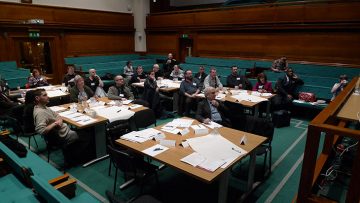
This thinking led a group of us (Edward Rochead, Rosalind Azouzi, Emma-Jane Wheal – the IMA Governance Manager, and me) to suggest some ways in which the Institute could look at what it does, what it does well, how it could be better, and what might be changed. At the November 2022 Council meeting there was some disagreement. There was a sense amongst some members of Council that our framework was too close to what we do now and so important cross-cutting themes, or ideas that did not already fit into our structures, would be harder to capture. As a result a group is going to report on where the opportunities and gaps might be and we will either incorporate this into the current plan or revise the process as a result of their insights. We will then be able to consult both within the current committee structures and within the membership – you.
The details of this process will be described elsewhere, but I want to finish with two comments and a request.
My first comment is that the use of the word ‘disagreement’ above was deliberately provocative. It would be much more accurate (but less dramatic) to have described the intervention in terms of engagement. Whenever a group of smart people (and the members of Council are certainly smart) gets together there will be differences of opinion and new perspectives. Some of these are easy to accommodate but some need either to be investigated or rejected even though they might be potentially beneficial. But without this level of engagement the Institute would be hollow, following a particular line without a lot of thought. So in my view, what I originally called disagreement is actually a symptom of something profoundly healthy in the discussions within the Institute. Long may that continue.
My second comment relates to the need, sometimes, to decide not to pursue alternative thinking. This is related to the issue of capacity, or the budgeting problem of Mr Micawber. It is easy to want to change the world, but it is much harder to effect that change. So, in everything we do and in everything we plan to do, a balance needs to be struck between what we would like in an ideal world and what we are able to deliver.
The request is that you think about what you wish we did that we don’t and also what we do that you value. Please engage with the review process as more details emerge, but also please understand that we have a finite capacity to do things.
Finally, back to Mr Micawber (spoiler alert). Things actually went quite well for him in the end, and if you want the details then read David Copperfield by Charles Dickens.
Paul Glendinning FRSE FIMA
IMA President
Reproduced from Mathematics Today, February 2023
Download the article, Preparing for the Strategic Review (pdf)