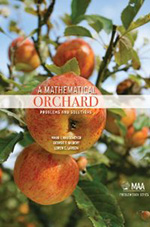
Mark I. Krusemeyer, George T. Gilbert, and Loren C. Larson
THE MATHEMATICAL ASSOCIATION OF AMERICA 2012, 409 PAGES
PRICE (PAPERBACK) £27.99 ISBN 978-0-883-85833-2
 Problem 123:
Fifty-two is the sum of two squares;
And three less is a square! So who cares?
You may think it’s curious,
Perhaps it is spurious,
Are there other such numbers somewheres?
This is a collection of 208 challenging problems, with carefully crafted instructional solutions, offering the reader a feast of mathematical entertainment. One hundred and thirty of the problems in the book were previously published in 1993 by the MAA in The Wohascum County Problem Book. The problems are not trivial to solve and given consideration, often offer scope for extension. For example,
Problem 26:
Starting at (a,0), Jessie runs along the x-axis towards the origin at a constant speed s. Starting at (1,0) at the same time Jessie starts, Riley runs at a constant speed 1 counterclockwise around the unit circle until Jessie is far down the negative x-axis. For what integers a>1 is there a speed s so that Jessie and Riley reach (1,0) at the same time and (-1,0) at the same time?
On reaching problem 26, I was distracted for some time considering the same problem in regard to journeys around various polygon shapes. This resulted in a variety of unexpected results. I would suggest that the problems in the book offer the reader many opportunities to indulge themselves in the pleasures of mathematical entertainment.
The problems contained in the book come from Algebra, Trigonometry, Calculus, Geometry, Number Theory and Discrete Mathematics, with a number of problems crossing the boundaries between topics. For example,
Problem 165:
Two d-digits are chosen randomly and independently, and then multiplied together. Let  be the probability that the first digit of the product is 9. Find
Over four-fifths of the book is devoted to presenting solutions to these problems. The solutions are very clearly and elegantly presented, with most having multiple solutions. Readers will find it fun to browse through the book, pausing to indulge in the problems that take their fancy as they walk through the orchard.
Steve Humble FIMA
Newcastle University