Clare Rees-Zimmerman was awarded the 2023 IMA Lighthill–Thwaites Prize at the British Applied Mathematics Colloquium (BAMC), held in Bristol in April, for her work on drying films [1].
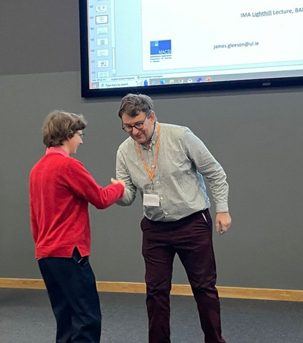
I was delighted to present my work on paint drying in a special session for the finalists of the IMA Lighthill–Thwaites Prize at the BAMC 2023. The judging panel deemed the quality of this year’s entrants so high that there were in fact two sessions to accommodate the eight finalists, one before and one after lunch. These were exceptional early career researchers presenting their work from across applied maths – from deep learning solutions to partial differential equations, and modelling an ice sheet surface.
The final talk of the whole conference was the IMA Lighthill Lecture, given by Professor James Gleeson, in which we gained an understanding of our Twitter followers’ interactions, through an agent-based model!
My background is as a chemical engineer, yet from the conference I acquired ideas of more mathematical tools to apply to industrial problems. Paint drying was the focus of my PhD, which I undertook at the University of Cambridge. I am continuing to explore my interests in functional thin films as a Junior Research Fellow at Christ Church, University of Oxford, which I joined in October 2022.
Far from being boring, paint drying is both industrially important and, to a mathematical scientist, a thin film fluid mechanics puzzle. A paint can be considered a dispersion of solid particles in solvent. As paint is drying, the solvent evaporates and in this time the particles can arrange themselves. Interestingly, it is observed that when a uniform paint mixture of particles of different sizes is dried, the particles will not end up uniformly arranged in the dried film. This non-uniform distribution is called stratification. Controlling this can be used to our advantage, to engineer the drying process such that expensive components end up only where required.
It is seen experimentally that smaller particles preferentially accumulate at the top surface, but it is not fully understood why (see Figure 1). Understanding this could allow the design of coating formulations which self-assemble during drying to give a desired structure. Potential applications are across a range of industries: from a self-layering car paint, to a biocidal coating in which the biocide stratifies to the top surface, where it is required.

The simplest model we can imagine involves only an evaporating solvent and diffusing particles of two different sizes. The top surface of the film (the solvent–air interface) descends as the solvent evaporates. Under this model, particles which cannot diffuse fast enough become trapped by the descending top surface. Particles which diffuse faster travel further down the film. The competition between diffusion and evaporation is characterised by the dimensionless group, the Péclet number:
![\[\textrm{Pe}=\frac{ĖH}{D},\]](https://ima.org.uk/wp/wp-content/ql-cache/quicklatex.com-a74c84f0f572455cf49603a2fd40afd0_l3.svg "Rendered by QuickLaTeX.com")
where  is the evaporation rate (speed of descent of the top surface),
  is the initial height of the film and
  is the diffusion coefficient. We would expect the larger particles to diffuse more slowly and so stratify to the top surface. Diffusional arguments alone are therefore unable to explain the experimental observations of smaller particles accumulating at the top surface – my research seeks further phenomena to include in the model.
Analogous to diffusion, diffusiophoresis is the migration of particles along a concentration gradient of a different solute species. A particular diffusiophoretic mechanism that has been hypothesised to cause small-on-top stratification is an excluded-volume effect [2]. To understand what we mean by excluded volume, imagine holding a football and a tennis ball: it is not possible to get the centres of these two spheres to overlap. This exclusion of the smaller particles (radius  ) from around the edge of each of the larger particles (radius
  ) is depicted in Figure 2; this results in an additional particle flux in the model. We explore what happens as the excluded distance (
 ) varies, corresponding to, for example, non-spherical particles.
![Figure 2: Diagram showing small particles being excluded from around the edges of the large particles. Reproduced from [1], CCBY.](https://cdn.ima.org.uk/wp/wp-content/uploads/2023/05/Figure-2-Diagram-showing-small-particles-being-excluded-from.png)
There are different approaches used to model drying films: firstly, molecular dynamics approaches, which model every particle, giving high accuracy but at computational expense; and secondly, continuum approaches, using variables that can be measured at a coarser scale, such as particle concentration profiles. We form a continuum fluid mechanics model, since it allows the relative contributions of different fluxes to be compared, shedding insight on their importance to the final film structure. A drying film is inherently difficult to model since it requires equations valid in dilute and concentrated dispersions. In addition, the descending top surface is problematic for numerical solution, so we transform to a coordinate system with fixed boundaries. The resulting equations are solved numerically using a finite volume method because this naturally conserves particles.
In Figure 3, example model results are shown for Péclet numbers around one (meaning diffusion and evaporation are similarly important): the predicted volume fraction,  , of each particle type, where
  is
is  (small particles) or
  (large particles), is plotted against scaled height up the film,
  , for different scaled times,
  . Starting from a uniform mixture at
  , we see that the films become more concentrated at the top surface, whilst the profiles at the bottom of the film are initially little affected by the effects of evaporation. We are interested in the relative positions of the blue (large particles) and red (small particles) lines at the top surface (grey vertical lines), which recedes over time. The diffusion-only model (Figure 3, left) has the blue line above the red line at the top surface, i.e., it is predicting large-on-top stratification. Cartoons of the predicted dried structures are shown inset in Figure 3.
![Figure 3: Evolution of the concentration profiles predicted by models with different strengths of excluded volume diffusiophoresis. Adapted from [1], CCBY.](https://cdn.ima.org.uk/wp/wp-content/uploads/2023/05/Figure-3-Evolution-of-the-concentration-profiles-predicted-by-models-with-different-strengths-of-excluded-volume-diffusiophoresis.-Adapted-from-1-CCBY-e1685977790513.png)
For hard spheres ( , Figure 3, centre), it is predicted that diffusiophoresis counteracts the effect of diffusion, resulting in approximately uniform films. When the excluded volume is increased (Figure 3, right), the small particles are predicted to stratify to the top surface. This suggests that diffusiophoresis does contribute to experimental observations of small-on-top stratification, but it might not be the only promoting factor.
Noting that the enhanced diffusiophoresis regime predicts small-on-top stratification, let’s explore this further. If we increase the Péclet number, the concentration profiles will become sharper: fast evaporation leaves the particles with less time to arrange themselves and beneath a transition position in the film, the particles do not ‘see’ the effect of the evaporation at the top surface. Exploiting this, in the high Péclet number regime, asymptotic (approximate analytical) solutions can be derived. Mathematically, asymptotic solutions overcome the difficulty of numerical solution with sharp profiles. Physically, they predict the solids deposition profile with fast evaporation and enhanced excluded volume diffusiophoresis: a top layer of almost entirely small particles.
Where’s next in paint drying? With my research group in Cambridge, I have run a set of experiments about to be published in which we measured the magnitude of the diffusiophoretic flux: we observed the motion of relatively large latex particles along a concentration gradient of nanoparticles. Other phenomena, such as charge interactions, are also expected to be significant in controlling the particle arrangement. We would like to exploit these different phenomena and watch to see if we can get paint to dry into a desired structure!
Clare Rees-Zimmerman
University of Oxford
References
- Rees-Zimmerman, C.R. and Routh, A.F. (2021) Stratification in drying films: A diffusion–diffusiophoresis model, J. Fluid Mech., vol. 928, p. A15.
- Sear, R.P. and Warren, P.B. (2017) Diffusiophoresis in non-adsorbing polymer solutions: the Asakura–Oosawa model and stratification in drying films, Phys. Rev. E, vol. 96, no. 6, p. 062602.
Reproduced from Mathematics Today, June 2023
Download the article, Controlling How Paint Dries (pdf)