This in-person workshop, organised by Noel-Ann Bradshaw, Tony Mann, and Neil Saunders of the University of Greenwich, was held on 11 July 2023 at the University of Greenwich and was attended by 36 participants. Assessment is inherently stressful for students and their tutors, and in mathematics, more than in many other disciplines, it uses traditional examinations. The aim of the workshop was to explore the impact of assessment on students’ mental and physical health, and ways in which the adverse effects might be mitigated.
It began with a talk by Sunday Blake (WonkHE), on Building Belonging in Higher Education. Sunday presented recent research on factors affecting students’ sense of belonging at their university and its impact on student success. This was followed by a presentation by Kerry Corrigan (University of Greenwich), Assistant Head of Psychological Wellbeing at the University of Greenwich, on Student wellbeing and assessment in higher education: the balancing act. Then Telma Silveira Pará (Universidade Federal de São Carlos, Brazil), delivered a presentation co-authored with Sue Johnston-Wilder (University of Warwick) entitled Maths anxiety: what can we do about it? The morning session concluded with Maya Al Saadi, who has just completed her mathematics degree at the University of Greenwich, telling us about her and her peers’ experience of assessment and the stress it causes.
After lunch, Neil Saunders (University of Greenwich), in his presentation, What Reinforcement Learning should remind us about assessing in mathematics and wellbeing, and Peter Rowlett (Sheffield Hallam University), speaking about Student-centred assessment design, discussed their experience with various assessment and feedback approaches. The final presentation, delivered online by Susan D Blum (University of Notre Dame), on Ungrading for Learning: Building on Students’ Superpowers, questioned the value of grading and suggested approaches which emphasised learning rather than assessment.
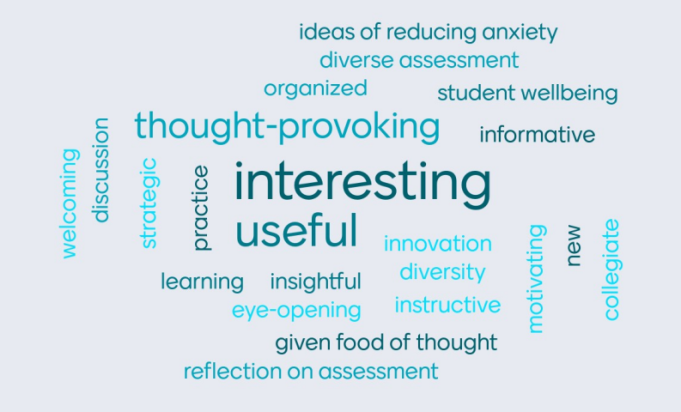
Word cloud showing participants’ view of the workshop
The day finished with small group discussions on a variety of topics, allowing participants to share their experience. Feedback was that those present found the workshop interesting, thought-provoking, useful, and eye-opening. Respondents to the survey indicated that many of the participants would aim to introduce ideas from the workshop into their practice.
Speakers and Abstracts
Sunday Blake (WonkHE): Building Belonging in Higher Education
Abstract: We know that belonging is crucial for students. But what facilitates it? And what are the consequences for students when they feel that they do not belong at their university?
Wonkhe and Pearson conducted a national research project, spanning the length of a calendar year with over 5,500 staff and student participants, and in partnership with 15 students’ unions. The project produced some stark findings about what facilitates – or prevents – feelings of belonging across almost every aspect of the student experience.
Students who felt they belonged at their university reported substantial differences in their academic confidence, their course inclusivity, and their peer networks, compared to students who reported feelings of not belonging. Sunday will present the findings of this research alongside further insights and wider research, implications, examples of good practice, and recommendations that colleagues can use to build a practical plan of action to improve student belonging and inclusion for the long term.
Bio: Sunday Blake is an associate editor at Wonkhe. She was previously the president of the University of Exeter Students’ Guild where she campaigned for, and implemented the UK’s first No-Detriment policy during the Covid-19 lockdowns. She has recently published research on belonging and inclusion at university focusing on academic autonomy, and peer connections.
Kerry Corrigan (University of Greenwich): Student wellbeing and assessment in higher education: the balancing act
Abstract: This talk will explore how, in a bidirectional fashion, assessment impacts student mental health and how student mental health impacts assessment. It will look at the mental health continuum model, stress-vulnerability model and stress bucket. We will also look at transitional times at university, how these can impact a student’s academic performance and ways to mitigate these. Finally, I have selected a relevant journal article to more closely examine how staff and students see assessment affecting their mental health.
Bio: Kerry Corrigan is Assistant Head Psychological Wellbeing within the Student Wellbeing Services at the University of Greenwich. Prior to joining the University of Greenwich, she worked in the NHS as a Registered Mental Health Nurse.
Sue Johnston-Wilder and Telma Silveira Pará: Maths anxiety: what can we do about it?
Abstract: Maths anxiety and test anxiety are disabling and can be addressed. In this presentation, Sue will briefly introduce the thinking behind the mathematical resilience framework and how to help your students take off the emotional handbrake on progression and achievement in maths.
Bios: Sue Johnston-Wilder is Associate Professor of Maths Education. She has a background in secondary maths teaching and teacher-development. For the last 15 years she has specialised on addressing maths anxiety and has co-developed the Mathematical Resilience framework. She is co-founder of the Mathematical Resilience Network.
Telma Pará is currently a researcher and IT teacher at FAETEC-RJ (Support Foundation for Technical Schools in Rio de Janeiro, Brazil) where she leads the research group POPCIENCIA which aims at the popularization of science, mathematics education, and technology-based creative learning. Her main research areas are: Mathematics Education, Teaching Methods and Techniques, STEM/STEAM Education, topics in neuroscience and psychology of learning.
Maya Al Saadi: Assessment and wellbeing: a student view
Abstract: I describe some of the ways in which university assessments affects mental health and well-being. I will also be looking into the extent which this affects students’ choice of module based on the way the module is assessed.
Bio: I am a final year mathematics student going on to do an MSc in actuarial science. I enjoy reading crime novels and playing piano when I’m not studying maths or at my job in well-being at a nursing home.
Neil Saunders (University of Greenwich): What Reinforcement Learning should remind us about assessing in mathematics and wellbeing
Abstract: The covid-19 pandemic forced a long-overdue rethink of the place of on-campus proctored exams. On the one hand, they undoubtedly cause students stress and anxiety, yet on the other, many academics and learned societies have argued for the importance of on-campus exams post the pandemic.
This talk will explore novel ways that assessment regimes can still include on-campus exams while minimising the anxiety and stress this might cause students. Drawing on analogies from machine learning and recent scholarship on theory of mind, as well as the presenter’s previous experiences, this talk will demonstrate how exams need not be stressful if the assessment regime is appropriately structured.
Bio: Neil is a Senior Lecturer at the University of Greenwich. He previously held research positions at the Universities of Sydney & Bristol, the EPFL in Switzerland and City University of London. His research expertise is abstract algebra, in particular geometric representation theory. Neil has also published research in mathematical education in collaboration with colleagues and students, most recently presenting a joint paper “Embracing Technology & Overcoming Institutional Barriers to Innovation and Student Partnership” with two of his current 3rd year students and previously “Learning and teaching in summer: is it better and why?”
Peter Rowlett (Sheffield Hallam University): Title: Student-centred assessment design
Abstract: This talk will outline and discuss approaches to whole-module assessment which empower students to develop and show their abilities to the fullest extent. This makes use of small-scale, low-stakes or formative activities to develop skills and confidence before building to more in-depth work, as well as featuring student topic choice and other forms of flexibility. Examples will be given of these approaches in practice across pure and applied mathematics, computer programming and history of mathematics.
Bio: Peter Rowlett teaches mathematics at Sheffield Hallam University, including mathematical modelling, game theory, programming and history of maths. He is a researcher focused on higher education mathematics educational practice. He is currently Vice President (Communications) of the Institute of Mathematics and its Applications and editor of MSOR Connections, and was Deputy Chair of the group writing the 2023 QAA Benchmark Statements for Mathematics, Statistics and Operational Research.
Susan D Blum: Ungrading for Learning: Building on Students’ Superpowers (to be delivered remotely)
Abstract: In this talk Susan D Blum introduces some of the principles behind the the growing umbrella of “ungrading” practices–calling into question the centrality of conventional grading practices, which practitioners of ungrading regard as both harmful and unnecessary. She also talks about many concrete practices that she and others use to implement ungrading—leading to greater learning, engagement, and equity.
Bio: Susan D Blum is a professor of anthropology at the University of Notre Dame, currently fixated on education and pedagogical praxis, after a previous incarnation as a China anthropologist. She is the author of “I Love Learning; I Hate School”: An Anthropology of College (Cornell, 2016) and My Word! Plagiarism and College Culture (Cornell, 2009), and the editor of the recent volume Ungrading: Why Rating Students Undermines Learning (and What to Do Instead) (West Virginia University Press, 2020). With 5 co-authors, she has written “A Theory of Public Higher Education,” imagining public higher education created from scratch, published in Soundings: An Interdisciplinary Journal in July 2021 (Korstange et al., 2021). Book 3 of her education trilogy, Schoolishness: Alienated Education and the Quest for Authentic and Joyful Learning, is due out from Cornell University Press in 2024. In her work, she draws on her background in cultural, linguistic, and psychological anthropology to ask questions about learning, and about the ways institutions shape and are shaped by cultural patterns. She is trying to move beyond complete relativism to make practical but principled recommendations.