Daniel Fleisch
CAMBRIDGE UNIVERSITY PRESS 2011, 208 PAGES
PRICE (HARDBACK) £43.00 ISBN 978-0-52-119369-6
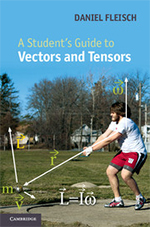 Before starting my undergraduate studies, all I was told of tensors was that they are ‘matrices on steroids’, which in hindsight seems an apt description. Tensors are described in the preface as ‘the facts of the Universe’, given their all-pervading nature in applied mathematics and physics. Tensors changed our understanding of the fundamental structure of the universe when Albert Einstein succeeded in expressing his theory of gravity in terms of tensors in 1915, which can quite rightfully be seen as the highlight of this book in the final chapter.
The book starts with a solid foundation in vectors, looking at them in a more formalistic way than when they are first introduced in a school setting, to set the scene for the more abstract tensor. Such preparatory work is built up gradually and occupies the first half of the book.
A middle chapter on coordinate transformations (covariant and contravariant vector components) provides the necessary bridging material before the penultimate chapter introduces the concept of a higher-rank tensor (a vector being a tensor of rank one) and the Christoffel symbols. The last chapter deals with some example applications: the inertia tensor, the electromagnetic field tensor and the Riemann curvature tensor.
Substantial supplementary material is provided by way of the companion website with that godsend – hints and full solutions to all exercises. Moreover, for some of the problems interactive solutions are also provided, which are wonderfully visual and help try to keep the subject intuitive. Of course, visualising the higher rank tensors will always require a strong imagination.
This highly readable introductory book will be of great assistance to those taking undergraduate or graduate courses and meeting tensors for the first time. There are no formal prerequisites; however a familiarity with differential vector operators will aid a fuller appreciation of the application chapters.
George Matthews AMIMA
Book review published directly onto IMA website (August 2013)