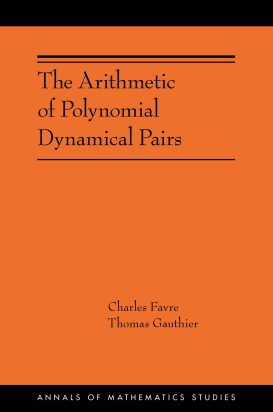
Charles Favre, Thomas Gauthier
PRINCETON UNIVERSITY PRESS 2022, 252 PAGES
PRICE (PAPERBACK) £89.00 ISBN 978-1-61197-671-7
The subject of this book is considering polynomial dynamical pairs from the perspective of Arithmetic Geometry. The dynamical aspect comes from passing values into a polynomial function and considering the patterns generated when outputs are fed back into the dynamical pair. The origin of the book is to provide deep discussions.
The book contains eight chapters as follows. Chapter 1 – Geometric Background. This chapter is intended as a review of useful material for the rest of the book. The first section on analytic geometry considers analytic varieties, non-Archimedian affine and projective lines and non-Archimedian Berkovich curves. The second section, on potential theory, states that theory will mostly use Riemann surfaces, but will sometimes require higher dimensional complex varieties on occasion. The third section covers line bundles on curves. Section four is on adelic metrics, Arakelov heights and equidistribution. The material covered includes the idea of subharmonic functions on analytic curves defined over either an Archimedean or non-Archimedean field, semi-positive and adelic metrics on a line bundle over a curve and the definition of heights attached to an adelic metrized line bundle. Xie algebraization theorem is proved.
Chapter 2 – Polynomial Dynamics. The moduli spaces of polynomials of interest are defined. Simple aspects of the iteration of complex and non-Archimedean polynomials in one variable are discussed, Fatou-Julia theory and canonical invariant measure. Böttcher coordinate expansion is studied in detail. Mane–Sad–Sullivan theory of bifurcation of holomorphic dynamical systems in the context of polynomials is reviewed. The chapter ends with a discussion of the locus of preperiodic points in an arbitrary family of polynomials.
Chapter 3 – Dynamical Symmetries. Here various dynamical symmetries for polynomials are studied. Initially the dynamical symmetries of a single polynomial are defined and various characteristics identified for the Archimedean case. We then consider the effect on this symmetry group when the polynomial belongs to an algebraic family. In section 3.4 primitive polynomials are introduced. These are polynomials that cannot be expressed as iterates of polynomials of lower degree. Any family of non-primitive polynomials can be induced by a family of lower degree polynomials.
Chapter 4 – Polynomial Dynamical Pairs. This chapter begins by covering polynomial dynamical pairs, this is a family of polynomials combined with a marked point. After considering basic ideas of bifurcation and activity for holomorphic dynamical pairs, a rigidity property theorem is proven. In the next section algebraic dynamical pairs are considered. This includes how to attach a canonical line bundle and continuity of the associated Green’s function. DeMarco’s theorem is recalled, relating to bifurcations. The chapter ends considering dynamical pairs defined over a number field.
Chapter 5 – Entanglement of Dynamical Pairs. It is shown that, if two dynamical pairs are entangled then there are iterates of these pairs that have the same degree and are intertwined. The following sections comprise the chapter: Dynamical entanglement, dynamical pairs with identical measures, multiplicative dependence of the degrees, proof of an implication of Theorem B, proof of Theorem C and further results.
Chapter 6 – Entanglement of Marked Points. This chapter is concerned with a single family of polynomials. The first section is concerned with the proof of Theorem D, the second with the proof of Theorem E.
Chapter 7 – The Unicritical Family. Papers written by Baker and DeMarco were mainly focused on the unicritical family. This chapter extends those results from those papers and then illustrates theorems proven in previous chapters. The first section provides general facts concerning the unicritical family. The second section concerns unlikely intersection in the unicritical family, followed by sections on archimedian rigidity, connectedness of the bifurcation locus and some experiments based on section four.
Chapter 8 – Special Curves. The conjecture of Baker and DeMarco relating to characterising curves in a moduli space of complex polynomials is proven. A combinatorial of special curves is investigated. This chapter consists of the following sections: Special curves in the moduli space of polynomials, Marked dynamical graphs, Dynamical graphs attached to special curves, Realization theorem, Special curves and special marked dynamical graphs, Realizability of PCF maps, Special curves in low degrees and Open questions on the geometry of special curves.
This book is aimed at people conducting research in certain aspects of arithmetic geometry. This is an area of study where techniques from algebraic geometry are applied to problems in number theory. The book is concerned with properties of paths generated by iterating an expression in the moduli space of complex polynomials.
John Bartlett CMath MIMA
Book review published directly onto IMA website