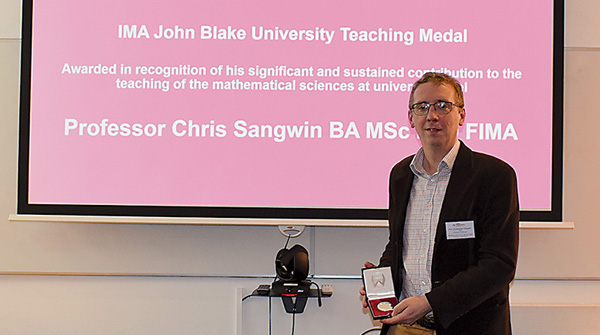
General artificial intelligence is rapidly changing the world and is likely to disrupt education. This article is based on a talk I gave on 29 November 2023 as a very grateful recipient of the IMA John Blake University Teaching Medal. I would like to express my gratitude to the IMA for making this award and to my colleagues for recognising me. I also record my thanks to Professor John Blake; I knew him well and he was a significant positive influence in my career.
Two days before my talk, XTX Markets announced that they would award $5 million to the ‘first publicly-shared AI model that is capable of achieving a gold medal in the International Mathematical Olympiad’. While this is an exciting challenge, endorsed by the IMO and a number of high-profile mathematicians, I am not particularly surprised by the call. Indeed, in thinking about the near future of teaching, I assume that AI will soon be able to complete the problems I set students to the standard of a first class student or a colleague. Given this, why am I not too worried about the effect of AI on education? The purpose of my talk, and this article, is to record my answer to this as of November 2023.
The first point I would like to make is that mathematics education has been disrupted by waves of technology for hundreds of years. Indeed, in the 1630s a dispute over the priority for the invention of the slide rule (an analogue mechanical calculator based on logarithms) led to back and forth invective [1]:
It is a preposterous course of vulgar Teachers, to begin with Instruments and not with the Sciences, and so instead of Artists to make their Schollers only doers of tricks, and as it were Juglers: to the despite of Art, losse of presious time, and betraying of willing and industrious wits unto ignorance and idlenesse.
Ever since there has been dialogue between proponents of theory first and practice first approaches [2]:
All are not of like disposition, neither all … propose the same end, some resolve to wade, others to put a finger in onley, or wet a hand: now thus to tye them to an obscure and Theoricall forme of teaching, is to crop their hope, even in the very bud.
We had similar discussions when electronic calculators were introduced in schools and later when computer algebra systems became widely available. AI provides another wave of technology.
The introduction of disruptive technology often follows a pattern of (i) ignore, (ii) forbid, (iii) reluctantly accept and then (iv) require. In parallel a ‘hype-cycle’ includes periods of excitement, inflated expectation and inevitable disappointment before productive use settles in. It is likely that the previous discussions about technology will be very useful to the mathematical community in debates over AI and education. We have had similar conversations before.
People derive considerable personal pleasure in solving problems and puzzles. For example, consider the following problem:
A hound starts in pursuit of a hare at a distance of 30 of his own leaps from her. He takes 5 leaps while she takes 6 but covers as much ground in 2 as she in 3. In how many leaps of each will the hare be caught?
I first came across this puzzle in [3, Ex 65]. It appears earlier in Alcuin of York’s book Problems to Sharpen the Youth, published in 790 CE (see [4] for a translation), and [5] traces it back even further to China around 100 CE. This problem, and many like it, have engaged people for thousands of years.
In my view, there is a continuous spectrum from simple, elementary puzzles through to Olympiad problems and novel research. I think of such problems and puzzles as playing a role similar to that of poetry, or verse, in literature. Since we want our students to become well versed, I think it is likely future generations will continue to engage with such puzzles, and teachers will continue to curate, select and develop them. People did not stop playing chess when computers began to win reliably against almost everyone. Puzzles, games and competitions, each play a significant and important role in human culture.
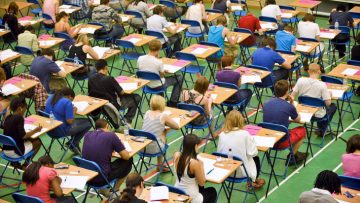
While solving puzzles gives personal pleasure, success can also earn respect from wider society. Social recognition of achievements will remain important, whether it is isolated traditional puzzles, Olympiad competitions, school and university examinations or passing peer review in the most prestigious research journals. Even when AI can solve every examination question, it still matters that the person awarded the certificate actually did the work, under the expected conditions. We need mechanisms to ensure this, and the invigilation of examinations in person seems to me to have few practical and reliable alternatives.
Mathematics is one of the few compulsory subjects at school. All functioning adults in society should understand some subtle and difficult ideas, and for this reason I do not anticipate that mathematics will become optional. These concepts include exponential growth (to avoid excessive usury) and why, even if you have a positive result for a very rare disease from a reliable medical test, you still probably do not have the disease. We cannot, and should not, take the compulsory status of mathematics in education for granted.
A computer used to be a profession, probably a routine and rather boring one. I have no doubt AI will replace other routine, boring jobs to the eventual benefit of everyone but at the cost of some interim disruption. This disruption will certainly be uncomfortable for people who currently have jobs that become automated by AI. As a mathematics community, we might like to start to develop arguments explaining what we should compel all students to learn and why and what to teach in later non-compulsory settings. I do anticipate change will be needed: nobody now learns to use a slide rule for practical reasons, as did every generation of engineers up until the 1980s. Mathematics will continue to offer abstract logical reasoning, teach modelling, teach the subtleties of sound statistical analysis and promote a sceptical attitude: all essential in a post-truth world.
Another important issue is the role of aesthetics in mathematics. It is not hard to generate novelty in mathematics. Indeed we could simply choose large numbers and establish a result such as  . At a formal level, we have proved a theorem, and if we choose large enough numbers, we almost certainly have a novel theorem. Rightly, nobody would care or pay any attention. Even if we spotted something unexpected, such as

we might not achieve the threshold of interest or acceptance. This particular result is a counterexample to Euler’s conjecture that at least 5 positive 5th powers are required to sum to a 5th power; hence, the result suddenly becomes interesting and significant [6]. Mathematicians make both aesthetic and value judgements. It is possible that AI will also make aesthetic and value judgements, and those judgements might pass the Turing test in that they are indistinguishable from those of humans. In any case, I do not see the role of humans in making such judgements disappearing in the way the profession of computer has (rightly) disappeared.
The last point I would like to consider relates to another important parallel activity to problem-solving: the systematisation of knowledge. Arranging mathematical knowledge, spotting patterns of thought, and choosing how to sequence and present mathematics in efficient, interesting and engaging ways is a key skill in teaching. I find elementary mathematics endlessly fascinating. As one example, I would like to consider the area of a planar triangle. Two papers [7, 8] consider over 110 different formulae for the area of a planar triangle, an extreme example perhaps of an attempt to organise this area of mathematics!
We have to wait until formula 38 (in [8]) for the familiar  where
where  is the side length opposite vertex
  and
and  is the length of the altitude, i.e. ‘height’, through . It is formula 73 (in [8]) I particularly want to mention:
  where
where  is the radius of the inscribed circle, and
  is the semi-perimeter. The pictorial proof in Figure 1 was developed by [9].

However, we can go further. The same geometric process of cutting up a shape into right-angled triangles can be used to show that holds for a square, a regular hexagon or any regular polygon. Indeed, for a circle:  and
and  giving
  . For what set of shapes is ? That last question provides a glimpse, in an elementary context, of part of the real work of the pure mathematician [10].
The formula inspired me to write a sequence of puzzles and problems for colleagues at an annual in-person gathering known as the Institute of Mathematical Pedagogy. At this four-day meeting, like-minded people come together to solve mathematical problems and discuss mathematics education generally. A basic job of a teacher will continue to be to devise, select and use such sequences of problems effectively with students. I sincerely hope people will continue to choose to come together in both competitive and collaborate situations, perhaps with AI alongside as well. Other colleagues, e.g. [11], have written compellingly about the design of interesting sequences that give progress through practice. I have no doubt that AI will contribute to teaching, e.g. Khan Academy has Khanmigo (an automated AI assistant), but I cannot imagine that human teachers will be displaced completely. Teaching people mathematics is a profoundly human process, and I think it will remain that way.
In summary, I think people will continue to pursue mathematics as a human activity and derive pleasure and value from it. I am not too worried about the effect of AI on mathematics education because, aside from a period of adjustment, I am rather excited at the opportunities AI offers.
Chris Sangwin FIMA
University of Edinburgh
References
- Oughtred, W. (1634) To the English gentrie, and all others studious of the mathematicks, in The Circles of Proportion and the Horizontal Instrument, Augustine Mathewes, London.
- Bryden, D.J. (1974) A patchery and confusion of disjointed stuffe: Richard Delamain’s ‘Grammelogia’ of 1631/3, Trans. Camb. Bibliogr. Soc., vol. 6, pp. 158–166.
- Tuckey, C.O. (1904) Examples in Algebra, G. Bell & Sons, London.
- Hadley, J. and Singmaster, D. (1992) Problems to sharpen the young, Math. Gazette, vol. 76, no. 475, pp. 102–126.
- Swetz, F.J. (2012) Mathematical Expeditions: Exploring Word Problems Across the Ages, Johns Hopkins University Press, Baltimore.
- Lander, L.J. and Parkin, T.R. (1967) A counterexample to Euler’s sum of powers conjecture, Math. Comput., vol. 21, no. 97, pp. 101–103.
- Baker, M. (1885) A collection of formulae for the area of a plane triangle, Ann. Math., vol. 1, no. 6, pp. 134–138.
- Baker, M. (1885) A collection of formulae for the area of a plane triangle, Ann. Math., vol. 2, no. 1, pp. 11–18.
- Nelsen, R.B. (2001) Heron’s formula via proofs without words, Coll. Math. J., vol. 32, no. 4, pp. 290–292.
- Apostol, T.M. and Mnatsakanian, M.A. (2004) Figures circumscribing circles, Am. Math. Mon., vol. 111, no. 10, pp. 853–863.
- Foster, C. (2013) Mathematical études: embedding opportunities for developing procedural fluency within rich mathematical contexts, Int. J. Math. Educ. Sci. Technol., vol. 55, no. 5, pp. 765–774.
Reproduced from Mathematics Today, February 2024
Download the article, Why I Am not (too) Worried about AI and Education (pdf)