To celebrate the IMA’s 60th anniversary in 2024, a number of articles have been chosen by IMA members and MT readers, who introduce their favourite MT articles and explain why they are important to them. Here Katie Steckles, Sheffield Hallam University, introduces …
The Hungarian Magic Cube by Dame Kathleen Ollerenshaw DBE FlMA (IMA President 1978–1979)
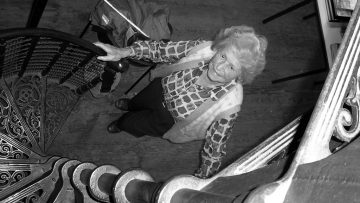
In this delightful introduction to a curious new toy craze sweeping the world, Kathleen Ollerenshaw explains the mysterious workings of the Hungarian Magic Cube, now well-known to many as Rubik’s cube. It’s both endearing and delightful to see her explain the way this ingenious new cube puzzle can be manipulated, and the various possible goals of trying to solve it, by optimising for speed or efficiency – many of which are now attempted in international championships by professional cubers.
She goes on to discuss the mathematical structure behind this fascinating object, as well as outlining her personal solution method – which can be completed in around 80, but no more than 90, individual moves – along with her unique form of notation and some illustrative diagrams. While Dame Kathleen credits fellow cube enthusiasts Cyril Isenberg and David Singmaster for their contributions to her understanding, it’s clear that she has spent a great deal of time working on it – she apparently once needed surgery on her hand, after a bout of protracted cube twisting left her with an injury dubbed the first case of ‘mathematicians’ thumb’.
Download the article, The Hungarian Magic Cube (pdf) scanned from the 1980 IMA Bulletin, vol. 16, no. 4, pp. 86–92.