This International Day of Women and Girls in Science (11 February), I invite you to consider the ideas of a mathematician whom you may not be aware of and reflect on the lost voices of women in mathematics everywhere.
Amal Clooney, Hillary Clinton, Michelle Obama and Mary Shelley. What do they have in common?
You might have already guessed it. Despite being brilliant, accomplished and extraordinary women in their own right, these – and many other – women made the grievous error (for their own careers) of getting married, which meant that for much of their lives, they were not referred to by their own names and accomplishments but by reference to their husbands instead.
Imagine that, despite being a highly qualified and experienced international human rights lawyer dedicated to representing victims of mass atrocities and receiving multiple awards, you are referred to simply as ‘George Clooney’s wife’. Similarly, Mary Shelley not only wrote many literary works, including Frankenstein, one of the most remarkable novels of the 19th century, but edited and promoted her husband Percy Bysshe Shelley’s work, all while dealing with the loss of her children, the suicide of dear friends, his constant pursuit of other women and the instability caused by his financial irresponsibility.
In professional partnerships, the same is often true; the quote that comes to mind is Bob Thaves’s comment on Fred Astaire: ‘Sure he was great, but don’t forget that Ginger Rogers did everything he did backwards … and in high heels’ [1]. Even when women are acknowledged for their excellence, we so often forget how much more difficult it has been for them to get there (such as barriers to accessing education, the burden of childcare, consistently higher domestic workloads and discrimination) and how much of their time and ideas have been sacrificed to bolster the careers of the men around them.
Sadly, mathematics has not been immune to stifling or erasing women’s achievements in the field. I wonder if you have heard of George Boole, whose name lives on in Boolean logic?
What about his wife, Mary Everest Boole?
Like the other women mentioned earlier, Mary Everest Boole (1832–1916) deserves to be remembered as so much more than ‘George Boole’s wife’. Not only did she support and contribute to Boole’s work, but she was an extraordinary mathematical thinker in her own right, for which she deserves credit, especially because in the mid-19th century such an endeavour for a woman was virtually unheard of. What she was contending with was not so much a glass ceiling as a wooden cupboard. Not only was she battling male expectations to ‘get back in her box’, but the way to writing, publishing and contributing to mathematics discourse was beset by closed doors, discrimination and barriers at every turn.
Frustrated at the lack of opportunities afforded to her by a society that did not value women beyond their ability to placate men, set tables and give birth, Mary taught herself mathematics from textbooks and began assisting her father and, later, tutoring mathematics at a local library. Here she began to develop some of the most exciting and engaging principles for exploring mathematics that we still use today in mathematics teaching and learning.
Use of manipulatives
Mary Everest Boole was a groundbreaking advocate for using manipulatives to explore mathematics. She wrote [2, p. 71]:
A common night-light placed in the bottom of a deep round jar in a dark room throws on a sheet of cardboard held over it patterns of conic-sections, which pass into each other as you change the position of the cardboard [see Figure 1]. Children very early learn to love watching figures thrown in light.
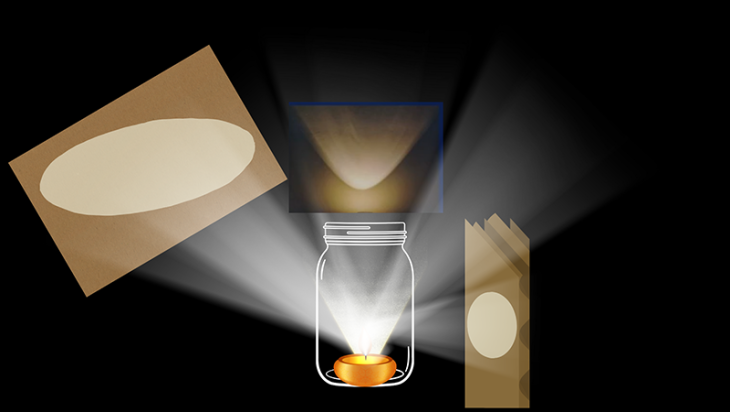
She used twigs, shadows and stones to help support the exploration of mathematics concepts and advocated for allowing children to play, experiment and make mistakes [3]. She suggested that it was crucial for all students of mathematics to have plentiful opportunities to handle and manipulate objects for themselves and so to become familiar with them before any attempts at technical or formal explanations. Using what she had at her disposal as a 19th-century woman, she invented Boole sewing cards as a ‘means of finding out the exact nature of the relation between one dimension and two’ [4, p. 51] as well as exploring the space between lines as a way of creating curves, which we now refer to as ‘curve stitching’ [5].
![Figure 2: Mary Everest Boole invented Boole sewing cards to explore dimension, line and space (see [2, pp. 91–92], [4, p. 51]).](https://cdn.ima.org.uk/wp/wp-content/uploads/2025/01/Boole-sewing-cards-explore-dimension-line-and-space.png)
In Figure 2, I have tried to reproduce some of the ways in which Mary Everest Boole intended to use sewing cards to explore mathematics. It was a remarkable repurposing of everyday items to encourage students, especially young women, to find joy and interest in the concepts of dimension, space and line. She was particularly excited to find that sewing a series of lines produced a curve, and she explored the relationship between the curves she could produce and the outline of the sewing card.
Joy and fun
Mary Everest Boole’s delight in mathematics can be inferred from her book and chapter titles alone: Philosophy & Fun of Algebra, ‘The Fairyland of Mathematics’ and Logic Taught by Love (1905). Her wry sense of humour is evident throughout her writing; some of my favourites include: ‘This method of solving problems by honest confession of one’s ignorance is called Algebra’ [4, p. 14] and ‘There’s no end to the rubbish that people get to think when they argue about what  is, instead of trying hypotheses in an orderly manner’ [4, p. 74]. She also describes Charles Babbage’s difference machine as an ‘extraordinary iron child of his own fashioning’ [6, pp. 24–25], and she created an image of his gazing adoringly at it like ‘the Madonna … gazing at the halo around her baby’s head’ [6, p. 25].
Algebra, logic and power
One of Mary Everest Boole’s works that made it to publication is her delightful short volume Philosophy & Fun of Algebra. Its introduction, in which she introduces abstraction, is a good example of her extraordinarily clear writing style [4, pp. 9–10]:
Arithmetic means dealing logically with facts which we know (about questions of number). ‘Logically’; that is to say, in accordance with the ‘Logos’ or hidden wisdom, i.e. the laws of normal action of the human mind. For instance, you are asked what will have to be paid for six pounds of sugar at 3 d. a pound. You multiply the six by the three. That is not because of any property of sugar, or of the copper of which the pennies are made. You would have done the same if the thing bought had been starch or apples. You would have done just the same if the material had been tea at 3 s. a pound. Moreover, you would have done just the same kind of action if you had been asked the price of seven pounds of tea at 2 s. a pound. You do what you do under direction of the Logos or hidden wisdom.
Boole goes on to suggest [4, p. 10] that, even if ‘Parliament’ or ‘kings and emperors’ were ‘stupid’ enough to try and pass laws about the use of mathematics, they could not change the underlying logic. Her beautiful introduction to the idea of algebra as an illustration of the power of mathematics to transcend the petty power moves of men stays with me today as I contemplate living in a post-truth democratic era, and it was particularly pertinent as only a few years before this work was published, the 1897 Indiana bill in the USA attempted to decree that the value of  was 3, to obvious disastrous effect [7]. Mary’s views on the power of mathematics can be summed up by her imperative: ‘We do not content ourselves with guesses; we proceed to algebra’ [4, p. 38].
In her work, she explores the advantages and limitations of algebraic thinking and its relationship to certainty, concluding that [4, p. 28]:
Even in this world there is a good deal of mathematical certainty to be had by whosoever has endless patience, scrupulous accuracy in stating his own ignorance, reverence for the As-Yet-Unknown, and perfect fearlessness in meeting the reductio ad absurdum.
These principles – that mathematical certainty (or proof) relies on patience, outlining assumptions and unknowns, and the brave, leap-of-faith application of rigorous methods – continue to apply in the present day, and they demonstrate her deep and remarkable understanding of what it is to practise mathematics, despite her lack of opportunity.
Storytelling and imagination
Boole’s appreciation for the power of storytelling and her use of imagination to bring concepts to life for the reader is compelling, especially when coupled with her great sense of humour. I particularly enjoyed the cautionary tale of the dangers of imaginary numbers [4, p. 77]:
When you come to quadratic equations you will be confronted with an entity (or non-entity) whose name is written this way:
, and pronounced ‘square root of minus one.’ Many people let this nonentity persuade them to foolish courses. A story is told of a man at Cambridge who was expected to be Senior Wrangler; but he got thinking about the square root of minus one as if it were a reality, till he lost his sleep and dreamed that he was the square root of minus one and could not extract himself; and he became so ill that he could not go to his examination at all.
Real-life applications of mathematics
Boole writes about using mathematics to find the [4, p. 27]:
Truth about the state of our balance sheet, the number of acres in our farm, the time it will take us to get from London to Liverpool, the height of Snowdon, the distance of the moon, and the weight of the sun.
These are all topics that, astonishingly, remain relevant and interesting for us as mathematicians today, some 115 years later.
Her way with words is particularly notable, as is her ability to simplify and exemplify mathematical concepts. For example, she writes [6, p. viii]:
Many philosophers have arrived, in different ways, at a perception of the truth that zero may have two totally different meanings; it may mean either negation or completion. Stillness may result either from the absence of force, or from a balance of compensating vibrations.
Similarly, she describes that when humans want to make an ellipse, we use a pen, string and two pins; she extends the metaphor to nature drawing ‘the ellipse of the earth’s orbit’ [6, p. 18]. Her ability to move seamlessly between mathematics and other subjects – philosophy, physics, religion, astronomy and biology – is the mark of a true interdisciplinarian.
As a mathematics educator myself, it is noticeable how many of Boole’s real-life examples I would use myself in the classroom, for example, her clear illustration of the principles of division-as-sharing by considering variables and their relationship to one another in this lovely example [4, pp. 81–82]:
Suppose there is a cake on the table. How many children can go through the room without the cake being all eaten up? Well, that depends on two things: the size of the cake, and the share which each child eats. If the cake weighs two pounds, and each child eats two ounces, it will be all eaten up when sixteen children have gone through the room. If the cake weighs only one pound, it will be eaten up when eight children have gone through the room.
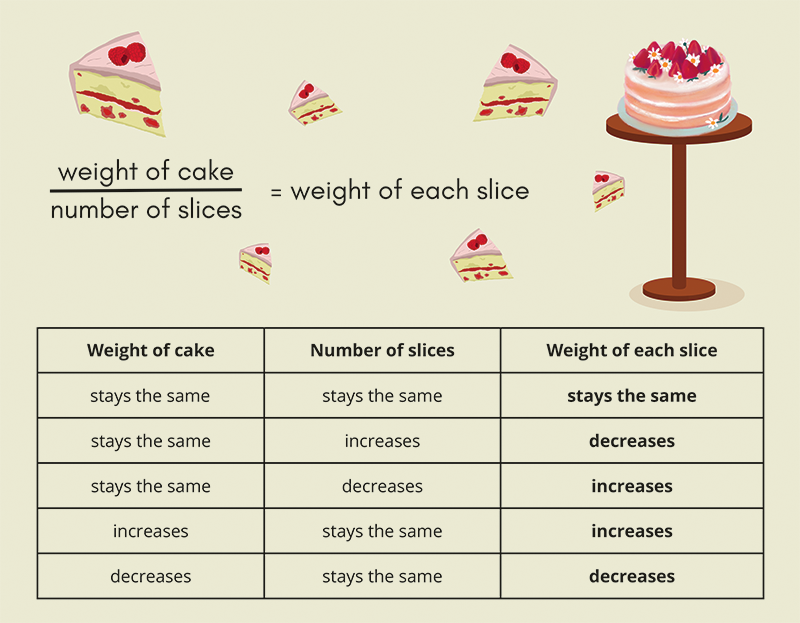
This seemingly simple idea is a really powerful way for the novice mathematical learner to start thinking about variables. It also adds the helpful contextual factor of the prospect of a larger (hurrah!) or smaller (boo!) portion of cake as one considers the idea of changing and fixing quantities within an equation and examining the consequences. There is also an interesting connection to combinatorics, as one considers all the possibilities (can you see which ones I have not listed here?).
Barriers
As with many of the women mentioned in this article, it is important to note that Mary did all this while handling at least two other full-time and profoundly undervalued jobs, as assistant and editor to her husband and as a domestic worker running a household and raising five children. When Mary finally did get to attend university-level maths lectures, it was only because her husband thought it might make her ‘of more use to him’, and she had to do so in the face of discrimination and censure (one person called her ‘un-maidenly’ for doing so) [8].
After George’s death in 1864, Mary was left to raise her five children (aged 1–8) as a single parent. She was also sacked from her position as library assistant at Queen’s College London for having ‘dangerous ideas’ [8]. History has erased precisely what these might have been construed to be, but sadly, as a woman, this could have included any number of intelligent or scholarly musings that were simply deemed unacceptable for a person of her sex.
The next time you read a newspaper, notice a headline or watch the news, look out for the insidiousness of naming women as wives and mothers as a priority over their careers, works and achievements. And the next time you find joy and fun in mathematics, remember Mary Everest Boole as your counterpart. You can read more about her life and works in the excellent book The Booles and the Hintons: Two Dynasties That Helped Shape the Modern World by Gerry Kennedy [9].
Lucy Rycroft-Smith
University of Cambridge
References
- Ratcliffe, S. (ed.) (2016) Bob Thaves 1924–2006, American cartoonist in Oxford Essential Quotations, 4th edition, Oxford University Press.
- Boole, M.E. (1904) The Preparation of the Child for Science, Clarendon Press, Oxford.
- Michalowicz, K.D. (1996) Mary Everest Boole (1832–1916): An Erstwhile Pedagogist for Contemporary Times, Mathematical Association of America, pp. 291–302.
- Boole, M.E. (1909) Philosophy & Fun of Algebra, C.W. Daniel, London.
- Innes, S. (2004) Mary Boole and curve stitching: A look into heaven, Endeavour, vol. 28, no. 1, pp. 36–38.
- Boole, M.E. (1884) Symbolic Methods of Study, Kegan Paul, Trench, Trübner & Co., London.
- Indiana State Legislature (1897) Indiana bill sets the value of π to 3, House Bill No. 246.
- Birbrower, S. (2021) The extraordinary life (and beliefs) of Mary Everest Boole, Medium blog.
- Kennedy, G. (2016) The Booles and the Hintons: Two Dynasties that Helped Shape the Modern World, Cork University Press.
Reproduced from Mathematics Today, February 2025
Download the article, The ‘Dangerous Ideas’ of Mary Everest Boole (pdf)