 Junaid Mubeen
PROFILE BOOKS 2022, 352 PAGES
PRICE (HARDBACK) £20.00 ISBN 978-1-78816-683-6
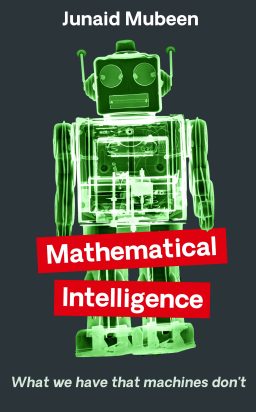
Defining ‘Mathematical Intelligence’ as Mubeen notes in his book, the term is defined as a ‘continual exercise in carefully defining and interrogating facts and employing the highest forms of reasoning to examine our arguments.’ (p. 35). As algorithms base their predictions on learning from historical data, they inherently harbour implicit biases. This is where human discernment and sagacity come into play. Our in-built estimation, language, and abstraction skills complement the precision of computers, creating a powerful representation that is more diverse than the binary language of computers. As humans, Mubeen claims, we also have the freedom to break conventions, to question and examine the logical consequences of our choices. Mubeen quotes Lord Kelvin’s edict, ‘Do not imagine that mathematics is harsh and crabbed, and repulsive to common sense. It is merely the etherealisation of common sense’ (p. 49) to explain humans’ innate core ability to obtain reasonable estimates, which points to our natural numerical proficiency.
Over the past few decades, algorithms have evolved significantly in the direction of versatility as well as processing power. We have birthed new branches of research such as ‘experimental mathematics.’ Despite all this in favour of machine intelligence, Mubeen asserts that a computer’s cognitive scope is limited to the choices it is given. Any unaccountable behaviour should be attributed to us, and conversely, we bear the responsibility of sense-checking the consequences of every choice we feed into our models. Therefore, Mubeen’s belief is that a major limitation of these algorithms is that they have no concept of the world against which to benchmark their calculations. Their comprehension of what is amusing or abhorrent is non-existent. Which then, leads to a ‘value dis-alignment’ in which programmes routinely behave in ways that deviate from the programmer’s intended goal. So, instead of machine learning, Mubeen reasons, we must arm AI with ‘mathematical intelligence’ constrained by tight logic and rigorously derived truths.
A notable aspect of this book is Mubeen’s focus on proofs. Proofs are used as a tool to define and divide mathematical intelligence within humans and computers. Mathematical truths are compiled in three stages: a conjecture is made, it is proved or refuted, and the resulting argument is then verified either way, and now computers can fully get stuck in each of these stages. They can go further still and detect patterns that are not obvious to humans. In this way, Mubeen thinks, mathematicians can refine their conjectures and even develop new ones on the back of new evidence brought forward by machines. ‘Mathematical reasoning… does not rely on patterns or probabilities—only on the surest of logical leaps.’ (p. 127).
Computers can also help disprove conjectures by generating counterexamples and constructing proofs from start to finish, as demonstrated by the Google DeepMind team, which applied its machine learning methods to the Mizar database of mathematical proofs. On the other hand, there are some conjectures that hold for exorbitantly high numbers that Mubeen claims computers simply cannot cut through in the way that only human mathematical reasoning can. Elevating the proofs beyond the symbol-crunching ways of machines, humans, he deems, can process statements in terms of what we know of the world in the context of everything that came before and everything that might follow. The author posits that ‘no proof is an island’, as mathematical thinking demands some level of human intuition and inventiveness that goes beyond cold logic.
Mubeen’s captivating second book explores the world of mathematical thinking and appreciates the beauty and art of mathematics in a unique way. He teaches us how to harness AI to amplify facets of mathematical intelligence that human beings are naturally in possession of. To make them our cognitive allies by understanding our differences in intelligence and deriving from them a distinct sort of collaboration. Throughout, the text is well-written, delving into intricate proofs and theorems with ease. The number of real-world examples is also a notable strength, along with the extensive bibliography, which comprises an impressive 377 references. The compelling tone keeps it enjoyable and imparts a weightless quality to the reading experience.
Richila Chamling
Book review published directly onto IMA website