Kenneth Falconer
OXFORD UNIVERSITY PRESS 2013, 126 PAGES
PRICE (PAPERBACK) £7.99 ISBN 978-0-199-67598-2
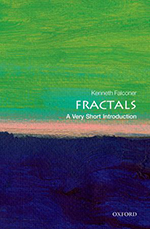 126 pages at A6, it is both short and small, but within it is contained a multitude of detail, explanation, background and relevance.
The book is very well written and is accessible to the interested middle-schooler, and definitely to those with some basic knowledge of geometric series and post GCSE mathematics. Whatever ‘special’ maths that is required, is carefully and succinctly explained; such as the basics behind complex numbers, squaring complex numbers, and a simple overview of the log laws.
The author first explains the concept behind a fractal, then how to construct the classics of the Koch Curve and Sierpinski Triangle (and a few modifications of them), using this as a template for future consideration. He also stressed the idea of itineraries and iterative processes. Discussion of self-similarity leads us through templates and self-affine fractals, and paves the way for a most interesting and informative chapter on fractal dimension.
The chapters on the Julia and Mandelbrot sets are simply and clearly written, and are incredibly interesting and illuminating; even for someone who already believes they ‘understand’ what these are.
Finally, the book discusses fractals in real life, including random walks, options pricing and the Black-Scholes model, amongst others.
I found this a most enjoyable, ‘short’ read, and it definitely did cause me to stop and think, at times, about itineraries, dimension and the relationship between the Julia and Mandelbrot sets.
Andrew Jones CMath MIMA CSci
Book review published directly onto IMA website (December 2014)